Most Canadians probably missed it.
While political debates consumed headlines, while social media churned through another cycle of outrage and distraction, and while the country argued about tariffs, affordability, and the latest political clash between Ottawa and Washington, something historic quietly began taking shape in Bowmanville, Ontario. Construction crews moved forward on what may eventually be remembered as one of the most strategically important infrastructure projects in modern Canadian history.
Canada is now building the first commercial Small Modular Reactor Canada has ever deployed — and the first commercial SMR currently under active construction anywhere in the G7.
That sentence alone should have dominated the national discussion. Instead, outside industry circles and specialized energy reporting, the story barely registered. And perhaps that silence says something larger about the modern information environment itself. Massive infrastructure projects unfold slowly. Nation-building takes time. But modern media ecosystems increasingly reward immediacy, outrage, and conflict over long-term strategic thinking.
Yet beneath the surface, something significant is happening.
The Darlington Small Modular Reactor project is not simply another energy announcement. It sits at the intersection of nearly every major challenge facing advanced economies today: rising electricity demand, artificial intelligence infrastructure, industrial competitiveness, energy sovereignty, geopolitical instability, and the accelerating push toward decarbonization. Increasingly, governments around the world are confronting a difficult reality: modern societies will require far more electricity than many grids were originally designed to supply.
That reality is forcing a global reassessment of nuclear power.
And Canada appears to be positioning itself at the centre of that shift.
🗝️ Quick Answer
The Small Modular Reactor Canada is constructing at the Darlington New Nuclear Project is the first commercial SMR currently under active construction in any G7 country. Using the GE Hitachi BWRX-300 reactor design, the project aims to provide reliable carbon-free electricity while supporting the broader Canada Nuclear Energy Strategy, which focuses on energy security, uranium production, nuclear exports, and long-term grid reliability in an era of rapidly rising electricity demand.
The Story Most Canadians Haven’t Heard
Between April 29 and May 1, 2026, three separate nuclear announcements unfolded almost simultaneously in Canada.
Subscribe To Our Newsletter!
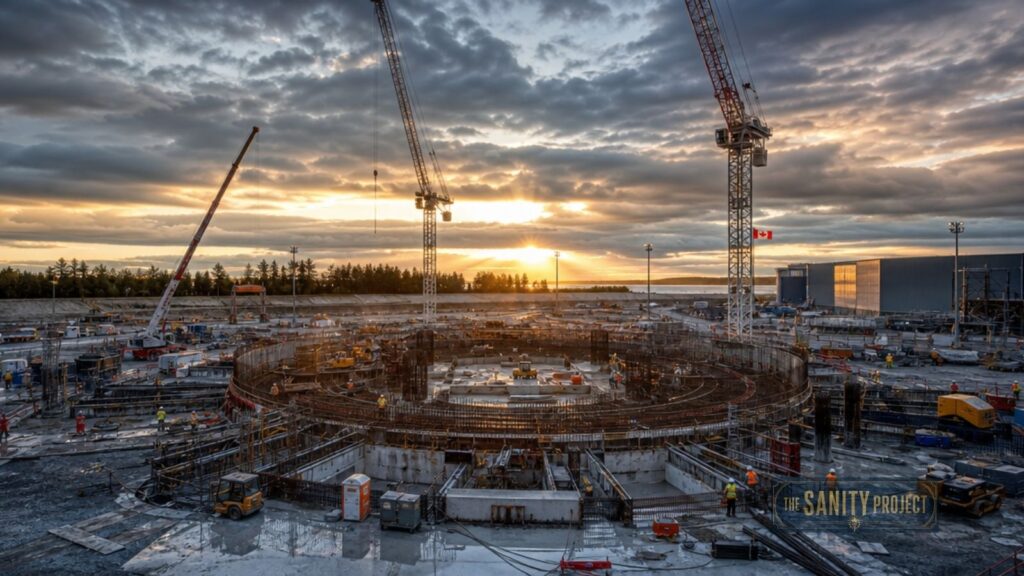
The federal government announced plans for a transformative National Nuclear Energy Strategy designed to expand reactor construction, strengthen uranium production, and position Canada as a global exporter of nuclear technology. Ontario advanced plans for major new nuclear development at Bruce Power. And Ontario Power Generation confirmed completion of the Basemat milestone at Darlington — the physical foundation of Canada’s first Small Modular Reactor.
Taken together, these developments represented one of the most consequential shifts in Canadian energy policy in decades.
Yet public discussion remained remarkably limited.
Part of the reason may be that nuclear energy still occupies an unusual place in public consciousness. For many people, the word “nuclear” immediately triggers images tied to Cold War fears, historic accidents, or highly polarized political debates. At the same time, much of the climate conversation over the past decade has focused primarily on expanding renewable energy, leaving nuclear power politically and culturally sidelined in many circles.
But the broader energy landscape is changing rapidly.
Artificial intelligence systems, hyperscale data centres, electric vehicles, industrial electrification, and population growth are dramatically increasing electricity demand forecasts across North America and Europe. Governments are beginning to recognize that achieving decarbonization goals while maintaining reliable grids may require a much broader mix of energy sources than earlier political narratives suggested.
That realization is helping drive what many analysts now describe as a global nuclear renaissance.
And Canada, quietly, may have positioned itself to become one of its most important players.
What is a Small Modular Reactor Canada is building?
Understanding the Technology Behind the Darlington Project
The phrase “Small Modular Reactor” often sounds more futuristic and experimental than it actually is.
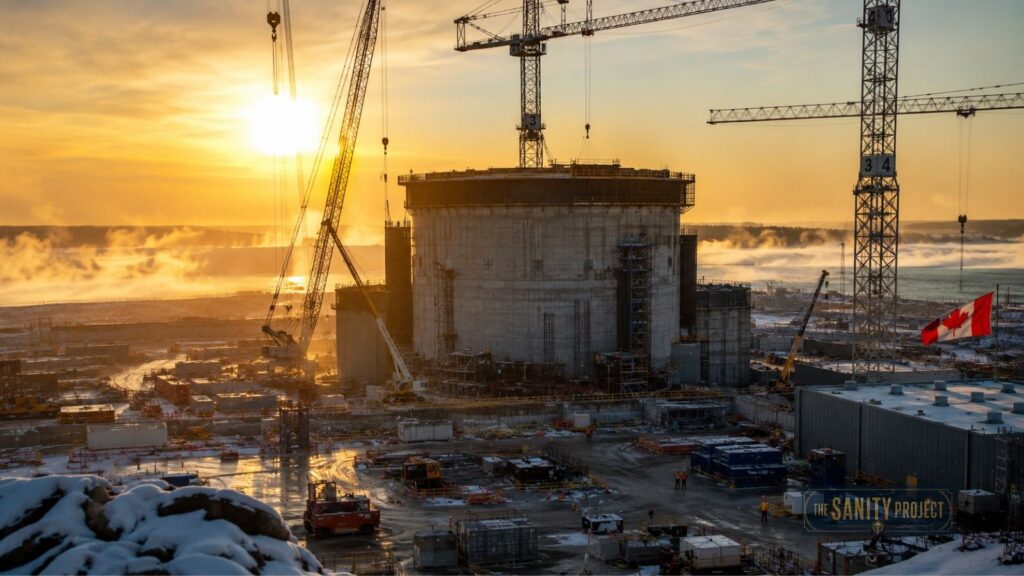
In simple terms, a Small Modular Reactor, or SMR, is a smaller-scale nuclear reactor designed around modular construction principles. Traditional nuclear plants are typically massive, highly customized projects built almost entirely on-site over long timelines. SMRs attempt to simplify that process by reducing reactor size and standardizing major components that can be manufactured and assembled more efficiently.
The reactor selected for the Darlington project is the BWRX-300, developed by GE Vernova and Hitachi. The design produces approximately 300 megawatts of electricity per unit and incorporates passive safety systems designed to maintain safe shutdown conditions without requiring active operator intervention or external power during emergencies.
That distinction matters because much of the public perception surrounding nuclear energy remains tied to older reactor generations and historical accidents. Modern SMR designs are specifically attempting to address many of those long-standing concerns through simplified engineering, reduced complexity, and passive safety architecture.
The Darlington project ultimately plans to deploy four SMR units with combined output exceeding 1,200 megawatts — enough electricity to power well over one million homes and businesses in Ontario. Unlike intermittent renewable sources, nuclear reactors provide continuous baseload electricity regardless of weather conditions, season, or time of day.
Supporters argue this combination of reliability, carbon-free generation, and compact infrastructure footprint is exactly why SMRs are attracting growing international attention.
Why Nuclear Energy Is Returning to the Global Conversation
AI, Electrification, and the Coming Electricity Surge
One of the most important aspects of the modern nuclear debate has little to do with climate politics directly. It has to do with electricity demand itself.
For decades, electricity consumption growth in many advanced economies remained relatively stable. But several technological and industrial shifts are now converging simultaneously. Artificial intelligence infrastructure, cloud computing, electric vehicles, industrial electrification, and data-centre expansion are all increasing demand projections at the same time.
According to the International Energy Agency, global data-centre electricity demand surged dramatically in 2025 alone. Goldman Sachs Research projects data-centre power demand could increase by 165 percent globally before the end of this decade.
That changes the energy equation significantly.
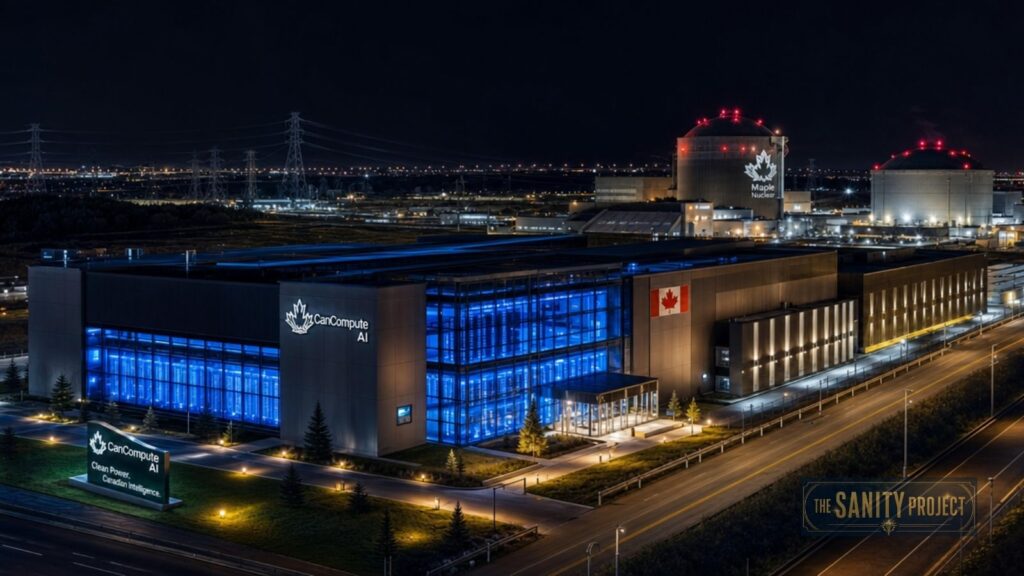
Modern AI systems require enormous computational infrastructure operating continuously around the clock. Data centres cannot simply pause operations when weather conditions reduce renewable output. This has forced policymakers and grid planners to confront a difficult question: how do modern economies rapidly expand clean electricity generation while maintaining stability and reliability?
Increasingly, many governments are concluding that nuclear power may need to play a larger role than previously assumed.
This does not necessarily mean replacing renewable energy development. In fact, many energy planners now view nuclear and renewables as complementary rather than competing systems. Wind and solar can provide low-cost generation when conditions are favourable, while nuclear offers stable, dispatchable baseload power that can operate continuously.
That combination is becoming increasingly attractive in an economy moving toward electrification at nearly every level.
Grid Reliability Is Becoming a Strategic Priority
Electricity systems are not judged only by how clean they are. They are also judged by whether they remain operational during periods of peak demand, extreme weather, industrial growth, and rapid technological change.
Ontario’s electricity planners have repeatedly identified the importance of stable baseload generation as the province transitions toward a lower-carbon future. The challenge is not simply producing more electricity. It is producing reliable electricity at scale while reducing emissions and maintaining affordability.
Supporters of SMR technology argue that Small Modular Reactors provide several advantages simultaneously:
- continuous carbon-free generation
- compact land requirements
- long operating lifespan
- reliable grid stabilization
- and scalable industrial deployment.
Those characteristics explain why countries around the world are suddenly re-engaging with nuclear energy after years of relative stagnation.
The Darlington SMR Project Is Already Underway
Canada’s First Commercial SMR Is No Longer Theoretical
One of the more misleading narratives surrounding the Darlington project is the suggestion that it remains hypothetical or speculative.
Construction is already happening.
The project timeline illustrates how far development has progressed:
Key Darlington Milestones
| Date | Milestone |
|---|---|
| December 2021 | OPG selects BWRX-300 technology |
| October 2022 | Licence application submitted |
| April 2025 | CNSC issues Licence to Construct |
| May 2025 | Ontario approves construction |
| March 2026 | CNSC lifts first regulatory hold point |
| May 2026 | Basemat milestone completed |
The Basemat milestone is particularly significant because it represents the physical foundation of the future reactor building itself. This is no longer a conceptual proposal or policy framework under discussion. Canada is actively constructing the first commercial Small Modular Reactor in the G7 today.
Understanding the $20.9 Billion Cost Debate
Why the Headline Number Can Be Misleading
No aspect of the Darlington project generates more criticism than its reported $20.9 billion cost estimate.
But much of the public conversation surrounding that number lacks important context.
Critics often present the figure as though it represents the cost of building a single reactor. In reality, the estimate reflects the projected all-in cost for four separate SMR units over an extended construction timeline. It includes financing costs, inflation escalation, engineering, licensing, operational readiness, site infrastructure, and contingency reserves.
The first reactor also absorbs substantial first-of-a-kind costs and infrastructure investments that later units are not expected to replicate. According to project projections, costs are expected to decline significantly as construction experience improves and modular efficiencies increase.
Importantly, Ontario Power Generation’s recent nuclear track record complicates many traditional anti-nuclear arguments surrounding project execution. Ontario recently completed the Darlington nuclear refurbishment project ahead of schedule and under budget, with each successive refurbishment completed faster than the previous one.
That history does not guarantee the SMR program will avoid challenges. Large infrastructure projects always carry risk. But it does undermine the assumption that nuclear construction projects are inherently incapable of competent delivery.
The Canada Nuclear Energy Strategy Is About Sovereignty
Energy Security Is Becoming Geopolitical Security
The broader significance of the Darlington project extends well beyond electricity generation itself.
Energy policy is increasingly inseparable from national security and geopolitical strategy.
Russia’s weaponization of natural gas following the invasion of Ukraine fundamentally altered how many Western governments think about energy dependence. Supply chains, once viewed primarily through economic lenses, are now increasingly evaluated in terms of strategic vulnerability and resilience.
Canada’s emerging Nuclear Energy Strategy reflects that shift.
The federal government’s framework focuses on four major priorities:
- enabling new nuclear builds across Canada
- Becoming a global supplier and exporter of nuclear technology
- expanding uranium production and fuel opportunities
- developing advanced Canadian nuclear innovation.
Taken together, these pillars reveal something important. Canada is no longer treating nuclear energy simply as another electricity source. It is increasingly treating nuclear capability as a strategic national asset tied directly to industrial competitiveness, energy independence, and geopolitical influence.
Why Canada Holds a Unique Advantage
Canada already occupies an unusually strong position in the global nuclear economy.
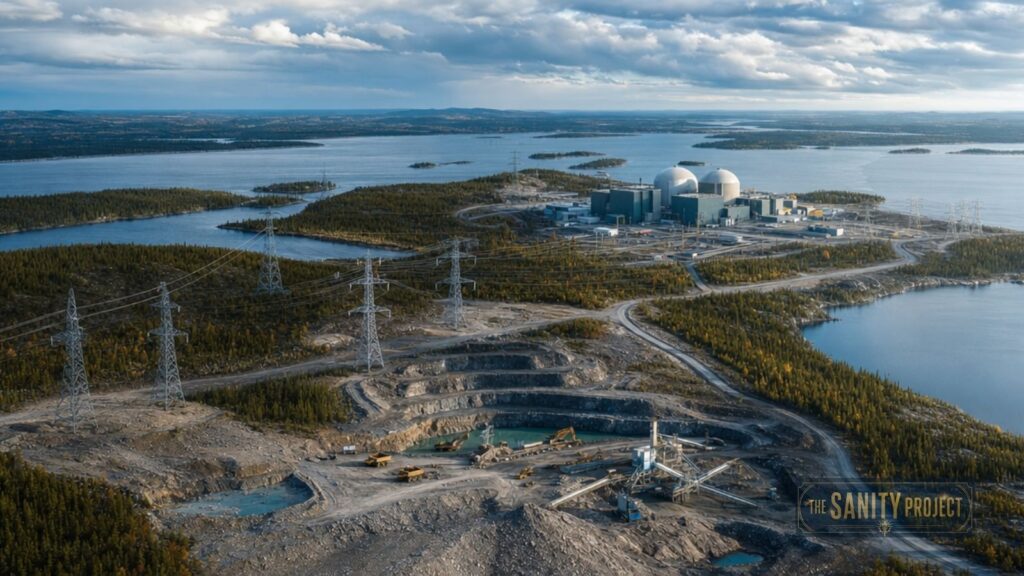
The country is the world’s second-largest uranium producer and possesses decades of nuclear engineering expertise, respected regulatory institutions, and long-standing reactor operating experience. Canada also maintains strong relationships within Western alliances increasingly concerned about energy security and supply-chain resilience.
Now, Canada may also become the first successful commercial reference model for SMR deployment within the G7.
That possibility is drawing international attention. Countries including Poland, Estonia, Sweden, and the United Kingdom are actively evaluating or advancing Small Modular Reactor deployment strategies.
If Canada successfully delivers the Darlington BWRX-300 project on schedule, it gains something extraordinarily valuable in global infrastructure markets: credibility.
And in international energy development, credibility often becomes export power.
The Nuclear Debate Remains Deeply Polarized
The Politics Surrounding Nuclear Energy
Nuclear energy continues to generate unusually emotional political debate.
Supporters often argue it represents one of the only scalable paths toward reliable deep decarbonization. Critics continue raising concerns involving waste management, project economics, environmental risks, Indigenous consultation, and long-term public safety.
The reality is more complex than either side’s slogans.
The Sanity Project white paper also references published analyses suggesting some anti-nuclear advocacy organizations have financial relationships involving fossil fuel or competing energy-sector interests.
At the same time, nuclear advocates sometimes minimize legitimate public concerns surrounding costs, waste storage, and long-term project uncertainty.
But regardless of political ideology, one reality is becoming increasingly difficult to avoid:
Modern industrial societies will require enormous amounts of reliable electricity.
And many governments are beginning to conclude that maintaining stable low-carbon grids without nuclear energy may be far more difficult than earlier political narratives assumed.
Final Thoughts
History rarely announces itself clearly in real time.
Often, the most consequential transformations happen quietly, buried beneath the noise of daily politics, social media outrage, and endless short-term distractions.
Right now, while much of the public conversation remains consumed by those cycles, Canada is actively constructing the first commercial Small Modular Reactor in the G7.
That alone makes this story remarkable.
But the deeper significance may lie in what the project represents. Beneath the engineering diagrams, concrete foundations, and regulatory approvals sits a much larger national question: what role does Canada want to play in the next global energy era?
A country watching technological transformation unfold from the sidelines? Or a country helping shape the infrastructure that powers it?
The foundation at Darlington has already been poured.
The reactor building is rising.
And whether most Canadians realize it yet or not, the future of Canada’s energy strategy may already be taking shape in Bowmanville, Ontario.
Resources Used:
https://www.canada.ca/en/privy-council/major-projects-office/projects/national/darlington.html
https://www.gevernova.com/nuclear/carbon-free-power/bwrx-300-small-modular-reactor
https://www.onr.org.uk/media/taufoxsv/bwrx-300-gda-step-2-summary-report.pdf
https://www.world-nuclear-news.org/articles/what-is-the-budget-for-canadas-first-smr-project