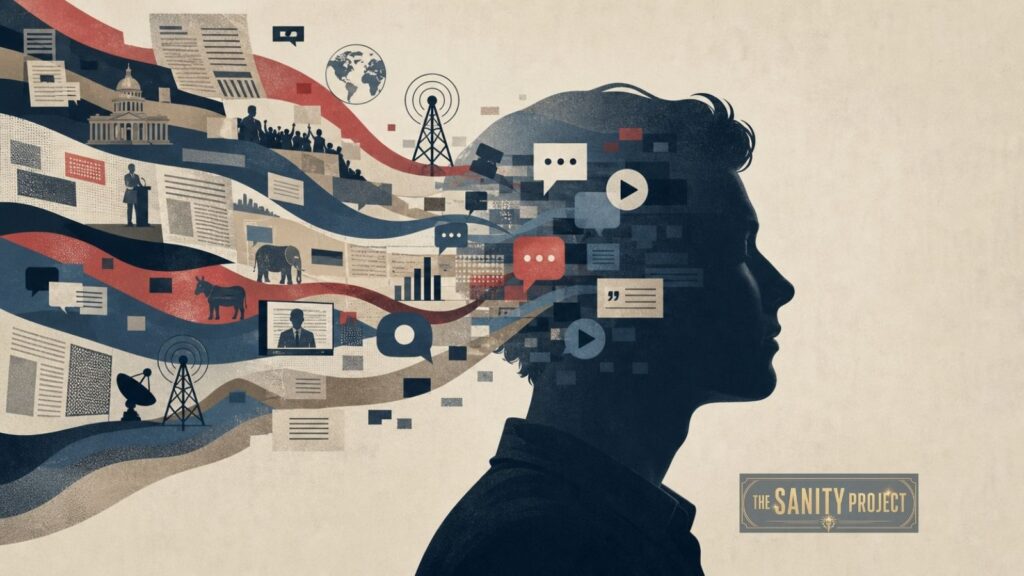
A jobs report comes out. One headline says the economy is cooling. Another says the labour market is resilient. A third warns that households are still under pressure. All three may be based on the same data. That is the basic mechanics of how media narratives shape perception: facts matter, but framing decides which facts feel important.
Most people do not read raw reports, policy documents, or earnings transcripts. They encounter reality through summaries, headlines, clips, and commentary. Fair enough – nobody has time to become a full-time analyst for every issue. But this shortcut creates a gap between what happened and what people think happened. Media narratives live inside that gap.
What a media narrative actually is
A media narrative is not just biased, and it is not always false. More often, it is a structured story that gives scattered events a usable meaning. It answers the questions people ask instinctively: What is going on? Who is responsible? Is this getting better or worse? What should I be worried about?
That sounds reasonable because it is. Humans need patterns. The problem starts when the pattern becomes more memorable than the underlying evidence. Once a narrative is set, new information tends to get sorted into it rather than judged on its own terms. The story stops describing reality and starts organizing it.
This is why coverage of the same event can produce wildly different public reactions. One outlet frames inflation as proof of policy failure. Another frames it as a delayed global aftershock. One story highlights spikes in crime in a few cities. Another shows long-term declines in violent crime nationally. Same country, same year, very different emotional climate.

How media narratives shape perception in practice
The easiest way to understand how media narratives shape perception is to look at the tools involved. Not the grand ideological ones – the routine editorial choices that seem harmless until they pile up.
Framing decides the emotional direction
A frame tells the audience what kind of story they are looking at before they process the details. Is a border issue a humanitarian crisis, a security failure, or a labour market reality? Is student debt a personal responsibility problem or a structural cost problem? The frame does not just add context. It sets the lane.
Once the lane is chosen, evidence gets interpreted accordingly. Identical numbers can look reassuring or alarming depending on the baseline used, the comparison chosen, and the language around them. A 4 percent unemployment rate can sound strong compared to history or worrying compared to six months ago. Both statements may be technically correct. Only one may dominate the public mood.
Repetition creates familiarity, and familiarity feels true
People often assume persuasion happens through one powerful argument. Usually, it is much less dramatic. A claim repeated across headlines, panels, clips, and social feeds starts to feel settled even if the supporting evidence is thin. Familiarity lowers resistance.
This is one reason correction rarely catches up to first impressions. A dramatic claim gets saturation coverage. The latter clarification gets a fraction of the attention. By then, the narrative has already rented space in the audience’s mind. Cheap rent, long lease.
Subscribe To Our Newsletter!
Selection matters as much as spin
Not every distortion comes from loaded language. Sometimes the bigger issue is which stories get sustained attention and which ones barely register. If the media fixates on retail-theft footage for weeks, audiences may conclude that social breakdown is accelerating, even if broader crime data show a more mixed picture. If layoffs at famous tech firms dominate the coverage, people may assume the labour market is collapsing, even as hiring remains solid in health care, construction, and government.
What gets covered repeatedly starts to stand in for what is common. What gets ignored starts to feel unimportant. That is not always malicious. It is often a byproduct of incentives. Dramatic, visual, conflict-heavy stories travel better than slow, statistical ones.
Narrative compression removes the mess
Reality is noisy. Causes overlap. Trends reverse. Policies help in one area and fail in another. Narratives hate that. They compress complexity into something shareable.
That compression is useful up to a point. Nobody wants a 40-page caveat before breakfast. But when every issue gets reduced to heroes, villains, and one obvious lesson, public understanding gets flatter. You can see this in coverage of housing, inflation, migration, public health, and education. The public is often offered certainty where the evidence supports something more annoying: partial answers and trade-offs.

Why smart people still get pulled in
This is not mainly about gullibility. Plenty of informed people get captured by media narratives because the mechanism is social as much as informational. Narratives give people a way to signal identity, sort allies from opponents, and reduce uncertainty fast.
In politically charged environments, accepting the dominant story of your side can feel like basic competence. Questioning it can feel disloyal, even when the facts are mixed. So people do not just consume narratives. They defend them.
There is also a status issue. Saying “it’s complicated” is often correct and frequently unrewarding. It performs badly against clean certainty. A bold but incomplete explanation usually beats a careful but accurate one in the attention economy. Strange system, not a great one.
The gap between data and public feeling
One of the clearest signs of narrative power is when sentiment detaches from measurable conditions. This happens often in economics. Consumers may report deep pessimism while still spending. Voters may say the economy is terrible even as wages rise and unemployment remains low. That does not mean people are irrational. It means that lived experience, price levels, media framing, and partisan cues interact simultaneously.
The media can amplify this gap by emphasizing change over level. If prices rose sharply, people would still feel the pain even after inflation slows. But coverage may alternate between “inflation is easing” and “families are being crushed,” leaving audiences with a blurry but intense sense of instability. Again, both angles may contain truth. The question is whether the overall picture being built matches the actual balance of evidence.
This matters beyond economics. Public fear about crime, institutional trust, and social cohesion often moves in response to narratives faster than to long-run data. Perception becomes its own force. Businesses delay hiring. Consumers pull back. Voters demand blunt solutions to problems they only partly understand. The story starts shaping the reality it originally claimed to describe.
How to read narratives without becoming cynical
The goal is not to distrust everything. That is just another shortcut, and not a very intelligent one. The better move is to separate three layers whenever you read or watch coverage: the facts, the frame, and the implied conclusion.
Ask simple questions. What is the actual event or dataset here? What comparison is being used? What is left out? Is this a trend, an anecdote, or a worst-case scenario packaged as a norm? If the same facts were framed differently, would the emotional takeaway change?
It also helps to watch for asymmetry. Are uncertainty and nuance applied evenly, or only when they complicate one side of the story? Are headline words stronger than the underlying evidence? Is a single month being treated like a permanent shift? These are not minor details. They are often where perception gets steered.
A useful habit is to resist instant emotional closure. If a story makes you feel immediately vindicated, furious, or terrified, pause before adopting its implied worldview. Strong emotion is not proof of manipulation, but it is often a cue that framing is doing heavy lifting.
Why this matters now
The speed of modern media makes narrative formation faster and correction weaker. Social platforms reward simplification. Cable formats reward conflict. Online publishing rewards urgency. None of this creates bias from scratch, but it does select for stories that are easy to feel before they are easy to verify.
That leaves the public with a strange burden. People are expected to hold sophisticated views while consuming increasingly compressed information. The result is a lot of confidence built on partial context.
A saner approach is not to reject the media, but to read it with one layer of distance. Narratives are unavoidable. They help people make sense of complexity. But they are still constructions, not reality itself. The moment you can see the frame, you are less likely to mistake it for the whole picture.
And that small bit of distance matters. It is often the difference between reacting to the loudest story in the room and actually understanding what is going on.