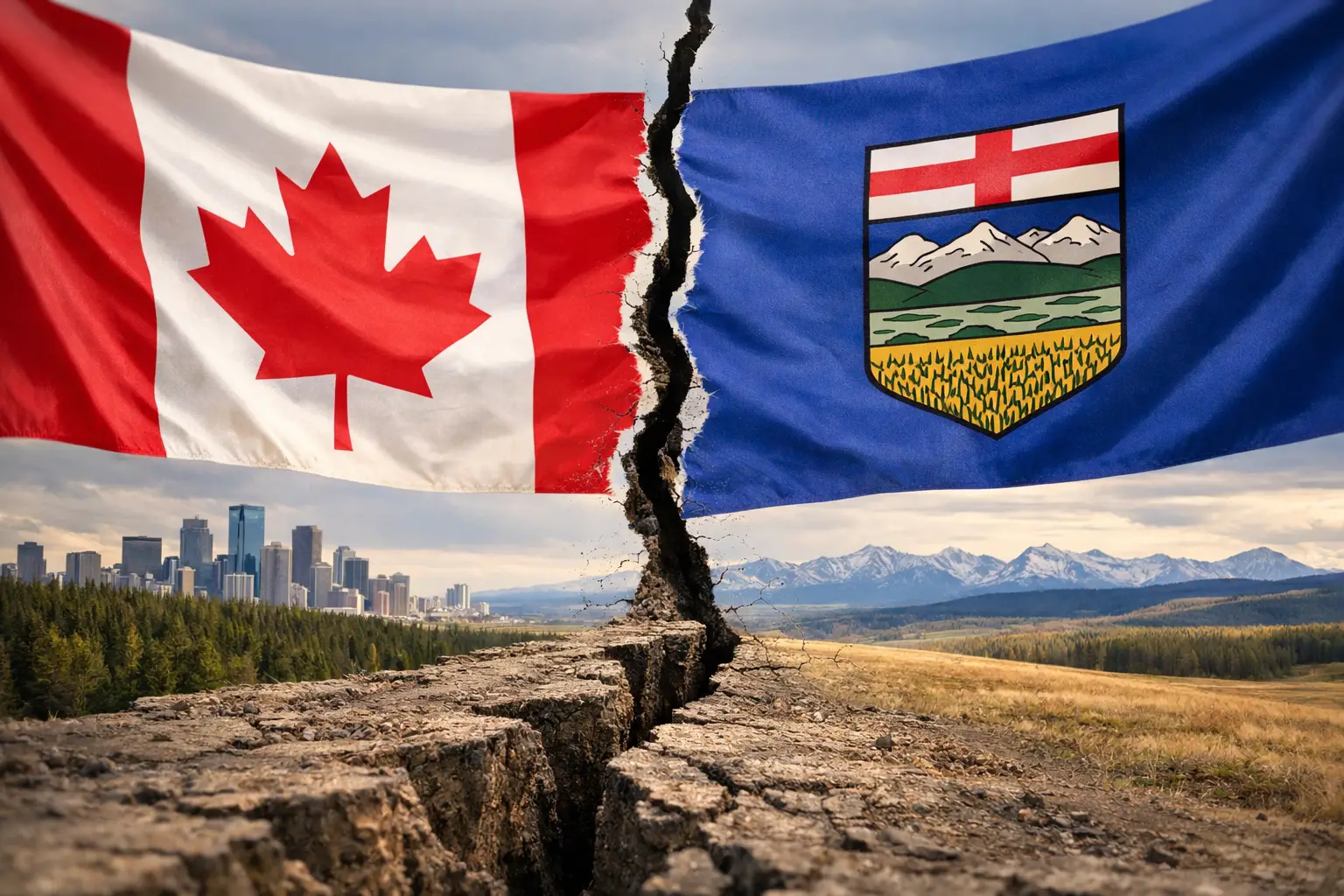
Every few years, alberta separation comes roaring back into the news as if Canada is one bad election away from a constitutional breakup. Then the cycle repeats. Polls spike, politicians posture, commentators panic, and most people are left with the same question: is this an actual secession movement, or is it a very loud bargaining tactic?
The honest answer is less dramatic and more useful. Alberta separation is real in the sense that a meaningful number of people feel politically alienated, economically squeezed, and culturally dismissed by Ottawa. It is less real in the sense that turning that frustration into an actual independent country would be legally difficult, economically risky, and politically fractured. Those two facts can coexist, even if cable news prefers cleaner storylines.
What alberta separation is really about
At the surface level, the grievance list is familiar. Many Albertans believe the province contributes heavily to the national economy while receiving limited political respect in return. Energy policy sits at the center of that resentment. So does equalization, whether or not the average complaint about it is technically accurate.
This is where the conversation often gets sloppy. People talk about Alberta as though it simply sends money east and gets punished for being productive. The real picture is more complicated. Equalization payments do not come from Alberta as a province writing checks to other provinces. They are federal transfers funded through national revenues. But the political feeling behind the complaint is not really about accounting mechanics. It is about the perception that Alberta’s economic engine, especially oil and gas, is tolerated when useful and scolded when visible.
That perception did not appear out of nowhere. Federal climate policy, pipeline fights, emissions caps, and regulatory delays have all fed a broader story inside Alberta: we produce wealth, we take the reputational hit, and then we get lectures from people whose economies do not face the same constraints. Whether one agrees with that framing or not, dismissing it as mere regional whining is a great way to make it stronger.
Why the movement keeps returning
Alberta separation tends to surge when three pressures overlap: weak energy prices or sector uncertainty, a federal government seen as hostile to provincial priorities, and a sense that democratic representation does not translate into national influence.
That last point matters more than outsiders sometimes realize. Alberta can vote overwhelmingly one way in a federal election and still end up governed by a party with little support in the province. That is not a democratic flaw. It is how parliamentary systems work. But politically, it creates a durable feeling of being ruled rather than represented.
Then there is geography and identity. Alberta is not just arguing over tax policy. The province has developed a distinct political culture that values decentralization, private enterprise, and skepticism of centralized control. When Ottawa expands its role, many Albertans do not see neutral governance. They see a distant institution making local trade-offs on their behalf.
That does not automatically produce separatism. But it does create fertile ground for it. Separation movements rarely start with constitutional theory. They start with a repeated sense that the system is not listening.
The economics are both stronger and weaker than activists claim
If you want a clear-headed read on alberta separation, this is the section where the slogans usually fall apart.
Subscribe To Our Newsletter!
The strongest argument for independence is that Alberta has real economic assets. It has a large energy sector, a comparatively young workforce, major agricultural output, and a tax base that has often outperformed much of the country. This is not a tiny province fantasizing about sovereignty on vibes alone. Alberta has genuine productive capacity.
But productive capacity is not the same thing as low-friction independence. A newly independent Alberta would face immediate questions that are easy to chant past and hard to solve. What currency does it use? How does it manage banking regulation? What happens to federal pensions, debt obligations, trade arrangements, defense, border management, and Indigenous treaty relationships? What is the plan for landlocked exports if relations with the rest of Canada become more contentious rather than less?
The trade issue alone should cool some of the rhetoric. Alberta’s economy depends heavily on access to external markets. That means transportation infrastructure, investor confidence, and regulatory certainty matter more than nationalist enthusiasm. Independence might offer more policy control, but it could also introduce exactly the kind of uncertainty capital tends to avoid.
This is the awkward part that movements built on grievance do not always like to discuss. You can be right that the current arrangement is frustrating and still be wrong that a clean break would make life easier.
Why separation talk is often a negotiating tool
A lot of separatist energy in Alberta functions less like a practical state-building project and more like a pressure campaign. The goal is not always to leave. Often it is to force concessions, gain leverage, or change the terms of federal-provincial relations.
That makes sense politically. Threats are useful when polite requests have failed. If Ottawa believes alienation is manageable, it has little incentive to adjust. If federal leaders believe frustration could harden into a larger crisis, suddenly meetings get scheduled and language gets softer. Funny how that works.
This does not make the movement fake. It makes it strategic. The existence of a separatist flank changes the bargaining environment even if most supporters would accept a looser federation over actual independence.
In that sense, Alberta separation resembles other regional protest movements that become strongest not when departure is imminent, but when trust in the center is weak. The point is partly constitutional and partly psychological. People want proof that their participation in the federation still means something.
The biggest obstacle is political cohesion inside Alberta
There is a tendency to talk about Alberta as though it has one unified political will. It does not. Urban and rural priorities differ. Business leaders, energy workers, public sector employees, Indigenous communities, and younger professionals do not all view the federation through the same lens.
That matters because successful separation movements require more than anger. They need broad and durable internal consensus on what comes next. Alberta is highly capable of producing outrage. It is less clear that it could produce agreement on the institutional design of an independent state.
There is also the issue of Indigenous rights, which cannot be treated as a footnote. Any separation process would run directly into treaty relationships and constitutional questions involving First Nations whose legal and political status is not subordinate to provincial impatience. That is not some technical nuisance. It is a central reality.
So when people speak about separation as though a referendum would settle everything, they are skipping several very large steps. The politics after a vote could be more complicated than the politics before one.
What the rest of Canada keeps getting wrong
The easiest bad take is to frame Alberta separation as a fringe tantrum powered by oil money and resentment. That reading is emotionally satisfying for people who already dislike the province’s politics, which is probably why it remains popular. It is also lazy.
The underlying issue is not that Alberta is uniquely aggrieved. It is that Canada has a recurring problem with regional legitimacy. Different provinces experience the federation differently, and national unity tends to look stable right up until it does not. Quebec understood this long ago. Western alienation is the version many central Canadian institutions still prefer to underestimate.
Treating all separatist sentiment as unserious does not reduce it. It simply confirms the story that national elites only take regional concerns seriously once they become disruptive. Again, not exactly a recipe for calm.
So is Alberta actually going to separate?
Probably not in the near term. The legal path is murky, the economic transition would be daunting, and public support, while meaningful, has not shown the kind of sustained majority consensus needed for a move of that scale.
But that does not mean the issue can be filed away as theater. Alberta separation is best understood as a stress signal. It tells you something about confidence in federal institutions, about the limits of symbolic national unity, and about how economic and cultural conflicts get translated into constitutional language.
If the question is whether Alberta is on the verge of becoming its own country, the answer is likely no. If the question is whether the anger behind the movement is politically significant, durable, and capable of reshaping Canadian politics, the answer is much closer to yes.
And that is the saner way to read it. Not as prophecy, and not as performance, but as a warning that federations do not run forever on sentiment alone. They run on legitimacy. Once that starts to erode, the loudest demand is not always the most likely outcome, but it is often the clearest sign that something deeper is no longer working.