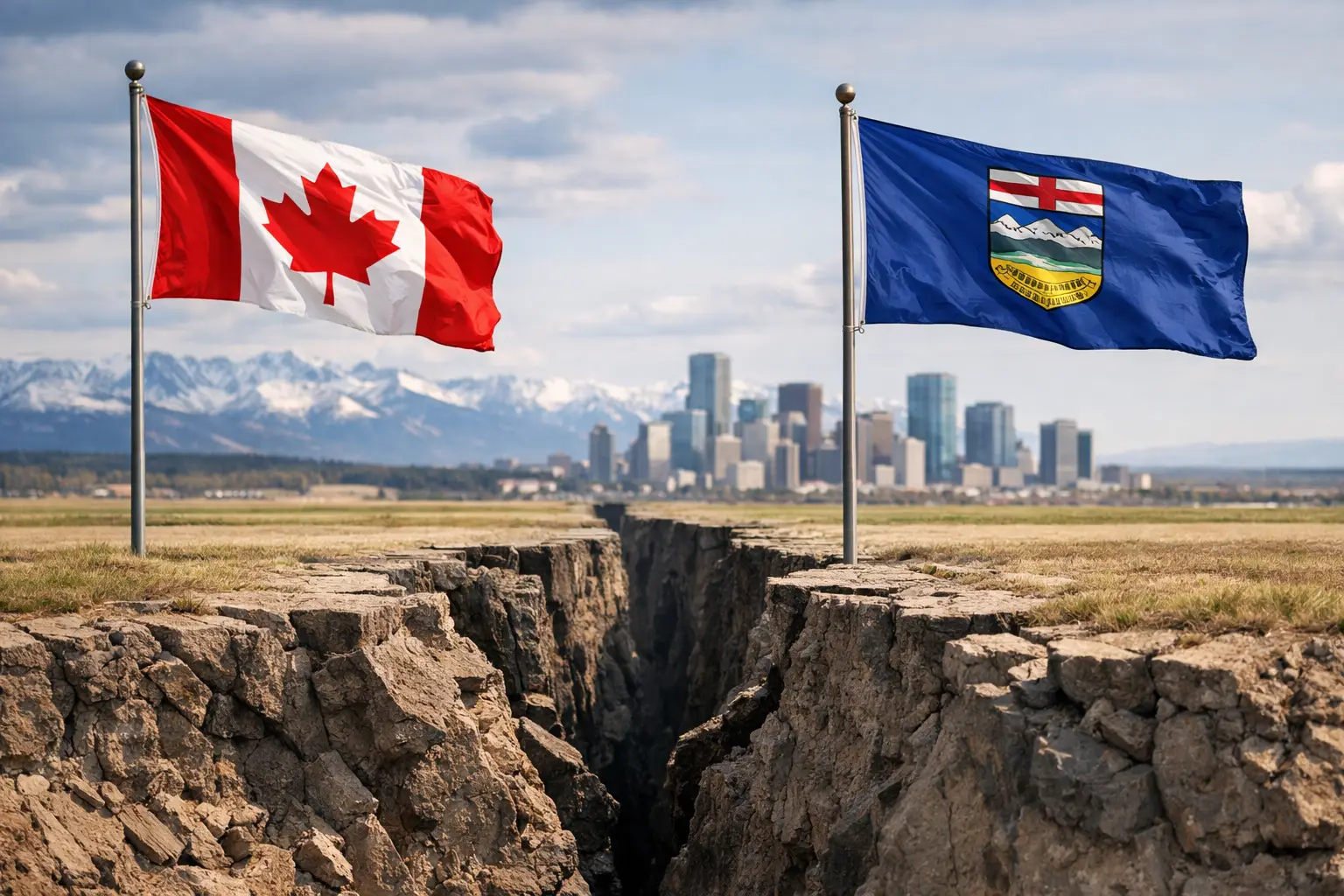
The alberta separation movement tends to surge whenever frustration in the province hits a familiar boiling point – low oil prices, federal climate policy, equalization arguments, or the sense that Ottawa is making rules for an economy it does not really understand. Then the national conversation usually goes off the rails in about ten minutes. One side treats separation talk as a punchline. The other treats it as an inevitable response to betrayal. Neither frame is especially useful.
What matters is not whether Alberta is on the verge of leaving Canada. It is not. What matters is why this idea keeps returning, what conditions give it energy, and what that says about the deeper fault lines in Canadian politics. If you want sanity instead of slogans, that is where to look.
Why the Alberta separation movement keeps coming back
This is not a single-issue protest, even if pipelines often get top billing. It is better understood as a recurring pressure release valve for layered grievances – economic, political, cultural, and regional.
Alberta has long seen itself as a major net contributor to the national economy, especially through energy production, while also feeling culturally distant from central Canadian institutions. That creates a combustible mix. When times are good, the tension is manageable. When times are bad, resentment starts sounding like a constitutional argument.
The basic complaint is simple: Alberta helps pay the bills, but does not get proportional influence over the rules. That complaint is not entirely invented, and it is not entirely accurate either. Which is inconvenient, because reality usually is.
1. The movement is more about leverage than imminent exit
Most separation movements have two layers – a symbolic one and a practical one. In Alberta, the symbolic layer is often stronger. For many supporters, separatist rhetoric is less a fully developed plan for independence than a way of signaling that the current arrangement feels intolerable.
That does not make it meaningless. Political threats do not need majority support to affect policy debates. They just need enough credibility to make federal parties nervous and provincial leaders more aggressive in negotiations.
So when you hear renewed talk of sovereignty, the first question is not, “Will Alberta leave?” It is, “What pressure is being applied, and to whom?” Often the real target is Ottawa, not Confederation itself.
2. Economics powers the anger, but not always in the way people think
The obvious driver is the oil and gas sector. Alberta’s economy remains far more exposed to commodity cycles than many provinces, despite years of talk about diversification. When energy prices fall or market access is constrained, the pain spreads quickly – jobs, investment, public revenue, business confidence.
That is why federal environmental policy hits differently in Alberta than it does in provinces with less direct exposure to hydrocarbons. A carbon policy that looks manageable from Toronto or Montreal can look like layered economic punishment from Calgary or Fort McMurray.
Subscribe To Our Newsletter!
Still, the economic case for actual separation is much weaker than the economic case for anger. Alberta would face hard questions about currency, trade, federal transfers, debt allocation, pensions, banking regulation, defense, treaty obligations, and access to export infrastructure. Being wealthy is not the same thing as being institutionally ready.
This is where a lot of public commentary gets lazy. People either assume Alberta would become instantly richer on its own, or they assume separation would be obviously impossible. The real answer is less cinematic. Alberta has a strong economic base, but state-building is expensive, messy, and full of second-order consequences.
3. Equalization is politically potent and publicly misunderstood
If there is one issue that reliably supercharges the alberta separation movement, it is equalization. The common belief is that Alberta writes massive checks to other provinces and gets punished for its success. That narrative is emotionally powerful, but the mechanics are often misunderstood.
Equalization payments are federal transfers funded through general federal revenues. Provinces do not write direct checks into a separate equalization pot. Alberta residents and businesses contribute more in federal tax revenue partly because the province generates more income and corporate activity. That distinction matters.
But here is the part that separatists are not wrong about: even if the program is often misstated, the broader fiscal imbalance can still feel real. Alberta can be a major net contributor to the federation while having little appetite for federal policies that seem to constrain the very industries producing that revenue. You do not need the simplified version of equalization to be literally correct for the underlying resentment to be politically potent.
In other words, the math is often mangled, but the frustration is not entirely fictional.
4. Federal policy is a trigger, not the whole cause
It is tempting to explain all of this through recent federal governments, especially when debates over emissions caps, pipeline regulation, and climate targets dominate headlines. But the Alberta grievance story predates any one prime minister.
There is a longer arc here – western alienation, perceived dominance of central Canada, institutional underrepresentation, and a persistent belief that Alberta’s political preferences can be ignored because the electoral map allows it. If voters in a province feel permanently outnumbered and structurally misunderstood, every policy fight starts to look like proof of a rigged system.
This is why technocratic rebuttals often fail. Telling people that a regulation is legally sound or administratively rational does not address the deeper question they are asking: who is this country built to listen to?
That does not mean every grievance is justified. Some are exaggerated. Some are strategically amplified by politicians who know a useful villain when they see one. But if a sentiment keeps resurfacing across decades, dismissing it as mere theatrics is not analysis. It is avoidance.
5. Public support rises fast in anger and falls fast in reality
One reason the movement is hard to read is that support is highly elastic. In moments of political conflict, polling can show surprisingly high openness to sovereignty or some version of autonomy. But support usually softens when the question becomes concrete.
People may like the emotional logic of “we would be better off alone” while disliking the practical details of borders, pensions, passports, Indigenous jurisdiction, and corporate uncertainty. That gap matters. Protest sentiment and statehood sentiment are not the same thing.
This is also why social media is a terrible guide. Online discourse rewards maximalism. It makes fringe certainty look larger than it is and moderate doubt look invisible. A loud movement can shape the national mood without representing a majority.
6. Indigenous rights make any separation scenario far more complex
This is one of the least discussed and most consequential parts of the debate. Alberta is not an empty constitutional container waiting to be repurposed. Any serious separation effort would collide immediately with treaty relationships, Indigenous sovereignty claims, land rights, and federal obligations.
That is not a side issue. It goes to the core of whether an independent Alberta could claim uncontested territorial authority. Many Indigenous nations would have their own legal and political positions, and there is no reason to assume they would align neatly with a separatist project.
So any version of the movement that talks as if independence is simply a matter of provincial will is skipping a very large part of the map.
7. The biggest effect may be on Canada, not Alberta alone
Even if Alberta never gets close to secession, the movement still matters because of what it reveals about the federation. A country does not need a breakup referendum to have a legitimacy problem. It just needs a growing number of citizens who see national institutions as distant, selective, or structurally biased.
That is the broader warning. If major producing regions believe they are politically useful but culturally disposable, national cohesion weakens even without constitutional drama. Investment decisions change. Party systems harden. Regional identities become more oppositional. The cost shows up gradually, which is often how countries miss it.
For the rest of Canada, writing off Alberta frustration as oil-soaked melodrama is comforting and shortsighted. For Alberta, pretending separation is a simple off-ramp from every grievance is equally unserious. One side ignores the pressure. The other oversells the cure.
So what is the Alberta separation movement really telling us?
At its core, it is a signal that economic contribution, political representation, and cultural recognition do not feel aligned. When people believe they bear heavy costs without commensurate influence, they start questioning the structure itself.
That does not automatically justify separation. It does mean the movement should be read as feedback, not just spectacle. Some of that feedback is distorted by opportunism, misinformation, and the usual political theater. Some of it reflects real institutional strain. The job is to tell the difference.
A calmer reading is possible. The alberta separation movement is neither an imminent national breakup nor a joke for cable panels. It is a recurring stress response inside a federation that still has unresolved questions about power, revenue, representation, and regional respect.
And those questions do not disappear just because the hashtag cools off.
The useful test is not whether you find separatist rhetoric persuasive. It is whether you are willing to ask what keeps making it plausible to so many people, over and over again.