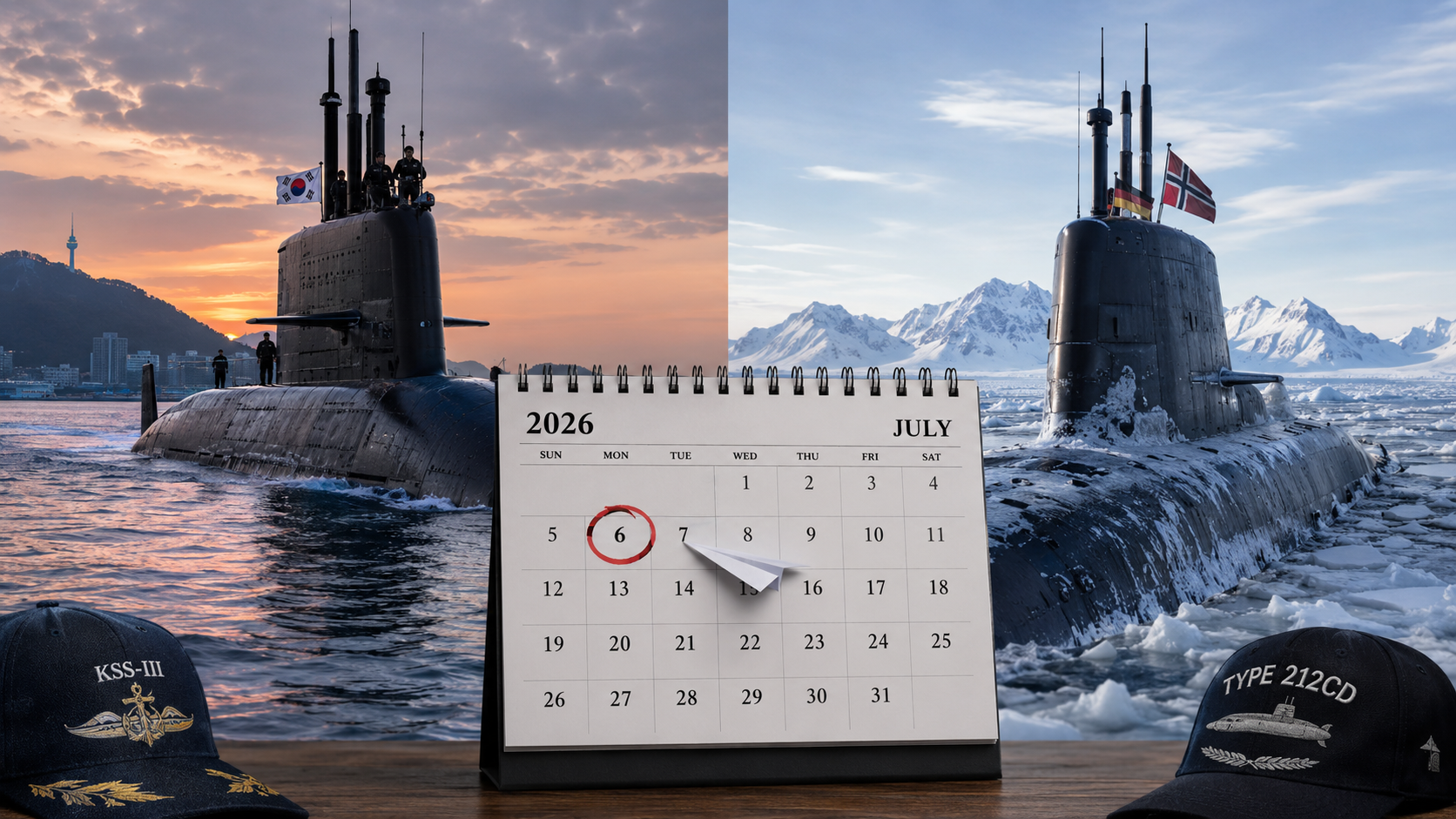
I run a small Substack that fact-checks Canadian political spin, and this week’s biggest defence story isn’t really about spin. It’s about timing.
For more than a year, Canada has been narrowing down who will build up to 12 new submarines for the Royal Canadian Navy, a program meant to replace the aging Victoria-class fleet. It came down to two bidders: South Korea’s Hanwha Ocean, offering its KSS-III submarine, and Germany’s TKMS, offering the Type 212CD it co-developed with Norway’s Kongsberg Defence and Aerospace — making it, functionally, a German-Norwegian bid. Both have spent the past year courting Canadian jobs, Canadian universities, and Canadian headlines.
Here’s the detail that gets buried under all that noise: both proposals reportedly already meet every operational requirement the Navy laid out. That’s not a rumour. It came from Canada’s own defence procurement secretary of state, Stephen Fuhr, in comments reported by the Asia Pacific Foundation of Canada. If that’s true, the “which submarine is better” framing that’s dominated coverage for months was never actually the deciding question.
Why Canada’s Submarine Decision Is Really a NATO Decision
So what is deciding it? Look at the calendar. Multiple defence-industry sources now expect Ottawa to name a winner as early as Monday, July 6 — one day before Prime Minister Mark Carney departs for the NATO summit in Ankara, Türkiye. That’s not a coincidence anyone in Ottawa is trying particularly hard to hide. A submarine announcement timed to land the day before a NATO summit gives Carney a rearmament story to walk into the room with — tangible proof Canada is serious about the spending commitments it’s made to the alliance.
That timing detail matters more than it might seem, because analysts have pointed out that the two bids send very different signals depending on which one wins. A Hanwha win signals a deepening of Canada’s Indo-Pacific strategy. A TKMS win signals reinforced NATO cohesion, with Germany and Norway, fellow member states, already operating versions of the same submarine. If Carney wants a story to tell at a NATO summit specifically, one of those two signals plays a lot better in the room than the other.
The economic packages, for what it’s worth, are close enough that they cancel each other out as a tiebreaker. Hanwha’s camp has cited figures ranging from roughly $70 billion to $120 billion in economic effects and 430,000 to 500,000-plus job-years through the 2040s. TKMS has countered with numbers in the $160 billion range and job-year totals north of 650,000. Both sets of figures come from modelling commissioned by the bidders themselves, not from independent Canadian analysis, and neither has been verified by a third party. Whichever number sounds bigger in a press release, treat both with the same grain of salt.
None of this is a knock on either submarine. The KSS-III is a proven, in-production platform with a Korean navy vessel that already sailed 14,000 kilometres to dock in British Columbia to prove it. The Type 212CD is a newer design built specifically for Arctic conditions, backed by two NATO navies putting their own production slots on the line to get Canada boats faster. Either one would likely do the job the Navy needs done.
That’s exactly the point. When the technical case is this close to a wash, the deciding factors stop being engineering and start being optics, alliances, and timing. My read: if Ottawa wants a rearmament announcement to carry into a NATO summit, the German-Norwegian bid is the one that tells that story cleanly. That’s a prediction, not a certainty, and Ottawa hasn’t confirmed anything as of this writing.
Whichever flag ends up on the hull, worth remembering: the decision on how Canada spends tens of billions of dollars on defence may have been shaped as much by a flight itinerary as by a single line of sonar specifications.