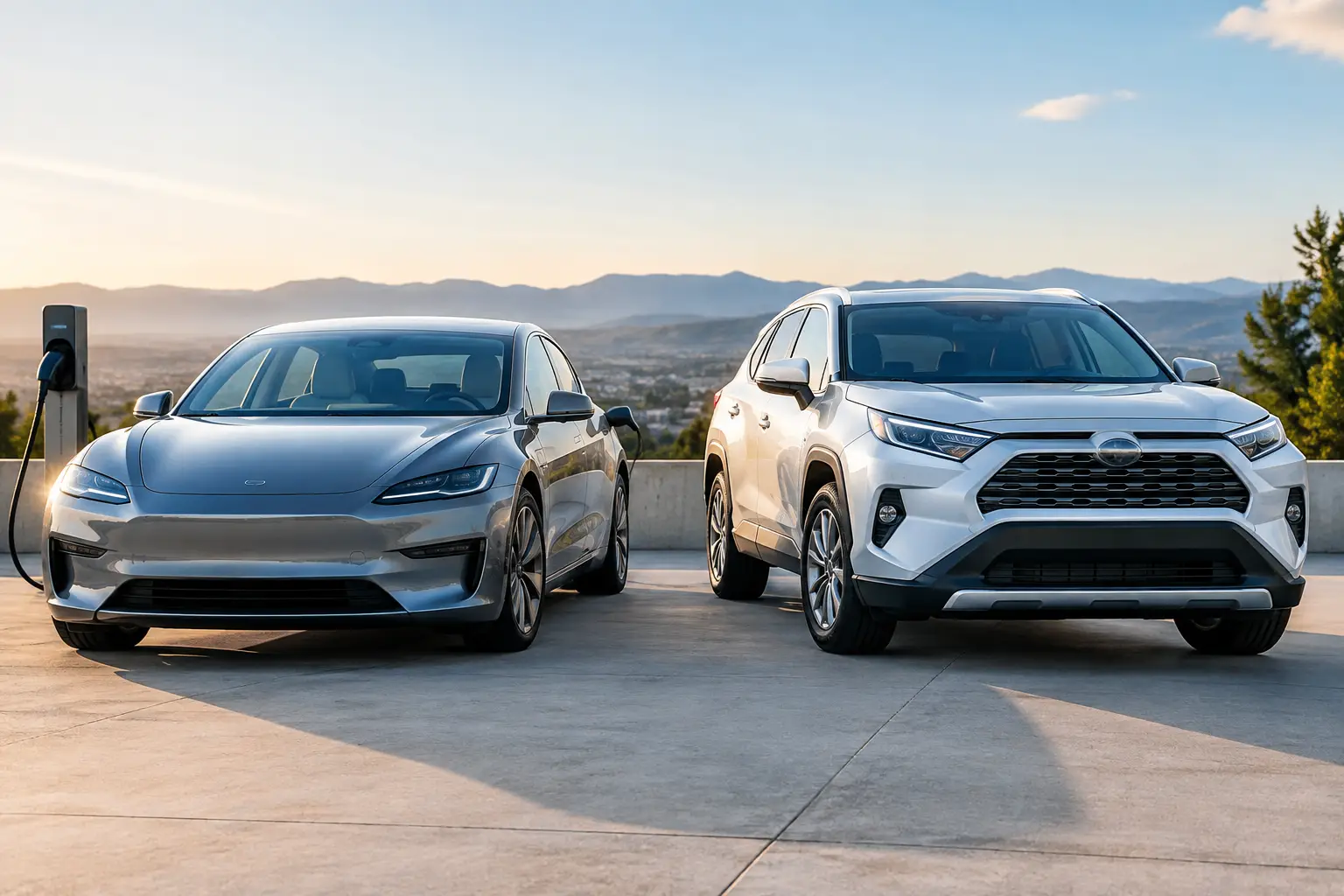
The electric vehicles vs hybrids debate is often presented as a clean choice between the future and the past. That framing is emotionally satisfying and practically useless. A vehicle is not a virtue signal or a campaign slogan. It is a very expensive machine that has to fit a household’s driving patterns, charging access, budget, and tolerance for inconvenience.
Battery-electric vehicles have real advantages. So do hybrids. The better option is not the one that wins a social-media argument. It is the one that reduces the most fuel, cost, and friction for the person actually driving it.
1. The biggest environmental win is replacing gasoline miles
A battery-electric vehicle produces no tailpipe emissions, and its climate advantage grows as the electrical grid gets cleaner. In much of the United States and Canada, that advantage is already meaningful over a vehicle’s lifetime, even after accounting for battery manufacturing. The grid is not perfectly clean, of course. Neither is the oil supply chain, despite its talent for disappearing from view once gasoline reaches the pump.
But the practical comparison is not always electric vehicle versus a 20-year-old SUV. For many shoppers, it is an EV versus a modern hybrid that can achieve 45 to 55 miles per gallon without requiring any charging behavior at all.
A hybrid can cut fuel use dramatically compared with a conventional gasoline vehicle, especially in city driving, where regenerative braking recovers energy that would otherwise become heat and brake dust. A plug-in hybrid can go further, but only if it is charged regularly. Driven mostly on gasoline after the novelty of plugging in fades, a plug-in hybrid can become a heavier, more complicated hybrid. Physics is annoyingly indifferent to good intentions.
For households replacing a thirsty vehicle and driving mostly predictable daily routes, a fully electric vehicle usually delivers the largest reduction in gasoline consumption. For drivers who cannot charge at home and frequently travel long distances, an efficient hybrid may produce a better real-world result than an EV that is hard to charge and therefore hard to live with.
2. Home charging is the dividing line, not range anxiety
The public debate spends enormous energy on maximum range. For most buyers, the more revealing question is simpler: Where will you charge on an ordinary Tuesday night?
Owners with a driveway, garage, or reliable workplace charger can treat an EV much like a phone. Plug it in when parked, wake up with a useful amount of range, and rarely visit a fast charger except on road trips. In that setup, even a modest-range EV can work well because daily driving is generally far below the advertised range.
Apartment residents, renters, and urban drivers without assigned parking face a different calculation. Public charging has improved, but availability, pricing, broken equipment, payment systems, and queues still vary widely. An EV can absolutely work without home charging. It just asks for more planning, and sometimes more patience, than advertisements imply.
Hybrids avoid this infrastructure question. They refuel in minutes nearly everywhere, a convenience that is easy to dismiss until a winter storm, family emergency, or unexpected work trip rearranges the week. Plug-in hybrids occupy an awkward middle ground: they offer electric commuting when charged, but retain gasoline flexibility. That can be ideal for a two-car household or a driver with reliable charging and occasional long trips. It can also mean paying for two propulsion systems rather than fully benefiting from either one.
Subscribe To Our Newsletter!
Cold weather deserves a less theatrical discussion
Cold temperatures reduce EV range because batteries operate less efficiently and cabin heat requires energy. The reduction can be noticeable, particularly on short trips and at highway speeds. That is not a reason to rule out EVs in northern states or Canada. It is a reason to buy with winter range in mind and use preconditioning while plugged in.
Hybrids also lose efficiency in cold weather, though they retain the familiar advantage of fast refueling. For a driver who regularly covers long rural distances in severe winter conditions, that advantage may matter more than a glossy annual cost estimate.
3. Purchase price and operating cost tell different stories
EVs often cost less to operate per mile because electricity is generally cheaper than gasoline and electric motors have fewer routine maintenance needs. No oil changes, fewer brake replacements in many driving conditions, and less engine-related maintenance are not trivial savings.
Yet the sticker price can still be higher, and the economics change with local electricity rates, gasoline prices, insurance premiums, financing costs, and available incentives. A low electric rate and home charging can make an EV unusually cheap to run. High public fast-charging prices can narrow or erase much of that fuel-cost advantage. Fast charging is valuable infrastructure, not necessarily bargain fuel.
Hybrids tend to have a lower purchase premium than comparable EVs and carry fewer lifestyle requirements. Their maintenance needs are greater than an EV’s but often lower than those of a traditional gasoline vehicle, particularly because regenerative braking reduces brake wear. They also have a long record of durability, although battery replacement costs should be considered in ownership plans that stretch well beyond the warranty.
Tax credits deserve restraint. Federal, state, provincial, and utility incentives can materially improve an EV or plug-in hybrid deal, but eligibility rules change, income limits may apply, and some incentives are tied to final assembly, battery sourcing, or vehicle price. Treat incentives as a discount you have verified, not a number a salesperson has casually waved into existence.
4. Electric vehicles vs hybrids is really a question of usage
The most sensible choice begins with a blunt audit of how the vehicle will be used. Not how it might be used on two vacation weekends a year. How it is used most weeks.
An EV is usually compelling for a household with dependable charging, routine daily mileage, and a willingness to plan longer trips around charging stops. It is especially attractive as a second vehicle, commuter car, or primary vehicle for drivers whose road trips fit existing fast-charging routes.
A conventional hybrid is often the rational choice for drivers who need one vehicle to do everything: urban errands, long highway trips, occasional towing, remote travel, or unpredictable schedules. It delivers a large efficiency improvement with almost no behavioral change. There is nothing glamorous about that answer, which may be why it is routinely underestimated.
A plug-in hybrid is best for a narrower group: drivers with reliable charging whose daily miles fit within its electric range, but who also make frequent longer trips that would make a pure EV inconvenient. Used this way, it can sharply reduce gasoline use. Used without charging, it becomes an expensive hedge.
5. The transition will not be one technology, one timeline, or one winner
Public narratives like clean villains and clean heroes. Transportation does not cooperate. Electrification is advancing, battery costs and charging networks are improving, and more drivers will find EVs practical each year. None of that requires pretending that every household should buy one immediately.
The better policy question is not whether governments should force a symbolic winner while infrastructure catches up. It is how to reduce emissions and fuel dependence as efficiently as possible across different homes, regions, incomes, and driving needs. That means cleaner grids, more dependable charging, better transit, smaller and more efficient vehicles, and room for hybrids where they remain the most practical step away from heavy gasoline use.
For an individual buyer, the cleanest answer is refreshingly unpolitical. Calculate your annual miles, your realistic charging access, your winter and road-trip needs, your electricity and gasoline costs, and the price after verified incentives. Then choose the vehicle that works without turning routine transportation into a part-time logistics project.
A good car decision should make your life quieter, cheaper, or cleaner. Ideally all three. It does not need to make a point.