
The Emergence of the Defence Security and Resilience Bank
In an era defined by profound Western institutional uncertainty and the accelerating transition toward a post-American NATO order, Canada’s selection as the host of the Defence Security and Resilience Bank (DSRB) represents a fundamental shift in global geoeconomics. This development is not merely a diplomatic achievement; it is a calculated response to an unpredictable American foreign policy environment.
By providing a “US-adjacent” alternative, Canada offers allies a sophisticated institutional framework that benefits from proximity to North American markets while remaining shielded from Washington’s political volatility.
🗝️ Quick Answer
The Defence Security and Resilience Bank (DSRB) is a new multilateral financial institution designed to fund long-term NATO defence infrastructure, procurement systems, and security resilience projects. Canada was unanimously selected as host, giving it a central role in shaping how allied nations finance defence. This positions Canada as a key player in global security finance, strengthens its economic influence, and reinforces its reputation as a trusted, stable leader in international policy and banking
Core Mandate of the Defence Security and Resilience Bank: Infrastructure and Capability Financing
The Defence Security and Resilience Bank is a Multilateral Development Bank (MDB) jointly owned by member nations, designed to mobilize up to US$135 billion in capital. Its mandate is to provide long-term, low-cost financing—via loans, grants, and technical assistance—for security infrastructure and supply chain resilience. Crucially, the DSRB operates as a financier of capability foundations (logistics, procurement systems, and dual-use tech) rather than an entity for purchasing lethal weaponry.
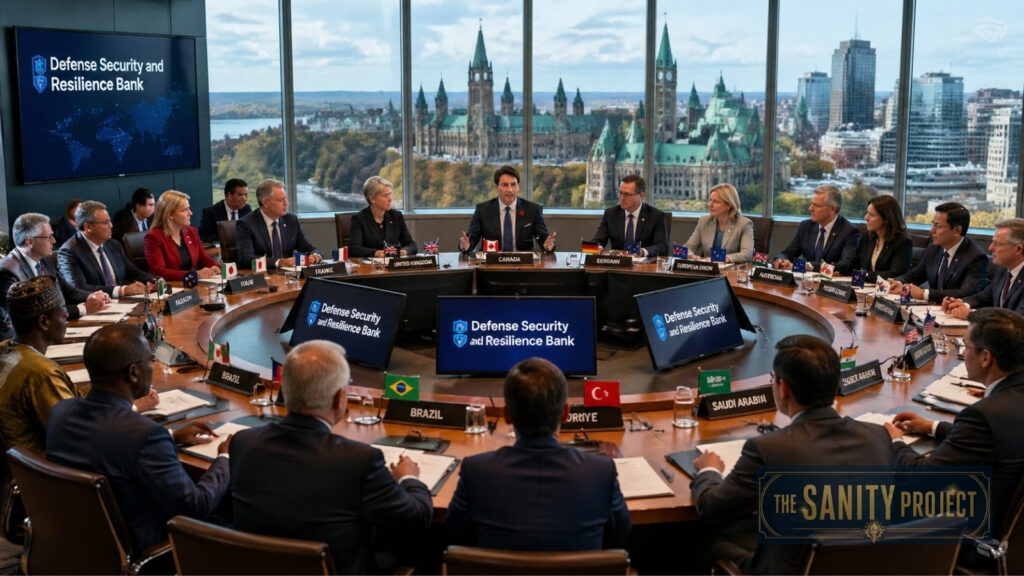
The selection of Canada as the unanimous choice of 19 founding nations followed three consecutive rounds of intensive charter negotiations hosted in Montreal. This “process authority” was reinforced by the role of Isabelle Hudon, President and CEO of the Business Development Bank of Canada (BDC), who served as lead negotiator. Her leadership signalled Canada’s intent to move beyond passive participation to become a primary architect of the next global order.
The “Basel Effect” and Rule-Shaping Authority
Hosting the DSRB is an act of “financial architecture” that extends far beyond the provision of office space. It grants Canada the authority to set the “regulatory fingerprints” of global defence finance. By establishing the legal and diplomatic framework within which the Bank operates, Canada transitions from a policy-taker to a policy-maker, providing the gravitational center for a more fractured and darker world.
A critical instrument of this authority is the Bank’s ability to define interoperability as a condition of lending. This shifts NATO from a regulation-driven model to an incentive-driven one, harmonizing allied capabilities through capital mobilization.
Precedent Analysis: The Transformation of Host-Country Gravity
| Institution / City | Historical Impact | Projected DSRB / Canada Equivalent |
| World Bank & IMF (Washington) | Established D.C. as the permanent center of global development; allowed the US to write the rules for 80 years. | Positions Canada as the permanent gravitational center for NATO defence finance, influencing every allied budget on the planet. |
| BIS (Basel) | Institutionalized Switzerland’s reputation for neutrality; created the “Basel Accords” as the global banking standard. | Reinforces Canada as a trusted center for security governance; DSRB standards for lending will carry Canadian “regulatory fingerprints.” |
| Asian Development Bank (Manila) | Inserted a regional player into every major development conversation; created structural proximity to massive capital. | Grants Canadian firms, SMEs, and researchers structural access to a US$135B institution and its global diplomatic network. |
This “Basel Effect” reinforces Canada’s brand as a neutral, high-trust jurisdiction, converting intangible diplomatic prestige into a permanent anchor for the nation’s long-term fiscal posture.
Economic Transformation: Beyond the “Branch Plant” Narrative
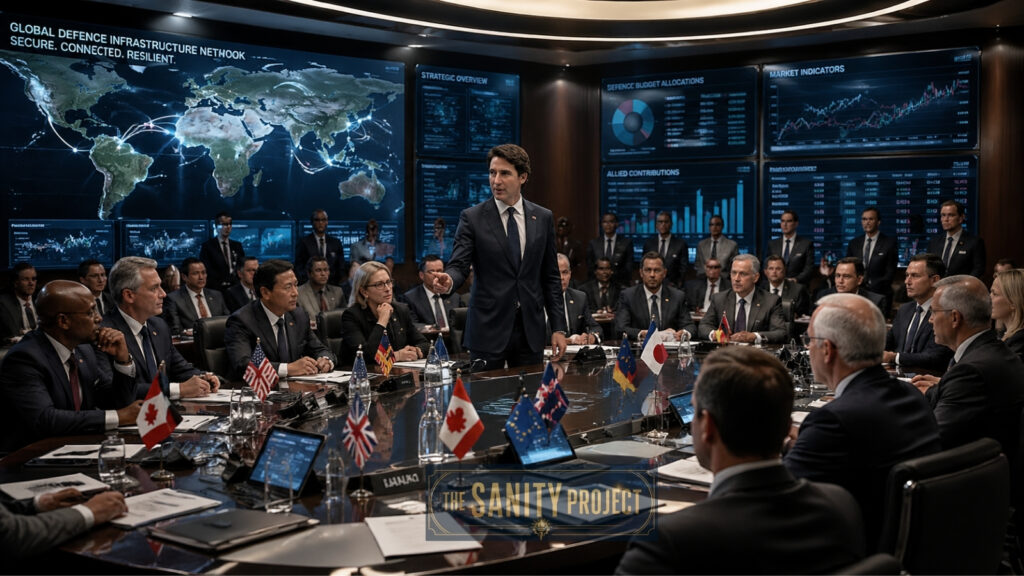
The DSRB fundamentally disrupts the historical “Branch Plant Canada” narrative by positioning the country as an exporter of institutional leadership and intellectual capital. No longer a mere importer of foreign governance, Canada is now the provider of the institutional backbone for the Atlantic alliance, backed by private capital from JPMorgan, Deutsche Bank, and the Canadian “Big Six.”
Projected Economic Outcomes
- High-Skilled Employment Clusters: Beyond the 3,500 direct high-skilled jobs in finance and procurement law, the DSRB is the catalyst for a ten-year projection of 340,000 jobs across the construction and supply chain sectors.
- Private Capital Integration: The Bank acts as a de-risking mechanism, opening the door for institutional investors to fund dual-use technologies previously constrained by ESG restrictions.
- Supply Chain Resilience: Supported by the $59 billion in infrastructure-related spending projected over the next decade, Canadian SMEs will gain unprecedented access to the global defence value chain.
The DSRB utilizes a Fiscal Leverage model that is essential for long-term stability. Canada’s modest equity contribution (projected at over $1 billion CAD) is recorded as an “asset on national accounts.” This ensures the contribution is viewed as a multiplier rather than a sunk cost, allowing the investment to count toward NATO GDP targets while raising massive market capital to strengthen collective security.
Subscribe To Our Newsletter!
Host City Strategic Value Proposition
The competition between Montreal, Toronto, Ottawa, and Vancouver highlights Canada’s diverse strategic assets. Montreal, in particular, leverages its history as a hub for international organizations such as ICAO and WADA, providing a proven precedent for hosting high-stakes multilateral institutions.
Canada’s Re-Armament and the 2% Milestone
Reaching the 2% NATO spending target in the 2025-26 fiscal year ($63 billion) was the necessary “credential” for Canada to lead the DSRB. This milestone serves as the foundation for the NATO Defence Investment Pledge, which aims to reach 5% of GDP by 2035.
Sovereign Industrial Capacity: From Reliance to Resilience
Canada is currently executing a suite of strategic projects designed to build independent capacity and reduce dependence on the United States:
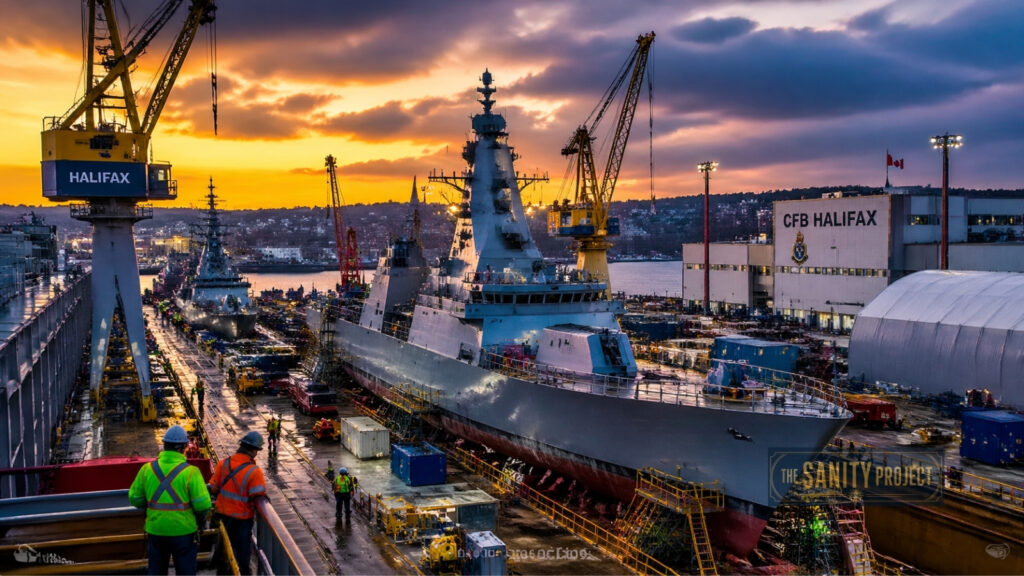
- River-Class Destroyers: This 22.2 billion investment provides the RCN with advanced combat capability while contributing **1.3 billion annually to GDP**.
- Polar Max Project: A critical component of Arctic sovereignty, designed specifically to reduce dependence on the United States for northern defence.
- Defence Investment Agency (DIA): Framed as the institutional overhaul mechanism, the DIA works in tandem with the DSRB to streamline procurement and maximize industrial benefit.
The DSRB acts as a Strategic Supplement, providing the multi-year financing required to sustain these projects through political cycles, effectively removing the “risk premium” from sovereign re-armament.
Risk Mitigation and Counter-Narrative Analysis
To maintain legitimacy, Canada must engage with domestic and international critiques through purpose-built governance.
Neutralizing the “War Bank” Rebuttal
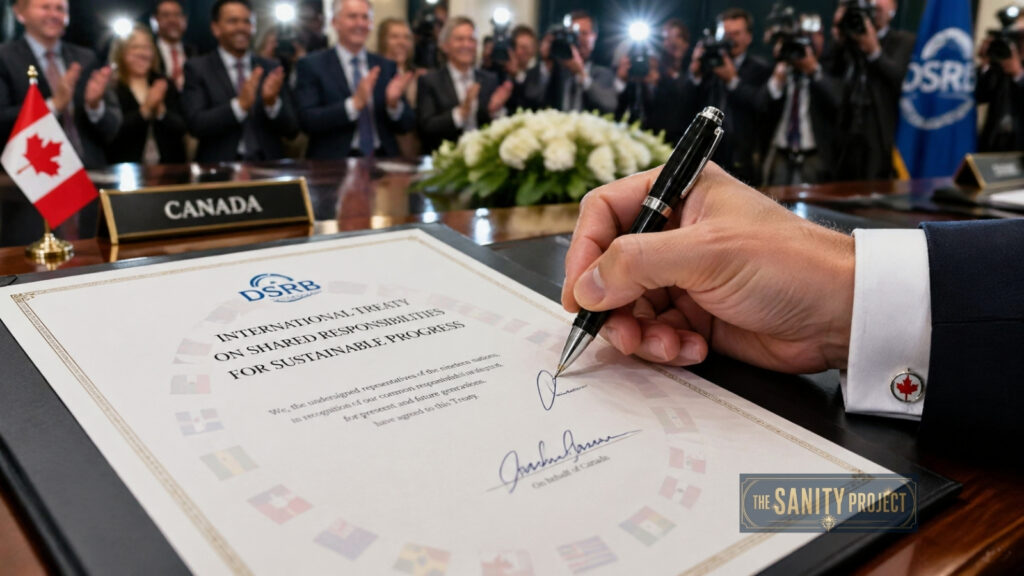
Critics such as the Canadian Centre for Policy Alternatives (CCPA), the Council of Canadians, and World Beyond War have labelled the DSRB a “War Bank.” This characterization fails to grasp MDB institutional logic. The DSRB is a supply-side engine for infrastructure and resilience; it finances the “room” and the “tools” of security, not the active conduct of conflict.
Strategic Independence and US Proximity
While critics fear geographic proximity to the US, this is Canada’s primary geoeconomic asset. Allies are actively seeking “US-adjacent” infrastructure that remains independent of US political interference. The DSRB provides this exact balance.
Institutional Risk Management
| Criticism | Strategic Rebuttal |
| Redundancy with SAFE | The EU’s SAFE is a short-term, demand-side program; the DSRB is a long-term, supply-side engine for industrial scaling. |
| Joint Liability Risks | Unlike Eurobonds, the DSRB avoids joint liability. Member nations are responsible only for their own commitments. |
| Borrowing Costs | The Bank’s AAA rating allows the 70% of NATO countries currently paying higher premiums to borrow at rates comparable to Germany’s. |
Conclusion: The Generational Strategic Realignment
The hosting of the Defence, Security and Resilience Bank is Canada’s “1944 Moment.” Just as the Bretton Woods conference established the US as the anchor of the 20th-century order, the DSRB positions Canada as the financial governance anchor for a 21st century defined by geoeconomic volatility.
By choosing to “build the room” rather than wait outside it, Canada has executed its most consequential act of diplomacy since the founding of the United Nations. In a fractured and darker world, the DSRB provides the institutional gravity and financial architecture necessary to secure the future of the Atlantic alliance and ensure Canada’s role as a sovereign, leading power.