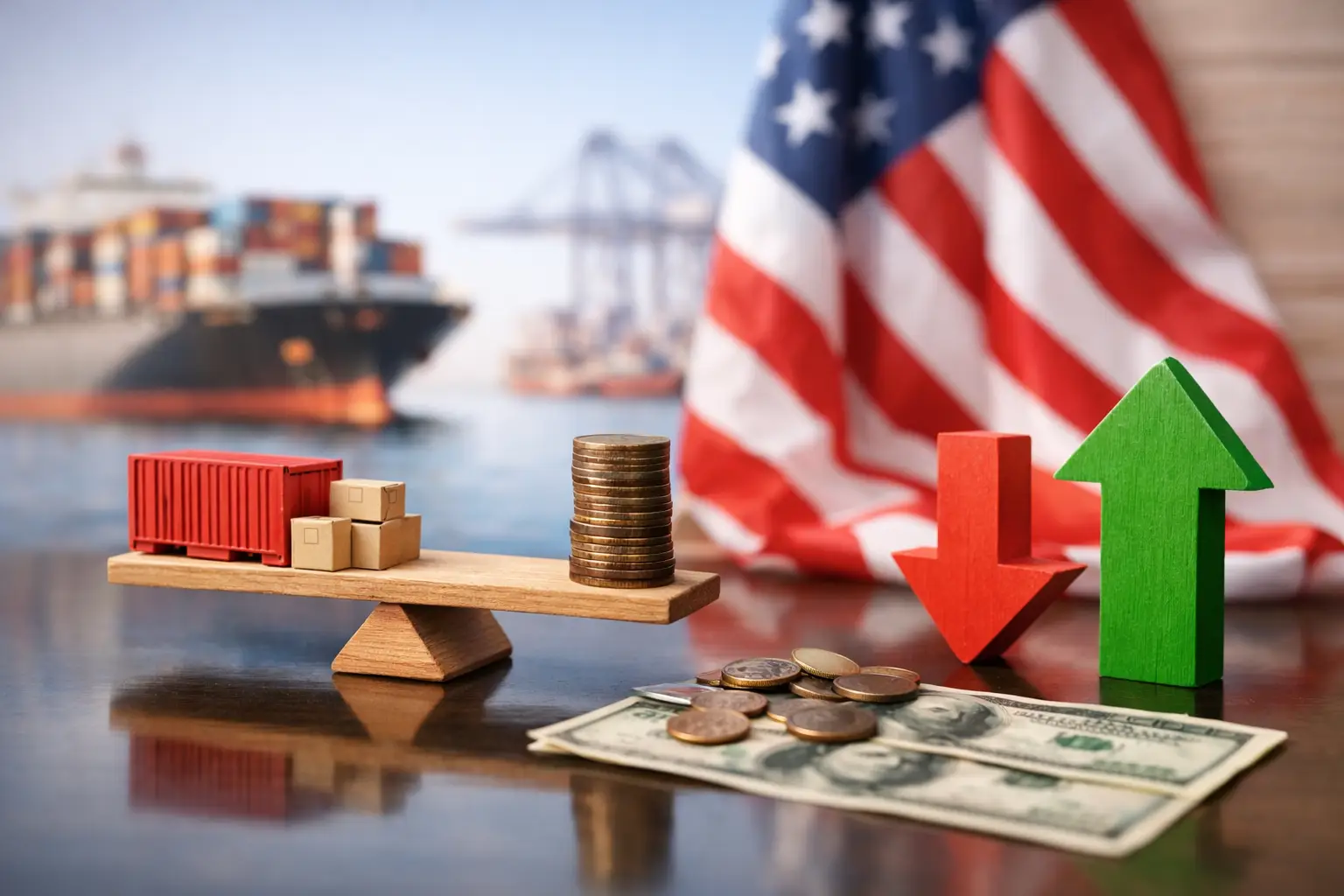
A trade deficit sounds like a national report card with a red mark on it. The country bought more from the rest of the world than it sold to them. Deficit. Bad. Case closed.
Except that is not how an economy works. A trade deficit explained simply is a gap between the value of imported goods and services and exported goods and services over a period of time. It is a real number, worth watching. It is also one of the most routinely overinterpreted numbers in public debate.
The better question is not whether a country has a trade deficit. It is why it has one, how it is financed, and whether the underlying economy is creating productive capacity or merely consuming beyond its means. Those are very different stories, even when the headline number looks identical.
Trade Deficit Explained Simply: The Basic Math
A country runs a trade deficit when it imports more than it exports. If Americans buy $4 trillion of foreign-made goods and services while foreign buyers purchase $3 trillion of American goods and services, the trade deficit is $1 trillion.
Imports include far more than cars, electronics, and clothing. They also include oil, industrial components, pharmaceuticals, travel abroad, and business services. Exports include aircraft, machinery, agricultural products, software-related services, financial services, entertainment, and tourism spending by foreign visitors.
That distinction matters because the popular picture is often a container ship full of imported televisions. Container ships are real, obviously. But services are a large part of modern trade, and the United States typically runs a surplus in services even while it runs a larger deficit in goods.
A bilateral deficit adds another layer of confusion. The United States may import more from one country while exporting more to another. Treating every country-to-country imbalance as a scorecard misses the point that supply chains span multiple countries. A phone assembled in one place may contain chips, software, machinery, design work, and raw materials from half a dozen others.
Fact 1: A Trade Deficit Is Not Automatically a Sign of Economic Failure
Countries with strong consumer demand often import a lot. Countries that attract investment also often run trade deficits. That may feel backward at first, but the accounting is straightforward.
When foreign investors buy U.S. Treasury bonds, stocks, real estate, or stakes in American businesses, dollars flow into the United States. Those dollars can then be used to buy American exports or to purchase American assets. The financial inflow is tied to the trade balance through what economists call the current account. No, this is not a magic trick. It is bookkeeping with major consequences.
A trade deficit can reflect confidence in a country as a place to invest. The United States, for example, has long attracted global capital because of its large economy, deep financial markets, legal institutions, and reserve-currency status. Foreign demand for dollar assets helps make it possible for Americans to buy more abroad than foreigners buy from America.
Subscribe To Our Newsletter!
That does not make every deficit healthy. A deficit driven by investment in factories, research, infrastructure, and productive businesses is not equivalent to a deficit paired with excessive borrowing for short-term consumption. Same label, different diagnosis.
The point is not that deficits are good. The point is that the word itself does not tell us enough. A thermometer can tell you that someone has a fever. It cannot tell you whether the cause is a cold, an infection, or standing too close to a grill in July.
Fact 2: Trade Can Help Consumers While Hurting Specific Communities
The argument that trade is broadly beneficial is often presented with the warmth and humanity of a spreadsheet. Lower-priced imports can stretch household budgets. Imported inputs can help domestic firms manufacture more efficiently. Export markets can support high-paying jobs in agriculture, aerospace, energy, technology, and professional services.
Those gains are real, but they are not distributed evenly.
When production moves abroad or foreign competition undercuts a domestic industry, a factory town can lose jobs, tax revenue, local businesses, and a sense of stability. Workers cannot pay rent with the theoretical benefits of lower-priced appliances. Telling them that cheaper consumer goods compensate for a lost career is technically tidy and socially unserious.
This is where trade discussions usually fail. They force a false choice between two claims: trade is always good, or trade is always destructive. Both are too simple.
Trade changes the composition of work. It can make some sectors more competitive and others less viable. The impact depends on how quickly workers can move into new jobs, whether training is accessible, whether housing is affordable near growing industries, and whether public policy helps communities absorb the shock. A country can gain overall from trade while still failing people who bear the adjustment costs.
That is not an argument for pretending the aggregate gains do not exist. It is an argument for taking the losses seriously enough to address them.
Fact 3: Tariffs Can Shrink One Deficit Without Fixing the Bigger Imbalance
When a trade deficit becomes politically charged, tariffs are usually the first proposed cure. The logic is appealing: tax imported goods, buy more domestic goods, and reduce the deficit.
In a narrow sense, tariffs can reduce imports of a specific product or from a specific country. But economies react. Importers may shift purchases to other countries. Domestic producers may raise prices because competition is weaker. Foreign governments may retaliate against exports. Companies that rely on imported parts can face higher costs, which can make their own products less competitive at home and abroad.
Most importantly, a country’s overall trade balance is heavily influenced by broader forces: domestic saving and spending, government budget deficits, investment flows, exchange rates, energy production, and the global demand for its currency.
If Americans continue to spend more than the country saves, and global investors continue to send capital into dollar assets, restricting imports from one trading partner may simply redirect trade elsewhere. The bilateral deficit changes. The overall deficit may barely move. Political theater has many set designs.
This does not mean tariffs are never justified. Governments may use them to respond to dumping, protect strategically vital supply chains, or gain negotiating leverage. But calling a tariff a simple trade-deficit solution is like calling a Band-Aid a housing policy. It might have a use. It is not the whole answer.
What a Trade Deficit Can Tell Us, and What It Cannot
A trade deficit can reveal useful information about an economy’s consumption patterns, investment inflows, industrial dependence, and exposure to foreign supply disruptions. A persistent deficit in critical goods, such as semiconductors, medical supplies, or defense-related components, may raise legitimate resilience concerns even if the overall balance is manageable.
It can also expose a mismatch between domestic demand and domestic production. If a country relies heavily on imports because it has underinvested in skills, infrastructure, energy capacity, or advanced manufacturing, the deficit may be a symptom of a deeper problem.
But it cannot, by itself, tell you whether the economy is weak. It cannot measure whether consumers are better off, whether exports are sophisticated, whether capital inflows are productive, or whether workers displaced by trade have been supported. It definitely cannot tell you whether one politician’s tariff announcement has repaired the national economy. For that, we would need to look beyond the press release.
The Better Way to Read the Headline
When you see a trade-deficit headline, ask three calm questions. What is driving the imports: consumer demand, energy needs, industrial inputs, or something else? Where are the offsetting capital flows going: productive investment, government debt, or speculative assets? And who is actually gaining or losing from the pattern?
Those questions are less satisfying than a slogan, but they are more useful. A trade deficit is neither a national humiliation nor proof that free trade has solved everything. It is one economic signal among many.
The sane response is not to cheer it or panic about it. It is to look at what the number is actually measuring, then insist that the real debate be about productive investment, resilient supply chains, and whether the people affected by economic change have a credible path forward.