
Most people still think of solar as something that might make sense someday. A future consideration. A project for when the timing is right.
Here’s the uncomfortable reality: for millions of homeowners and business owners, the timing has already been right for several years — they just didn’t know it. Solar panel costs have dropped more than 90 percent since 2010. The federal government is offering the most generous tax incentive in U.S. clean energy history. And the payback periods that once stretched into uncomfortable territory now land somewhere between six and nine years for most systems.
The solar energy transition isn’t approaching. It’s already underway, and the question worth asking isn’t whether solar makes sense. It’s whether you understand what you stand to gain — and lose — depending on when you act.
Quick Answer
The solar energy transition is the large-scale shift from fossil fuel-based electricity generation to solar photovoltaic (PV) systems across residential, commercial, and utility sectors. Falling panel costs, climate policy, and energy security concerns are accelerating adoption globally. For individuals and businesses, transitioning to solar involves assessing energy needs, evaluating property suitability, choosing the right financing structure, and installing a system that typically pays for itself within 6 to 10 years.
Key Takeaways
- 📉 Solar panel costs have fallen over 90% since 2010, making solar the cheapest electricity source in history across much of the world
- 💰 The federal 30% Investment Tax Credit is currently at its peak value and begins stepping down after 2032 for residential, but state incentives can disappear much sooner
- ⚡ Solar paired with battery storage has evolved from a luxury upgrade into a practical energy independence tool, especially in storm-prone regions
- 🏠 Homes with solar installations sell for approximately 4.1% more than comparable non-solar homes, per Zillow research
- 🌍 Community solar programs now make the transition accessible to renters, apartment dwellers, and anyone with an unsuitable rooftop
What Is the Solar Energy Transition?
The solar energy transition refers to the systematic shift away from burning coal, natural gas, and oil to generate electricity, toward capturing sunlight directly through photovoltaic technology. It happens at every scale simultaneously: a homeowner in Phoenix adding panels to a south-facing roof, a retailer powering its distribution network through a 20-year solar contract, a utility retiring its last coal plant and replacing that capacity with a grid-scale solar farm spanning thousands of acres.
What separates this moment from previous waves of solar optimism is simple: the economics have genuinely changed.
For most of the 20th century, fossil fuels won on price. That structural advantage is now gone across a growing portion of the global electricity market. In 2023, the International Energy Agency confirmed that solar is now the cheapest source of electricity in history — not cheap for a renewable, but the cheapest full stop. Global solar capacity surpassed 1 terawatt for the first time in 2022 and is projected to reach 5 terawatts before 2030. The United States installed more solar in 2023 than in any previous year on record.
These aren’t environmental statistics. They’re market signals.
Key Drivers Behind the Solar Energy Transition
Understanding what’s pushing the solar transition forward explains why the financial case is strongest right now, and why that calculus will gradually shift.
Subscribe To Our Newsletter!
Falling costs changed everything first. The price per watt of installed residential solar has dropped from roughly $8 in 2008 to under $3 today. At those prices, solar frequently beats utility electricity rates before any incentives are applied. Return-on-investment timelines that once stretched beyond 20 years now routinely fall under a decade.
Policy is amplifying the economy. The Inflation Reduction Act of 2022 locked in a 30 percent federal Investment Tax Credit for residential and commercial solar installations through 2032. State-level incentives layer on top in many markets: net metering policies, property tax exemptions, utility rebates, and performance-based incentive programs that pay you for the electricity your system generates.
Energy security entered the conversation permanently. The price shocks that followed Russia’s invasion of Ukraine reminded households and businesses that fossil fuel prices are geopolitical variables outside their control. Solar panels on your roof produce electricity at a fixed cost regardless of what happens at the next OPEC meeting or during the next pipeline disruption.
Battery storage transformed the value proposition. A solar system without storage sends excess electricity to the grid and draws from it at night. A solar-plus-storage system fundamentally changes your relationship with your utility. Modern battery products like the Tesla Powerwall, Enphase IQ Battery, and Franklin WH have become cost-competitive enough that solar-plus-storage is now the standard recommendation for most residential installations, not an expensive add-on.
Technological progress keeps improving the math. Mainstream solar panels now convert sunlight to electricity at efficiencies of 20 to 23 percent. Bifacial panels capture reflected light from below. Perovskite cell research points toward efficiencies above 30 percent at lower manufacturing costs. Each technological step makes solar more productive per square foot of roof space.

Benefits of the Solar Energy Transition
The benefits are well-documented, though they vary meaningfully by location, property type, and how you choose to finance the system.
Bill reduction and long-term cost certainty are the headline numbers for most homeowners. A properly sized solar system in a high-sun market like California, Texas, or Florida can eliminate 80 to 100 percent of a typical electricity bill. More importantly, solar locks in your electricity cost for 25-plus years, insulating you from utility rate increases that have historically averaged 2 to 3 percent annually. Over 25 years, that compounding adds up to a significant sum.
Energy independence with battery backup means something real when grid outages become common. Extreme weather events are stressing aging grid infrastructure across the country. A solar-plus-battery system keeps your lights, refrigerator, medical equipment, and critical devices running during outages without a generator and without fuel costs. For many homeowners in storm-prone regions, this has shifted from a nice-to-have to genuine emergency preparedness.
Property value follows the installation reliably. The 2019 Zillow study found that homes with solar sold for approximately 4.1 percent more than comparable non-solar properties. On a $500,000 home, that’s $20,500 in added market value. Depending on your system cost and financing structure, that recovered value can represent a significant portion of your total investment.
Environmental impact is real but often overstated in solar marketing. A typical residential system offsets roughly 3 to 4 tons of CO2 annually, equivalent to planting around 100 trees. Over a 25-year lifespan, that’s meaningful. But the financial case stands entirely on its own without requiring the environmental argument to close.
How to Transition to Solar Energy: A Step-by-Step Process
Step 1: Analyze Your Energy Consumption
Pull 12 months of utility bills and calculate your average monthly kilowatt-hour (kWh) usage. This number drives every decision that follows. A system sized too small won’t meaningfully reduce your bill. A system sized too large wastes capital on capacity you cannot use or sell back profitably.
Step 2: Evaluate Your Solar Energy Potential
South-facing roofs with minimal shading between 9 a.m. and 3 p.m. are ideal in the Northern Hemisphere. East or west-facing roofs typically produce 10 to 20 percent less but can still deliver strong economics. Tools like Google Project Sunroof give a useful preliminary read before you invest time in installer quotes.
If your roof is unsuitable, you are not locked out of the transition. Community solar programs allow renters, apartment dwellers, and homeowners with problematic rooftops to subscribe to a share of a remote solar array and receive credits on their utility bill. Availability varies by state and utility territory, but coverage is expanding rapidly.
Step 3: Obtain Multiple Installer Quotes
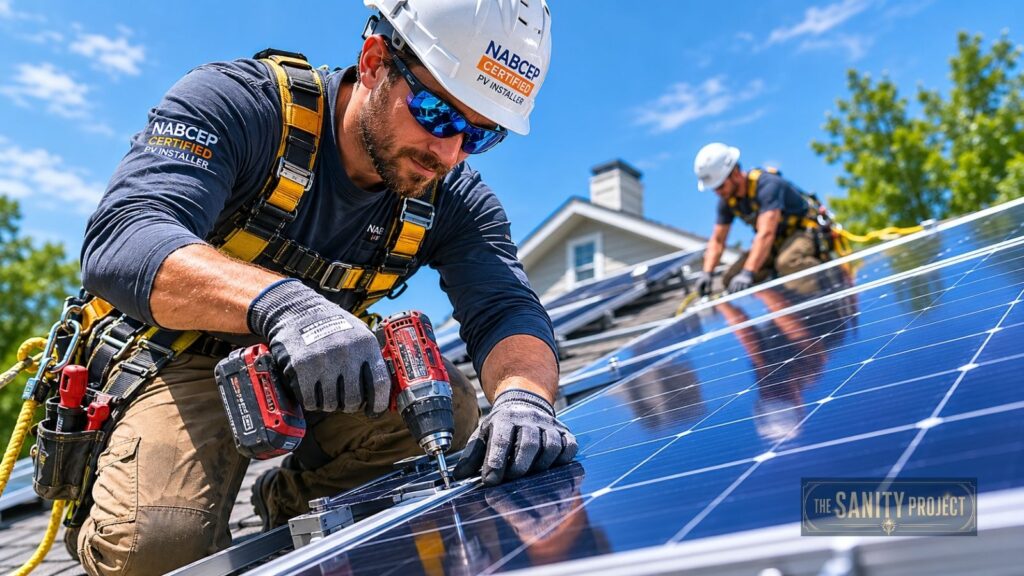
The solar installation market is competitive, and pricing varies significantly between providers. Get at least three quotes from NABCEP-certified installers. Compare system size in kilowatts, panel brand and efficiency rating, inverter type, warranty terms, and projected annual production. The lowest price is not automatically the best value — warranty depth and installer track record matter over a 25-year system life.
Step 4: Choose the Right Financing Structure
This is where the math gets personal, and where most homeowners make decisions they later regret or celebrate:
- Cash purchase delivers the highest lifetime return. You claim the full 30 percent federal tax credit directly, own the system outright, and eliminate your utility bill. Payback periods of 6 to 9 years are common in most markets.
- Solar loan lets you own the system with no upfront cost, claim the tax credit yourself, and typically achieve positive cash flow from day one when the loan payment is lower than your previous utility bill. Most solar loans run 10 to 25 years.
- Lease or Power Purchase Agreement (PPA) requires no upfront investment and no system ownership. You pay a fixed monthly rate for the solar electricity produced. Simpler to enter, but you don’t claim the federal tax credit, and long-term savings are lower than ownership paths.
Step 5: Navigate Permits and Utility Interconnection
Your installer handles most of this, but expect a permitting timeline of 2 to 8 weeks, depending on your municipality. Utility interconnection — the formal agreement that allows your system to connect to the grid and participate in net metering — is the step most likely to cause delays in congested markets. Factor this into your activation timeline.
Step 6: Installation and Activation
Physical installation of a residential system typically takes 1 to 3 days. Final inspection and utility meter upgrade may add another 2 to 6 weeks before your system is fully operational and exporting to the grid.
Step 7: Monitor Performance and Maintain Your System
Modern solar systems include monitoring apps that display real-time and historical production data. Panel cleaning is rarely necessary in most climates — rainfall handles most of it. An annual visual inspection and inverter check is sufficient for most systems. Inverters, the component most likely to need replacement, typically carry 10 to 12-year warranties with 25-year upgrade paths available.
Solar Energy Transition Challenges: Honest Answers
The case for solar is genuinely strong. Pretending the challenges don’t exist would be a disservice.
Upfront cost remains the primary barrier. A typical residential system runs $15,000 to $30,000 before incentives. The 30 percent federal tax credit reduces that to $10,500 to $21,000, and state incentives can cut further. But not every household can absorb even a loan payment, and that’s a real constraint.
Intermittency is the technical challenge that battery storage largely resolves at the residential scale. Without storage, solar panels produce electricity only when the sun shines, and you remain grid-dependent at night and during cloudy periods. A properly sized battery bank changes that equation but adds $8,000 to $15,000 to the system cost.
Grid integration creates growing challenges at the utility scale. Some regions with high solar penetration are experiencing grid stability issues during low-demand periods when solar production peaks and supply outstrips demand. Utilities are investing in smart grid infrastructure and demand response programs, but this is a real engineering challenge that will take years to fully resolve.
Panel end-of-life deserves more attention than the industry typically gives it. Modern panels carry 25- to 30-year performance warranties, which means a significant volume of first-generation residential panels will begin reaching the end of life around 2030 to 2040. Recycling infrastructure is underdeveloped relative to projected volumes. Several manufacturers and startups are actively working on this, but it remains a legitimate gap in the long-term sustainability story.
Solar Tax Credits and Financial Incentives: 2024 to 2026
The 30 percent federal Investment Tax Credit is the most consequential financial incentive in the history of U.S. solar adoption. Under the Inflation Reduction Act, it’s locked in at 30 percent through 2032 for residential installations — but that doesn’t mean the urgency to act has evaporated.
Several factors make the 2024 to 2026 window strategically significant. State-level incentives are subject to budget caps and can disappear without warning or a phase-down notice. Net metering policies — which determine how much your utility pays you for excess solar electricity — are under active revision in multiple states, with several already moving to less favourable “net billing” structures that meaningfully reduce payback calculations. Locking in your system under current interconnection agreements and net metering terms matters as much as the federal credit itself.
Solar installation demand has also surged, pushing wait times with quality installers from weeks to months in high-demand markets. Acting now means entering the queue while terms are favourable, before additional policy changes shift the equation.

The Future of the Solar Energy Transition
The trajectory points toward a world where solar electricity is effectively too cheap to meter during peak production hours — a genuine possibility in high-sun regions within this decade.
Emerging technology is accelerating that timeline. Perovskite solar cells promise efficiencies above 30 percent at a lower manufacturing cost. Bifacial panels capture reflected ground light to boost production without additional roof space. Agrivoltaic systems combine solar generation with agricultural land use, addressing the land-use concerns that come with utility-scale development.
EV integration is already arriving. Bidirectional charging allows your electric vehicle battery to power your home during grid outages and export excess solar production during peak pricing periods. The car parked in your garage becomes a secondary battery bank.
Smart home energy management systems are beginning to orchestrate solar panels, battery storage, EV charging, and major appliances into a unified optimization platform — automatically shifting loads to match peak production periods and minimize grid draw during expensive rate windows.
The role of solar in achieving net-zero emissions is no longer aspirational planning — it’s the baseline assumption in every credible climate pathway produced by the IEA, the IPCC, and national energy agencies. The only serious policy debate is speed.
Frequently Asked Questions
What is the energy transition in solar energy? The solar energy transition is the large-scale, systematic shift from fossil fuel-based electricity generation — coal, natural gas, oil — to solar photovoltaic systems at residential, commercial, and utility scales. It is driven by falling solar costs, government policy, and energy security concerns, and is accelerating across most major economies.
Is the 30% solar tax credit going away in 2026? No. The federal Investment Tax Credit is locked at 30 percent through 2032 under the Inflation Reduction Act. It then steps down to 26 percent in 2033 and 22 percent in 2034. However, state incentives and net metering policies can change sooner and without warning, which is why near-term action still carries real financial logic.
How long does it take to transition to solar energy? From initial quotes to a fully operational system, the typical residential solar timeline runs 2 to 4 months. Physical installation takes 1 to 3 days. Permitting, utility interconnection, and meter upgrades account for most of the remaining time.
What are the main barriers to solar energy transition? Upfront cost, roof suitability, and regulatory complexity are the primary barriers. Solar loans and leases address cost; community solar programs address suitability issues; experienced, certified installers handle regulatory complexity. The barriers are real but increasingly surmountable for most property types.
Can I transition to solar energy if I rent my home? Yes, through community solar subscriptions. These programs allow renters to subscribe to a share of a remote solar installation and receive bill credits for the electricity it produces. Availability varies by state and utility territory, but the number of available programs has expanded significantly in recent years.
How much does it cost to transition to solar energy? A typical residential solar system costs $15,000 to $30,000 before incentives. After the 30 percent federal tax credit, the net range drops to $10,500-$21,000. State rebates, utility incentives, and financing options further reduce the effective cost. Most systems reach payback in 6 to 10 years, depending on local electricity rates.
Does solar energy work during power outages? Standard grid-tied solar systems automatically shut off during grid outages to protect utility workers. Systems with battery storage can continue operating as a home microgrid during outages, powering essential loads independently.
What happens to solar panels after 25 years? Most panels continue producing electricity beyond their 25-year performance warranty, typically at 80 to 85 percent of original output. End-of-life panels can be recycled, though recycling infrastructure is still scaling to meet projected future volumes. Many manufacturers are developing take-back programs in anticipation of this need.
The Transition Is Already Priced In — The Only Question Is Whether You Are
Here’s what the data shows clearly: the solar energy transition is not a speculative bet on technology that might eventually work. It’s a present-day economic reality that millions of homeowners and businesses are already acting on, while others wait for some future moment of perfect certainty.
The panels are cheaper than they’ve ever been. The financing is accessible in a way it wasn’t a decade ago. The federal incentive is at its historical peak. The technology has 25-year warranties from manufacturers who’ve been in the market long enough to stand behind them.
What changes as time passes isn’t whether solar makes sense. It’s the terms under which you access it: the net metering rate your utility offers, the availability of state incentives, the interconnection queue length, and the installer wait time. The macro transition is locked in. The personal financial case is most favourable at the moment.
That’s not a sales pitch. It’s arithmetic.
Resource Links
- U.S. Department of Energy — Solar Energy Technologies Office
- SEIA — U.S. Solar Market Insight
- EnergySage — Solar Calculator and Certified Installer Marketplace
- IRS Form 5695 — Residential Energy Credits (30% ITC)