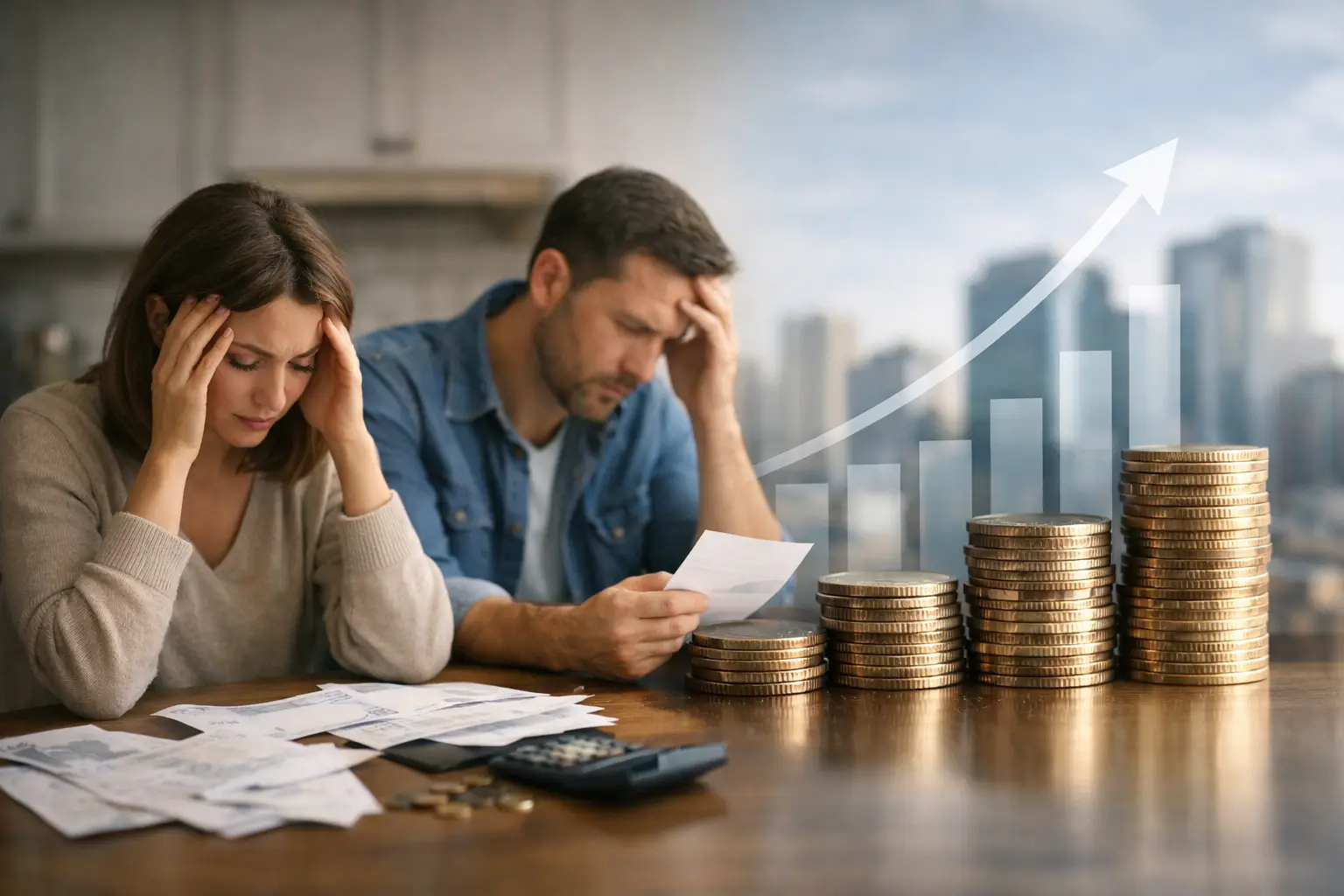
A headline says the economy grew. Then rent clears, the grocery bill lands, and the credit card balance quietly becomes next month’s problem. That gap is the whole reason why GDP misses household stress. It tells us how much economic activity happened. It does not tell us how manageable life felt while it was happening.
This is where public debate often goes off the rails. GDP gets treated like a national mood ring, as if a bigger number should settle the argument. If output is up, people should feel fine. If people do not feel fine, they must be misreading the data. Convenient theory. Not especially useful.
What GDP actually measures
Gross domestic product measures the value of goods and services produced in an economy over a period of time. That makes it useful. If GDP is rising, the economy is generally producing more. Businesses may be investing, consumers may be spending, and incomes may be growing somewhere in the system.
But GDP is a production measure, not a household condition measure. It counts market activity. It does not ask whether that activity improved financial security, reduced anxiety, or made basic life more affordable.
If a city has a construction boom, legal fees surge, insurance costs rise, and health spending climbs, GDP can look stronger. None of that guarantees households are under less strain. In some cases, the opposite is true. More spending can reflect pressure, not prosperity.
That distinction matters because people do not live inside national aggregates. They live inside monthly budgets.
Why GDP misses household stress in real life
The cleanest way to see the problem is to separate total output from lived affordability. A country can produce more overall while the median household feels pinned down by a few very specific costs.
Housing is the obvious example. If home prices and rents rise faster than wages, households feel poorer even in an expanding economy. GDP may benefit from real estate activity, construction, and related services. The family trying to renew a lease is less impressed.
The same goes for debt service. Higher interest rates can boost income for savers and help cool inflation, but they also raise payments on variable-rate debt, new mortgages, car loans, and business credit. GDP can remain positive while households shift from spending freely to juggling obligations.
Then there is inflation itself. Official inflation may cool from a peak, which is good. But prices do not return to their old level just because the rate of increase slows. Families still face the higher base. When wages lagged during the run-up, the damage did not vanish because the chart got less dramatic.
Subscribe To Our Newsletter!
This is one reason people often feel gaslit by economic messaging. They hear that inflation is down, growth is up, and the labor market is solid. All can be true. Their rent can also be 30 percent higher than it was a few years ago. Reality has room for both facts.
The average economy is not the median household
A deeper issue is distribution. GDP is an aggregate number. It says nothing on its own about who received the gains.
If high-income households and asset owners capture most of the upside from growth, GDP can look healthy while the middle of the income distribution treads water. Equity markets rise, corporate profits improve, luxury spending holds up, and the national numbers stay respectable. Meanwhile, households with little savings and high exposure to essentials feel every price increase immediately.
This is not a statistical glitch. It is the difference between totals and typical experience.
The same economy can contain a booming top tier and a stressed middle at the same time. In fact, that split helps explain why debates about the economy often sound so disconnected. One person looks at payroll growth and market performance. Another looks at child care, insurance premiums, and the cost of replacing a car. They are describing different parts of the same system.
Why rising spending can hide strain
One of the more misleading habits in economic commentary is treating consumer spending as a clean sign of confidence. Sometimes it is. Sometimes it is just what people do when essentials cost more.
If households spend more on food, shelter, utilities, and health care, total consumption rises. GDP likes this. Household finances may not. Spending data rarely tells you whether purchases were discretionary, debt-financed, or simply unavoidable.
This is how stress can hide in plain sight. Families keep spending because they have to live somewhere, eat something, commute to work, and cover medical costs. They may fund that spending by drawing down savings, taking on debt, delaying retirement contributions, or cutting the few categories that make life feel flexible. Dinner out disappears. The streaming subscriptions get trimmed. The emergency fund stops growing. GDP does not mark those trade-offs in red ink.
A national account can record the transaction. It cannot record the sigh that came before it.
Labor markets matter, but job counts are not enough
A strong labor market usually helps households. More jobs and higher wages are better than the alternatives. But even here, GDP and headline employment numbers can miss important details.
What kind of jobs were added? Are wages keeping up with housing and insurance costs? Are workers taking second jobs or extra hours to maintain the same standard of living? Has bargaining power improved, or are people just running harder on the same treadmill?
A low unemployment rate can coexist with financial fragility. Someone can be employed, even fully employed, and still feel economically exposed. If one missed paycheck would trigger serious trouble, the labor market is not telling the whole story.
This is where the popular shorthand breaks down. Having a job is not the same as having slack in the budget. It is possible to be statistically secure and personally stressed.
What measures get closer to household reality
If the goal is to understand whether people are actually coping, GDP needs company. A better picture comes from combining output data with household-centered measures.
Real median income is one useful check because it focuses on the middle rather than the total. Housing affordability matters because shelter is not optional. Debt delinquency rates can reveal strain before it becomes a crisis. Savings rates and liquid cash buffers help show whether spending is being sustained from income or from financial erosion.
Consumer sentiment also matters, though carefully. People are not always precise economists, but they are usually good at noticing when daily life is getting tighter. Sentiment should not replace hard data. It should challenge analysts to ask whether the hard data is capturing the right thing.
Another valuable lens is the share of income going to necessities. When more of a paycheck is absorbed by housing, food, transportation, health care, and debt payments, the room for error shrinks. That shrinking margin is often what people mean by stress.
Why this gap keeps showing up in politics and media
The argument over economic reality is often less about facts than about scale. Policymakers and commentators talk at the level of the nation. Households experience the economy at the level of the week.
That mismatch creates a predictable pattern. Officials point to GDP growth, business investment, and resilient consumption. Voters respond that life feels expensive and precarious. Each side thinks the other is ignoring reality. More often, they are looking through different windows.
There is also a messaging problem. Aggregate indicators sound authoritative, so they get repeated. Household stress is messier. It shows up in skipped purchases, delayed moves, rising balances, and a constant sense that one surprise expense could break the month. That does not fit neatly into a triumphant press release.
Still, it is the part people actually live.
Why GDP misses household stress – and why that matters
None of this means GDP is useless. It is an essential measure of economic scale and direction. If output collapses, households usually suffer. If output grows, that creates possibilities. But possibilities are not outcomes.
The mistake is treating GDP as a proxy for broad well-being. It is not designed for that job. It can signal momentum without telling you whether the gains are affordable, evenly shared, or durable at the kitchen-table level.
A calmer way to read the economy is to stop asking one number to answer every question. GDP can tell us whether the machine is producing. It cannot tell us whether families feel stable inside it.
That is not pessimism. It is just cleaner thinking. And in a conversation this noisy, cleaner thinking is already a pretty good start.