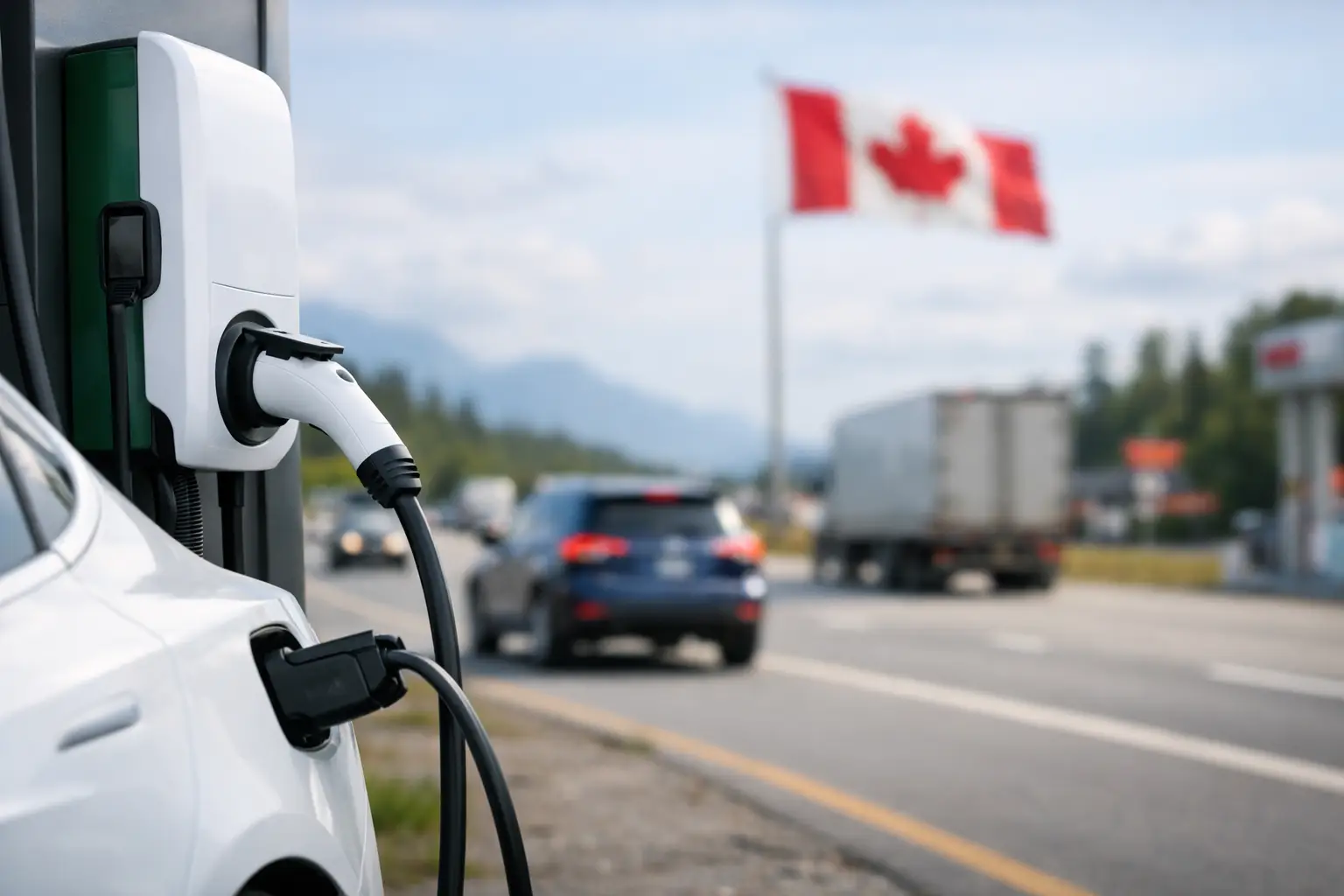
The headline version of EV adoption in Canada sounds simple: sales are up, governments are pushing hard, and the future is clearly electric. That is the public narrative, anyway. The real picture is less dramatic and more useful. Canada is not moving at a single pace, consumers are not making a single kind of decision, and policy targets are doing a lot of work that market conditions have not fully earned.
That distinction matters. If you are trying to understand where the market is actually headed, optimism alone is not analysis.
Quick Answer: Electric Vehicle (EV) adoption in Canada is growing rapidly, with zero-emission vehicles (ZEVs) accounting for approximately 14-15% of new vehicle sales in 2024, rising to over 18% in some areas by late 2024. As of early 2026, the new Electric Vehicle Affordability Program (EVAP) offers up to $5,000 for qualifying vehicles, aiming to accelerate adoption towards mandated 2030 targets.
EV adoption in Canada is real, but uneven
Electric vehicle sales in Canada have grown meaningfully over the past several years. In some provinces, especially Quebec and British Columbia, EVs have moved beyond niche status and into the mainstream new-car conversation. In others, they remain a smaller urban phenomenon with limited reach outside higher-income buyers and fleet use.
This is the first gap that tends to get flattened in national coverage. A country can post a rising EV market share while still operating as several distinct

vehicle markets. Quebec benefits from strong hydro power, aggressive incentives, denser population clusters, and a policy environment that has pushed both supply and demand. British Columbia has similar structural advantages in key regions. Alberta, Saskatchewan, and much of Atlantic Canada operate under different conditions, with different distances, weather patterns, grid mixes, and consumer preferences.
So yes, EV adoption in Canada is increasing. But no, that does not mean a uniform transition is underway.
The incentives story is doing more heavy lifting than people admit
When demand rises after large rebates, tax advantages, and zero-emission sales mandates, the obvious question is whether we are seeing durable consumer preference or subsidy-shaped behaviour. That is not a criticism. It is just the question adults should ask before declaring a market settled.
Canadian federal incentives, combined with provincial rebates in places like Quebec and British Columbia, have materially lowered the upfront cost for eligible buyers. That has helped move buyers who were already EV-curious into action. It has also helped automakers prioritize inventory for provinces with the strongest policy support.
But incentives do not eliminate the core affordability issue. They soften it.
Subscribe To Our Newsletter!
For many households, the problem is not whether an EV is cheaper to run over eight years. The problem is whether they can afford the monthly payment right now. A middle-class buyer comparing a used gasoline SUV to a new electric crossover is not making a spreadsheet-perfect climate decision. They are making a cash flow decision. The public discussion often pretends that those are the same thing. They are not.
And this is where the tone of some EV coverage gets a little too tidy. If a product needs layered subsidies, infrastructure buildout, and regulatory pressure to achieve broad uptake, that does not mean it is a bad product. It means the market transition is still in progress, not complete.
Charging infrastructure is improving, but convenience still decides behaviour
A lot of EV debate gets framed around range, as if consumers are obsessing over edge-case road trips. Some are. But for many people, the real issue is routine friction.
If you own a home with a driveway and can install Level 2 charging, the EV experience is often straightforward. You charge overnight, avoid gas stations, and the vehicle fits neatly into daily life. If you live in a condo, rent an apartment, rely on street parking, or drive long rural routes, the calculation changes fast.
This is why national charger counts can be misleading. A country can add thousands of public chargers and still leave large parts of the population with an inconvenient ownership experience. What matters is not just the number of chargers. It is where they are, whether they work, how fast they charge, how often they are occupied, and whether they align with actual travel patterns.
The infrastructure challenge is not unsolvable. It is just more mundane than the slogans suggest. Wide adoption depends less on symbolic announcements and more on boring execution – apartment retrofits, grid upgrades, highway reliability, payment interoperability, and maintenance. Not glamorous, but then neither is being stranded with a 12 percent battery in February.

Canada has a geography problem, not just a policy challenge
Canada is large, cold, and in many regions sparsely populated. Those are not anti-EV talking points. They are operating conditions.
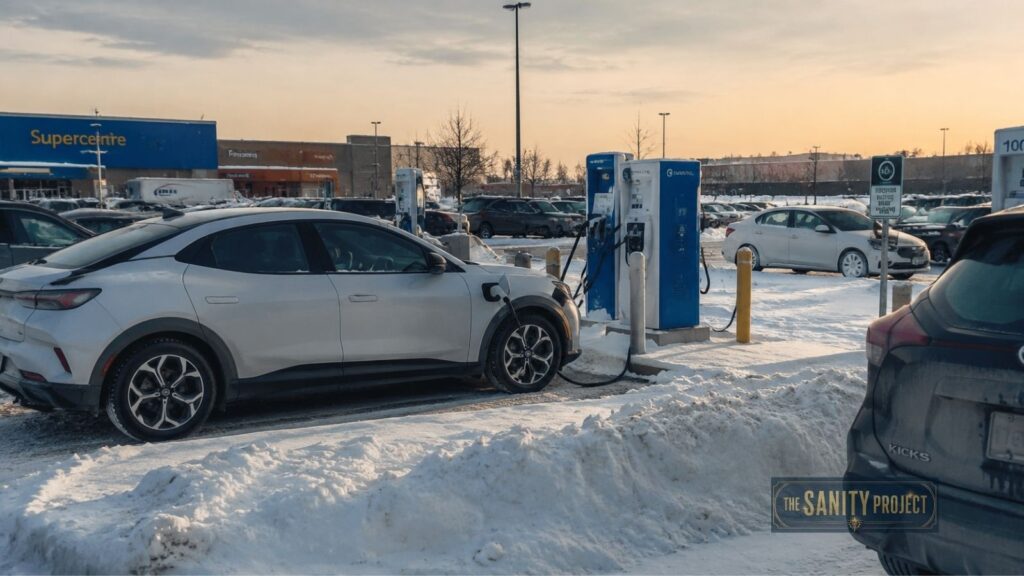
Cold weather affects battery performance and charging speed. Longer travel distances increase the importance of dependable fast charging. Rural and northern communities face infrastructure economics that look very different from downtown Montreal or Vancouver. If policymakers treat EV adoption as a single national rollout problem, they risk designing for the easiest markets and calling it universal progress.
That is partly why sales targets can sound more confident than reality on the ground. Mandates can pressure manufacturers to bring more EVs into the market. They cannot, by themselves, make rural charging profitable, reduce winter range anxiety, or turn older multifamily housing stock into easy-charging environments.
There is also an energy-system wrinkle that gets less attention than it should. Electrifying transport at scale requires generation, transmission, and local distribution capacity to keep up. In hydro-rich provinces, that alignment is easier. In provinces with different grid profiles or infrastructure constraints, the path is more complicated. Again, not impossible. Just inconvenient for neat narratives.
The next phase of EV adoption in Canada depends on who buys next
Early adopters are not the whole story anymore. The next buyers are more price-sensitive, less patient, and less interested in being part of a transition story. They want a vehicle that works, costs less, and does not create lifestyle hassles.
That changes the market.
Luxury EVs and high-income urban households helped establish momentum, but mass adoption will be won or lost in more ordinary segments – compact crossovers, used vehicles, fleet replacements, and households with one car that has to do everything reasonably well. If the industry cannot meet those buyers where they live financially, adoption rates may keep rising even as it underperforms the rhetoric around it.
The used market matters here, too. A healthy auto transition cannot rely forever on new-vehicle buyers. Broad adoption requires confidence in resale value, battery longevity, repair networks, insurance treatment, and the availability of affordable secondhand EVs. Canada is still building that ecosystem. It exists, but it is not yet mature enough to make the transition feel routine for most households.
What the public narrative gets right – and what it misses
The bullish case is not fake. Battery technology has improved. More models are available. Operating costs can be lower. Policy momentum is real. In major urban corridors, EVs are becoming normal.
But the skeptical case is not fake either. Purchase prices remain high. Public charging still feels patchy for many users. Regional differences are substantial. Consumer adoption outside favourable policy environments is slower than the cleanest charts imply.
The mistake is treating either side as complete.
Canada is neither failing at EV transition nor racing toward a frictionless electric future. It is doing what large, complex economies usually do: moving unevenly, with policy pulling ahead of infrastructure in some places and consumer behaviour lagging behind ambition in others.
That may sound less exciting than the standard hot takes. Good. Excitement is overrated in public analysis.
So what should people actually watch?
If you want to understand where this goes next, watch three things. First, watch whether affordable EV models gain real traction without unusually generous incentives. Second, watch whether charging access improves for renters and multifamily housing, not just suburban homeowners. Third, watch provincial divergence. If adoption continues to concentrate in a few favourable regions, the national story will remain stronger on paper than in practice.
The broader point is simple. EV adoption in Canada is not a yes-or-no question. It is a distribution question, an affordability question, and an infrastructure question disguised as a culture-war argument.
And once you strip away the slogans, the path forward looks less like a revolution and more like a long systems upgrade – slower than advocates promise, faster than skeptics assume, and far more dependent on practical details than public messaging likes to admit.
That is usually how real change works. Quietly, unevenly, and with much less moral theatre than the internet would prefer.