The phrase “AI slop” has exploded across social media, journalism, and online culture. It’s now commonly used to describe low-quality AI-generated content flooding the internet: spam articles, surreal images, fake engagement posts, deepfakes, and automated misinformation campaigns.
And to be fair, some of the concerns are justified.
AI-generated misinformation is real. Deepfakes are becoming more convincing. Search engines are increasingly polluted with low-value content. Some AI systems confidently produce incorrect answers, fabricated citations, and entirely fictional information.
But beneath the panic lies something historically familiar.
Because every major communication breakthrough in human history — from the printing press to the typewriter to desktop publishing — triggered the exact same fear:
that new technology would destroy truth, creativity, and civilization itself.
The AI panic may feel unprecedented.
History suggests otherwise.
🗝️ Quick Answer
AI slop refers to low-quality, mass-produced AI-generated content designed primarily for volume, engagement, or manipulation rather than usefulness or accuracy. Critics argue AI content floods the internet with misinformation and noise, while supporters note that similar panic surrounded the printing press, cheap newspapers, typewriters, and desktop publishing before society eventually adapted.
Busy newsroom with journalists on phones and computers. Large red screens display what causes misleading headlines: Shocking Truth Revealed!, Scandal Explodes!, and social media stats. The intense, chaotic atmosphere fuels breaking news.
What Does “AI Slop” Mean?
The term “AI slop” has become shorthand for digital content that feels:
automated,
repetitive,
emotionally manipulative,
low-effort,
or factually unreliable.
Examples include:
AI-generated spam websites,
fake celebrity images,
engagement-farming Facebook posts,
fabricated political videos,
low-quality SEO articles,
and synthetic clickbait designed to exploit algorithms.
The phrase itself is intentionally emotional. Merriam-Webster traces the historical meaning of “slop” back centuries, originally referring to watery waste or low-quality food given to animals. In modern internet culture, the term has evolved to describe overwhelming quantities of low-value digital content.
And right now, artificial intelligence sits at the center of that cultural anxiety.
Why Are People Worried About AI Generated Content?
The fear surrounding AI generated content isn’t simply about quality.
It’s about trust.
For decades, most people assumed that creating professional-looking media required significant human effort, expertise, or institutional backing. Artificial intelligence changes that equation dramatically.
Today, a single user can generate:
articles,
videos,
images,
audio,
websites,
and even entire fictional identities
…within minutes.
That creates a new problem:
The cost of creating content has collapsed, but the cost of verifying truth has not.
This creates what researchers increasingly describe as asymmetric effort.
An AI system can generate thousands of words in seconds. But fact-checking those claims may take hours. A fake image can be created instantly, while proving it is fake may require forensic analysis.
That imbalance is one of the biggest reasons AI-generated content feels so destabilizing.
In a candlelit medieval stone scriptorium, monks in brown robes meticulously write and illuminate manuscripts at wooden desks, surrounded by towering bookshelves—an inspiring contrast to today’s ai generated content filling digital libraries.
The Printing Press Triggered Similar Fears
To understand why society reacts this way, we need to look backward.
Before Johannes Gutenberg’s printing press in the 1400s, books were rare and expensive. Knowledge was largely controlled by institutions such as the Church, wealthy elites, and universities.
Books had to be copied by hand, often by monks. Information moved slowly and remained concentrated among the powerful.
Then the printing press arrived.
And chaos followed.
Suddenly, ideas could spread rapidly and cheaply across Europe. Religious factions weaponized pamphlets and propaganda. Sensationalized misinformation exploded. Graphic woodcut illustrations were used to inflame fear and outrage among populations with widely varying literacy levels.
In many ways, Europe experienced its first large-scale misinformation ecosystem.
Authorities panicked.
The Catholic Church eventually created the Index Librorum Prohibitorum, a formal list of banned books intended to suppress dangerous or heretical ideas.
Sound familiar?
The same arguments used against modern AI-generated content were once used against the printing press itself:
misinformation,
dangerous ideas,
declining quality,
social destabilization,
and loss of institutional control.
But history also remembers something else.
The printing press enabled the Scientific Revolution. It spread the ideas of Copernicus, Galileo, and Newton. It dramatically expanded literacy and decentralized knowledge across Europe.
The same technology that amplified misinformation also accelerated human progress.
Victorian-era street scene of excited boys crowding a newsstand covered with illustrated penny dreadful magazines. A man in a top hat observes, unaware this bustling, historic London atmosphere is the product of cheap paper.
Cheap Newspapers Once “Corrupted Society”
The pattern repeated again in the 19th century.
Advances in cheap wood pulp paper dramatically lowered the cost of newspapers and books. Suddenly, literature and news became accessible to ordinary working-class readers.
Critics were horrified.
Cheap novels and “penny dreadfuls” were accused of:
corrupting morality,
encouraging crime,
weakening intelligence,
and poisoning young minds.
The logic was remarkably similar to today’s AI panic.
If information became too accessible, elites feared society would drown in low-quality content.
And to some extent, they were right.
Sensationalized media did explode.
But mass literacy exploded too.
The same communication revolution that created tabloid sensationalism also dramatically expanded public education and access to information.
History rarely gives us one without the other.
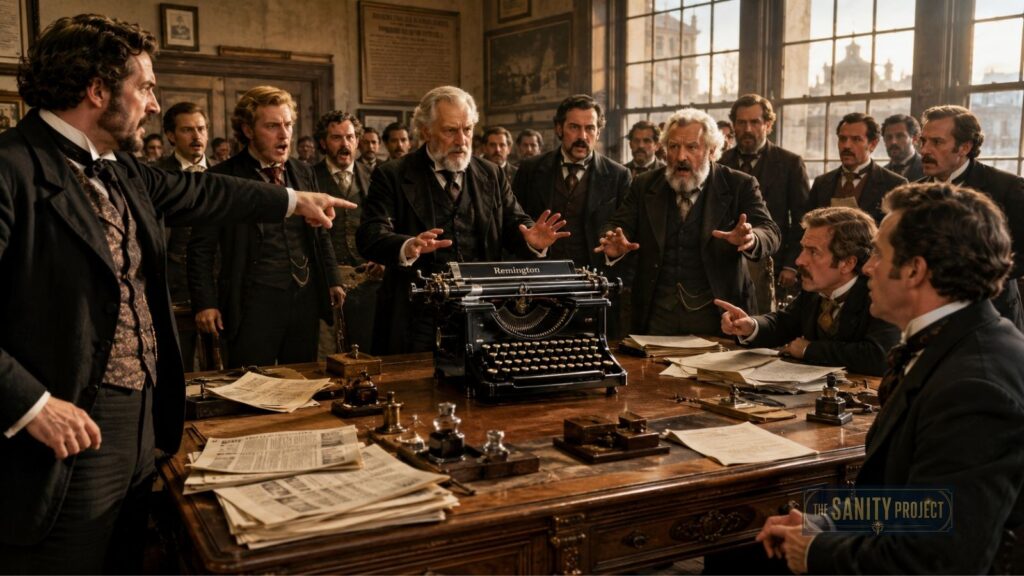
A group of Victorian-era men in suits passionately debate around a large wooden table with newspapers, a Remington typewriter. Many gesture or point amid the ornate, old-fashioned office surroundings.
The Typewriter Was Called a Threat to Human Creativity
Today, it feels absurd to imagine society fearing the typewriter.
But when the Remington typewriter appeared in the late 1800s, many professional writers reacted with panic. Critics argued mechanized writing would destroy craftsmanship, remove the human soul from language, and flood society with inferior writing produced by amateurs.
In reality, the typewriter democratized professional communication.
It lowered the barrier to creating legible, standardized documents. It expanded access to clerical and professional careers. It opened new economic opportunities for women entering office work for the first time at large scale.
Again, the same pattern emerged:
lower barriers,
wider participation,
more noise,
more access.
The panic was framed as a means of protecting quality.
But structurally, existing gatekeepers were losing control.
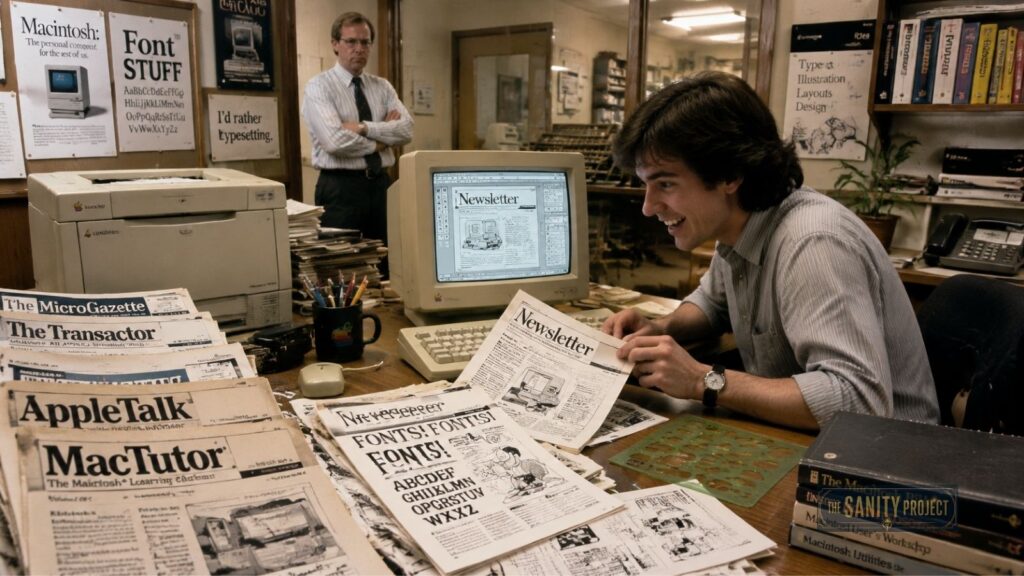
A young man enthusiastically shows a printed newsletter at a cluttered desk covered with papers about fonts, newsletters, and ai generated content. An old computer displays the same newsletter onscreen as a man in a tie watches from the office background.
Desktop Publishing Created “Content Chaos” Too
The cycle repeated again in the 1980s with desktop publishing software.
Programs like Aldus PageMaker and affordable laser printers allowed ordinary people to create newsletters, brochures, and magazines without expensive commercial publishing infrastructure.
Professional typesetters panicked.
And honestly?
Some of their fears were valid.
The world was flooded with ugly newsletters, terrible formatting, chaotic fonts, and amateur design disasters. Anyone who remembers early desktop publishing probably remembers the visual chaos it created.
But the deeper story mattered more.
Desktop publishing also allowed smaller voices, independent researchers, local communities, and developing nations to publish information without requiring institutional permission.
Researchers in parts of Africa, for example, suddenly gained the ability to publish scientific work locally without relying entirely on expensive Western publishing systems.
Once again, technology democratized participation while simultaneously increasing informational clutter.
Is AI Slop Actually Dangerous?
Yes — in some ways, absolutely.
Unlike previous communication revolutions, modern AI systems can generate highly convincing synthetic media at enormous scale.
Current risks include:
deepfake political videos,
AI-generated misinformation,
fabricated citations,
fake news automation,
synthetic propaganda,
and large-scale content farming.
Some AI search systems have also demonstrated alarming factual inaccuracy rates. A Columbia Journalism Review analysis found certain AI-powered search tools produced incorrect answers more than 60% of the time in testing.
That is not a minor problem.
Artificial intelligence can absolutely amplify misinformation faster than previous technologies.
But this is where an important distinction matters.
The danger often comes less from the tool itself and more from:
incentives,
human intent,
platform algorithms,
and a lack of verification systems.
A hammer can build a house or break a window.
Artificial intelligence works similarly.
A man in glasses sits at a desk with multiple monitors, analyzing data. Above him swirls a tornado of sensational headlines, images, ai generated content, and conspiracy theories—highlighting information overload and digital chaos. The Sanity Project logo appears at the bottom right.
The Mistake Society Keeps Making
One of the biggest problems in the modern AI debate is that society increasingly treats:
the technology itself,
and
deceptive human behavior
…as though they are identical.
They are not.
There is a massive difference between:
a propaganda network generating fake political deepfakes,
and
a researcher transparently using AI to organize, summarize, or translate legitimate information.
But culturally, many people are collapsing those distinctions into one emotional label:
“AI slop.”
Once that happens, nuance disappears.
And history suggests societies repeatedly make this mistake whenever information becomes easier to access.
Facts Are Medium Neutral
This may be the most important concept in the entire debate.
Facts are medium neutral.
A true statement does not become false because it was:
handwritten by a monk,
printed by Gutenberg,
typed on a typewriter,
published through desktop software,
or assisted by artificial intelligence.
The truth value of information has never depended on the instrument used to assemble it.
It has always depended on:
evidence,
verification,
transparency,
and human intent.
That standard has not changed.
And it never will.
Will Society Adapt to AI Generated Content?
History strongly suggests the answer is yes.
Human civilization has already adapted to:
printing press propaganda,
sensationalized newspapers,
radio panic,
television misinformation,
internet hoaxes,
and social media outrage cycles.
Messily.
Imperfectly.
But successfully enough to continue functioning.
Artificial intelligence will almost certainly follow the same trajectory.
The internet will likely become noisier. Verification systems will become more important. Digital literacy will become increasingly valuable.
But humanity will adapt — just as it always has.
The Bigger Pattern Behind Every Technology Panic
Every major communication breakthrough in history has done two things simultaneously:
It created more noise.
And it expanded access.
The printing press created propaganda — and the Enlightenment.
Cheap newspapers created sensationalism — and mass literacy.
Desktop publishing created clutter — and global participation.
Artificial intelligence will likely create:
more misinformation,
more spam,
more manipulation,
and more content pollution.
But it will also expand:
creativity,
accessibility,
participation,
education,
and democratized knowledge.
History rarely gives us one without the other.
Frequently Asked Questions About AI Slop
What is AI slop?
AI slop refers to low-quality AI generated content designed primarily for mass production, engagement farming, or manipulation rather than usefulness or accuracy. Examples include spam articles, fake images, automated clickbait, and synthetic misinformation.
Why is AI generated content controversial?
AI generated content is controversial because it can spread misinformation quickly, produce inaccurate facts, create convincing deepfakes, and make it harder for users to distinguish authentic information from fabricated media.
Is AI generated content always bad?
No. AI tools can also assist researchers, writers, educators, translators, and creators. The quality depends more on human intent, transparency, and verification than on the technology itself.
Why do new technologies always create panic?
Historically, nearly every major communication breakthrough — including the printing press, newspapers, radio, television, and the internet — triggered fears about declining quality, misinformation, and social harm before society eventually adapted.
Can AI replace human creativity?
AI can assist creative work, but human judgment, emotional understanding, originality, ethics, and lived experience remain essential to meaningful storytelling, research, and analysis.
Final Thoughts
The phrase “AI slop” may survive.
But history suggests the panic surrounding it probably won’t.
Because eventually, every generation normalizes the tools it once feared.
The printing press became civilization itself. The typewriter became invisible. Desktop publishing became standard.
And someday, artificial intelligence may simply become another ordinary layer of how humans create, organize, and communicate information.