The Geopolitics of Canadian Air Power
For nearly three decades, Canada’s defence strategy has been paralyzed by the replacement of its geriatric CF-18 fleet. What began as a technical hardware upgrade has morphed into a profound geopolitical crossroads. The choice between the F-35 and the Saab Gripen isn’t just a selection of airframes; it is a referendum on Canada’s national identity. For too long, the Department of National Defence (DND) operated under a framework designed by the people who wanted the plane to evaluate whether Canada should buy it. This wasn’t a competition; it was a confirmation.
The “So What?” layer here is stark: a total commitment to the F-35 is a voluntary surrender to U.S. bureaucratic dependency. Conversely, the Gripen represents a pivot toward Canadian industrial autonomy. As the High North becomes a theatre of renewed great-power competition, Canada must decide if its air force is a sovereign tool for homeland defence or merely a vassal auxiliary for U.S. power projection. These two aircraft represent diverging philosophies: one built for “day one” of a world war, and one built for the missions Canada actually flies every single day.
Quick Answer
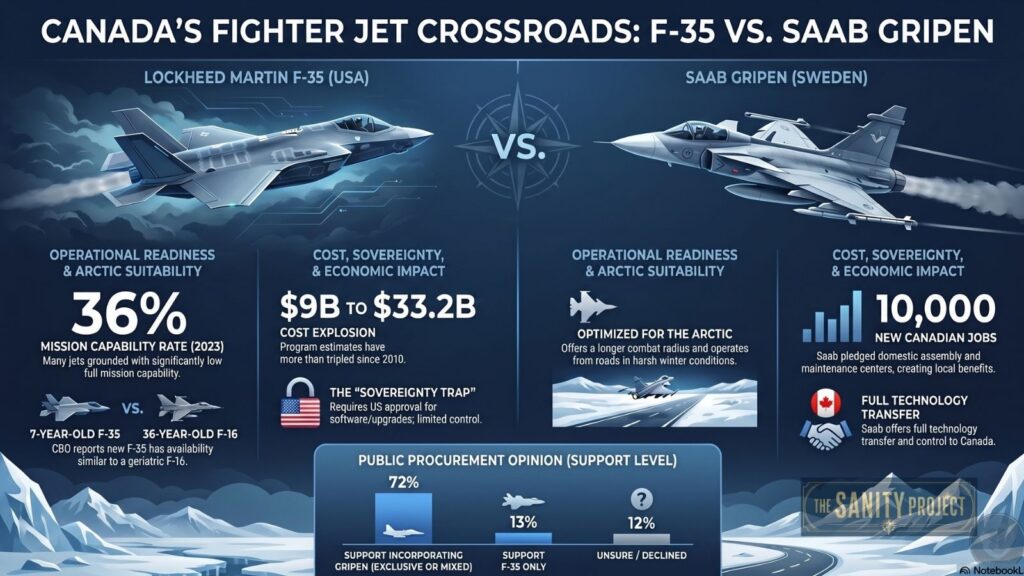
Canada’s fighter jet procurement has reached a strategic breaking point where the perceived prestige of the Lockheed Martin F-35 has finally collided with the uncompromising reality of Arctic sovereignty. While the F-35 was long presented as an inevitable choice by a defence establishment deep in “institutional capture,” its persistent “Readiness Catastrophe”—highlighted by a 2023 full-mission-capable rate of only 36%—and ballooning costs, now estimated at $33.2 billion, have shattered the narrative of its superiority.
The Saab Gripen E has re-emerged as the rational alternative, offering a platform specifically engineered for the High North’s harsh climates and sparse infrastructure. With 72% of Canadians now backing a shift toward the Gripen in a dual-fleet model, the debate is no longer about hypothetical stealth but about the practical, fiscal, and sovereign survival of the Royal Canadian Air Force.
——————————————————————————–
II. Operational Realities: Readiness and Arctic Suitability
Beyond Stealth: Evaluating the Saab Gripen in the Canadian Arctic
Stealth is the ultimate marketing hook for a fifth-generation jet, but it is a secondary concern for a pilot grounded by maintenance failures. When we evaluate the Saab Gripen against the F-35 in the context of Canada’s 10 million square kilometres of unforgiving territory, the “stealth advantage” begins to look like a strategic liability.
The Mission Capable Rate Crisis
Let’s talk facts: the F-35 is currently mired in a “Readiness Catastrophe.” A 2025 Canadian Forces College paper revealed that the F-35A’s full mission capable (FMC) rate—the ability to perform its entire mission profile—was a pathetic 36% in 2023. This is far below the 75-80% NATO standard. The Congressional Budget Office (CBO) 2025 report offered the most damning “Geriatric Comparison” yet: a brand-new, seven-year-old F-35A exhibits the same availability as a 36-year-old F-16. Your tax dollars are essentially purchasing a brand-new jet, even though a geriatric one is available.
Operating in the High North
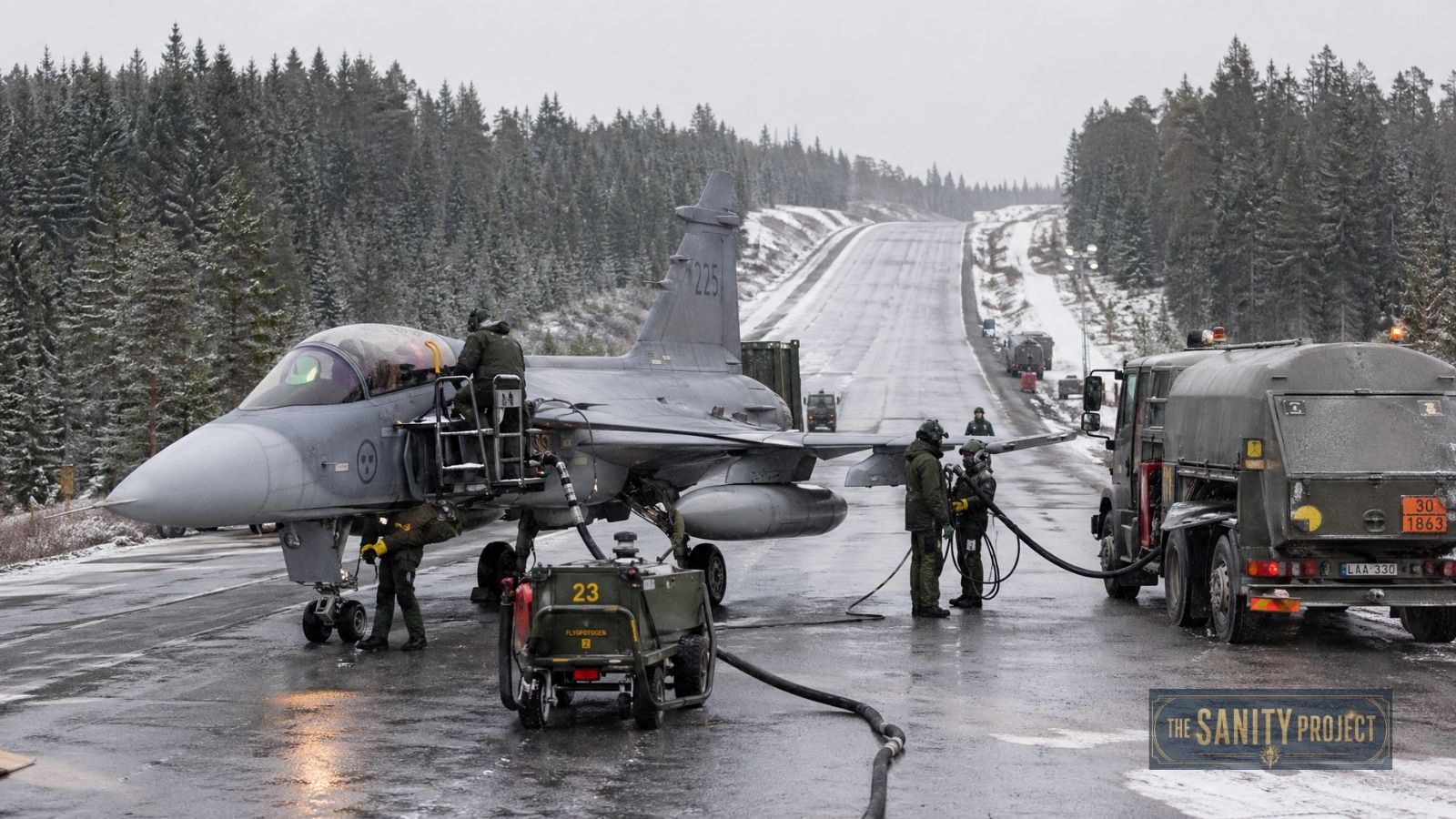
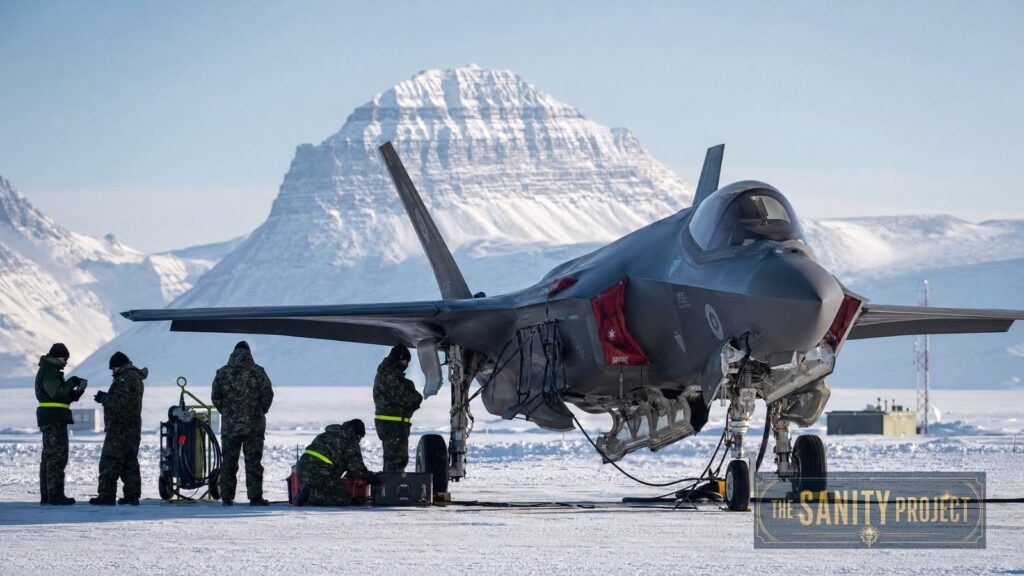
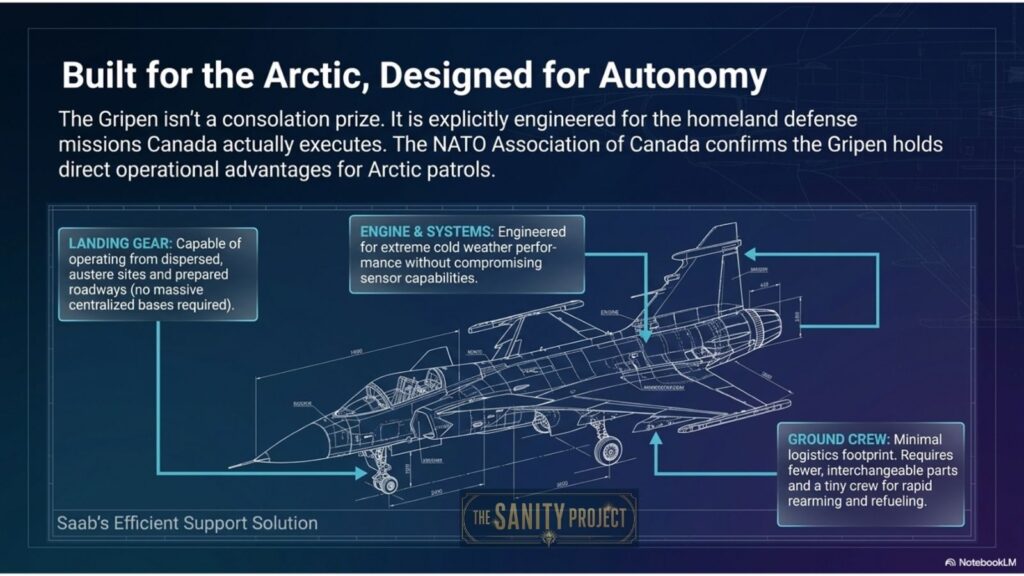
Canada’s Arctic frontier is an environment where logistics go to die. This is where the Saab Gripen’s “Efficient Support Solution” shines. Designed for the Swedish dispersed-base doctrine, the Gripen can operate from prepared roads and austere remote sites with a minimal footprint. While the F-35 requires specialized, climate-controlled infrastructure and a small army of technicians, the Gripen can be refuelled and rearmed by a handful of conscripts in the snow.
For routine intercepts and sovereignty patrols in regions where runways are few and infrastructure is sparse, the Gripen’s superior combat radius (800 miles vs. 670 miles) and cold-weather engineering make it the only logical choice for Arctic enforcement.
Fighter Jet Operational Comparison
| Feature | F-35A | Saab Gripen E |
| Combat Radius (miles) | 670 | 800 |
| Mission Capable Rate (%) | 36% (Full) | Optimized for High Availability* |
| Maintenance Footprint | High / Complex | Low / Minimal |
| Infrastructure Requirements | Conventional/Specialized Runways | Prepared Roads / Austere Bases |
| *While a younger aircraft, all signs point to significantly higher readiness than the F-35’s 36%. |
Here’s the problem with the F-35: a jet that cannot fly reliably in the cold is not a defence asset; it is an $80 billion paperweight.
Subscribe To Our Newsletter!
III. The Financial Trajectory: From $9 Billion to a National Scandal
Deconstructing the F-35 Cost Explosion
The fiscal history of Canada’s F-35 procurement is a masterclass in institutional deception. Every estimate ever attached to this program has been revised upward. That is not a record; that’s a pattern.
The Bottomless Invoice: $33.2 Billion and Counting
In 2010, the Harper government pitched 65 jets for $9 billion. By 2023, the Trudeau government admitted to $19 billion for 88 jets before a single plane arrived. In June 2025, Auditor General Karen Hogan dropped the hammer: the true acquisition cost is now $27.7 billion, plus an additional $5.5 billion just to reach full operational capability. That is $33.2 billion minimum. As the Sanity Project puts it: “You don’t own the plane. You own the invoice.”
Long-term Sustainment and the Saab Gripen Alternative
While the F-35’s sustainment costs skyrocket, Canada is also paying for a capability that literally does not exist. The “Block 4” modernization package is currently $6 billion over budget and won’t be ready until 2031 at the earliest. Canada is buying a 2023 airframe and waiting nearly a decade for the advertised performance. The Saab Gripen offers a predictable alternative: lower flight-hour costs, interchangeable parts, and an upgrade path that doesn’t require begging a foreign bureaucracy for software keys.
Procurement Cost Evolution (Timeline of Revisions)
- 2010: $9 Billion (Initial DND estimate for 65 jets)
- 2023: $19 Billion (Revised price for 88 jets)
- 2025: $27.7 Billion (Auditor General acquisition figure)
- 2025 (Current): $33.2 Billion (Total cost including $5.5B for operational capability)
But hey—at least the lobbyists got paid. These pressures are finally forcing a pivot toward a rational “dual-fleet” model.
——————————————————————————–
IV. Sovereignty vs. Interoperability: The Strategic Dilemma
The Sovereignty Trap: Who Really Controls the Kill Switch?
The F-35 is not a purchase; it is a “contractual embrace.” This is the core of the “Sovereignty Trap”—a reality where Canada pays billions for hardware it does not truly control.
Software Control and the “Leash” Argument
The U.S. retains absolute control over the F-35’s software, mission-system access, and classified data. This is a strategic leash. In an era where a U.S. President has openly questioned Canadian sovereignty and even threatened annexation or sovereignty violations, handing the “kill switch” of our primary defence asset to Washington is a strategic vulnerability. When the country threatening your sovereignty also controls the software in your fighter jets—that’s not an alliance. That’s a leash.
Industrial Benefits: 10,000 Jobs and Tech Transfer
The Saab Gripen offer is a direct rebuttal to this vassalage. Saab has promised full technology transfer, domestic assembly, and in-country maintenance. This would create approximately 10,000 jobs and ensure that Canada owns the knowledge required to sustain its fleet. Choosing the Gripen is an assertion that Canada is a sovereign state, not a “branch office” of the U.S. defence industry.
V. The People’s Verdict: Public Opinion and the Path Forward
The 72% Majority: Why Canadians Favour the Saab Gripen
The public has seen through the procurement mythology. A December 2025 EKOS Politics poll shows that 72% of Canadians now favor incorporating the Gripen into the fleet, with only 13% supporting a continued F-35-only path.
Partisan Alignment and the Carney Review
This shift is cross-partisan, though particularly strong in Quebec, where voters lean toward the mixed-fleet model. This sentiment culminated in Prime Minister Mark Carney’s formal 2025 review of the F-35 deal. With the Carney Review weighing the catastrophic 36% readiness rates against the industrial sovereignty of the Swedish offer, the “Sanity Project” outcome of a dual-fleet approach—using the F-35 for niche stealth and the Gripen for the bulk of Arctic missions—is the only politically viable path left.
——————————————————————————–
VI. Conclusion: The Rational Path to Aerial Sovereignty
The verdict is clear: the F-35 is a remarkable tool designed to penetrate Russian airspace on “day one” of a war Canada will never fight alone. For the routine Arctic patrols that define our actual defence requirements, it is “overkill” and chronically unreliable. To commit our entire aerial defence to a platform that flies one day out of three is a failure of leadership. The Saab Gripen represents a rational, sovereign, and fiscally responsible choice. It is time for Canada to stop owning the invoice and start owning the plane.

VII. FAQ: Most Common Questions on Canada’s Jet Procurement
- Why is the Saab Gripen considered better for the Arctic? The Gripen features an 800-mile combat radius and “Efficient Support Solution” engineering. It operates from prepared roads in extreme cold with minimal logistics, making it ideal for Canada’s vast, infrastructure-sparse northern territories where the F-35’s heavy footprint is a liability.
- What is the “Full Mission Capable” rate of the F-35? According to a 2025 Canadian Forces College paper, the F-35A’s full mission capable rate was only 36% in 2023. This means on any given day, nearly two-thirds of the fleet is grounded and unable to perform its full mission profile.
- Will Canada still buy any F-35s? Canada has already ordered 16 F-35s. However, Prime Minister Mark Carney’s formal review has put further orders in question, favouring a dual-fleet approach that relies on the Saab Gripen to meet the majority of Canada’s sovereign air defence needs.
——————————————————————————–
Google SEO Title: Saab Gripen vs F-35: The Battle for Canada’s Skies Subtitle: Analyzing the F-35 Procurement Financial Crisis. Google Meta: Explore why the Saab Gripen is challenging the F-35 for Canada’s Arctic defence. We analyze costs, sovereignty, and the 72% support for a dual-fleet model.
Resources Used:
- Canadians Favour Gripen over F-35 – EKOS Politics (Dec 2025)
- Caught between Allies and Autonomy: F-35 vs Gripen – NAOC (April 2026)
- The Sanity Project Research Brief: Canada’s $80 Billion Mistake
- Hush-Kit Aviation: Why the Gripen vs F-35 Debate Isn’t About Hardware (Nov 2025)
- CBO: Availability, Use, and O&S Costs of F-35 Fighter Aircraft (June 2025)