A county board meeting about a wind or solar project usually sounds like a fight about scenery, noise, or politics. But underneath all that, the real question is simpler: what is the wind solar farms rural areas economic impact once the press releases fade and the construction crews leave?
That question gets mishandled in both directions. Critics often treat renewable projects as a pure extraction play dressed up in green branding. Supporters can sound like every turbine arrives carrying jobs, prosperity, and a marching band. Reality, as usual, is less cinematic and more useful.
What wind solar farms in rural areas actually change
For rural communities, large energy projects are not abstract climate symbols. They are land-use decisions with local winners, local losers, and very uneven timing. A wind farm or utility-scale solar project can bring lease payments, short-term construction jobs, new tax revenue, and spending at local businesses. It can also change viewsheds, strain roads during construction, create disputes between neighbors, and raise a fair question about who really captures the long-term value.
That mix matters because rural economies tend to be narrow. A modest increase in tax base or landowner income can have an outsized effect in a county with limited industry. At the same time, a project that looks big on paper can disappoint if most specialized labor, equipment, and profits come from elsewhere. The headline number is rarely the whole story. Convenient, but false.
The most visible upside is landowner income
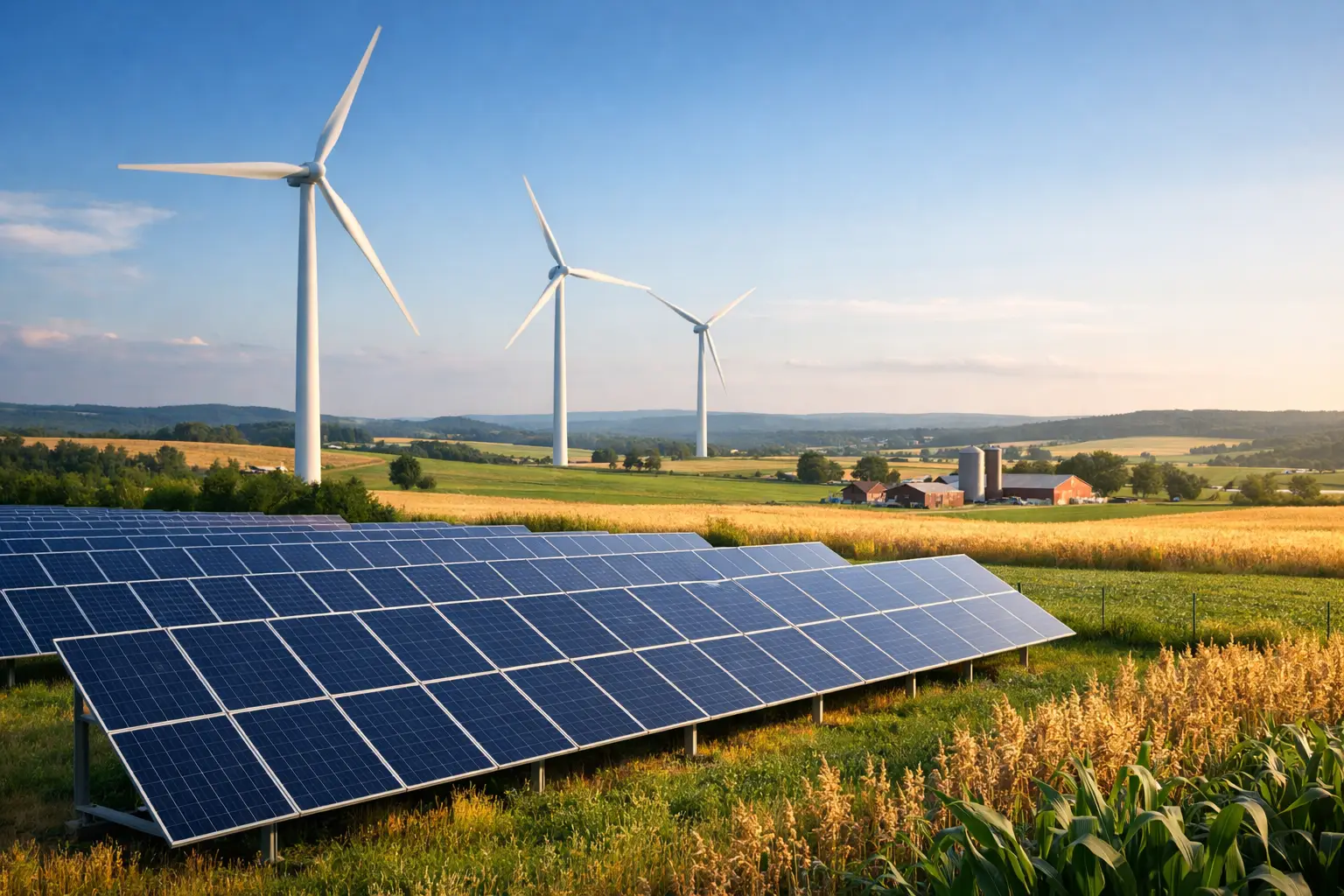
If you strip away the rhetoric, one of the clearest economic benefits is lease revenue paid to landowners. Wind projects often allow farmers and ranchers to keep using most of their land, since turbines occupy relatively small footprints. Solar uses more contiguous acreage, so the trade-off with farming can be larger, though some projects combine grazing or pollinator-friendly ground cover with energy production.
For participating landowners, lease income can be meaningful and stable. That matters in places where farm income swings with commodity prices, weather, and borrowing costs. A predictable annual payment can help keep a family operation afloat, support debt servicing, or fund succession planning.
But this benefit is concentrated. If your property hosts turbines or panels, you may do well. If your property sits nearby and you dislike the visual change, you may feel like you are subsidizing someone else’s check. Economically, that is not a small side issue. Distribution shapes local politics more than averages do.
Why the jobs story gets overstated
Developers are not wrong to talk about jobs. Construction does create a burst of labor demand. Hotels fill up, restaurants get busier, fuel and materials move, and some local contractors benefit. In counties that have seen little investment for years, that activity is noticeable.
The problem is duration. Construction jobs are temporary by definition, and operations jobs are far fewer once a project is running. A utility-scale solar site may need only a modest ongoing workforce. Wind farms require technicians and maintenance staff, but still not hundreds of permanent local positions.
So the honest version is this: renewable projects can create jobs, but they are better understood as capital-intensive infrastructure than as broad-based employment engines. If a town is expecting a manufacturing-style labor boom, it is likely to be disappointed. If it is expecting supplemental employment and some spillover spending, that is more realistic.
Subscribe To Our Newsletter!
Tax revenue can matter more than payroll
In many rural areas, the strongest public-case argument is not jobs but tax base. Wind and solar projects can increase local property tax revenue or payments in lieu of taxes, depending on state rules and project agreements. That money can support schools, emergency services, roads, and county budgets without raising rates on existing residents.
This is where context matters. In a fast-growing suburban county, one energy project may barely register. In a sparsely populated rural county, it can materially change public finances. School districts in particular may benefit if new revenue stabilizes budgets that were previously tied to a thin local tax base.
Of course, there is a catch because there is always a catch. Tax incentives and abatements can reduce the near-term fiscal gain. Some communities also underestimate road repair costs tied to heavy construction traffic. If officials negotiate weak agreements, the county may absorb wear and disruption while receiving less revenue than advertised.
The project itself is not the whole economic outcome. The contract is.
What happens to local businesses
Local business effects are real, but they are often lumpy rather than transformational. During construction, hospitality, food service, fuel suppliers, equipment rental firms, and some trades can see a clear uptick. Landowners receiving lease payments may also spend more locally, especially in smaller communities where additional household income tends to circulate through farm supply stores, vehicle dealers, banks, and retail.
That said, many high-value components and specialized services are sourced outside the county and often outside the state. Turbines, panels, inverters, engineering services, and major financing flows are usually not local. So while rural communities host the physical asset, they do not necessarily capture the largest share of the value chain.
This is one reason public debate often feels so mismatched. One side says the project brings millions. The other side says locals get scraps. Both can be partly right, depending on which part of the revenue stream they mean.
The harder question: do wind and solar projects hurt property values?
This is where certainty tends to outrun evidence. Some residents assume nearby homes will inevitably lose value. Some advocates dismiss the concern as myth. Neither response is especially serious.
The evidence from different regions is mixed and often highly specific to property type, project scale, visibility, distance, and local market conditions. Agricultural land under lease may gain income value. Rural residential properties with strong scenic appeal may face more buyer resistance if views change substantially. In some markets, effects appear limited or hard to detect. In others, there may be localized downward pressure.
The useful takeaway is not that property values never change or always collapse. It is that impacts are uneven. Counties should treat this as a site-specific planning issue, not a slogan war.
Wind versus solar in rural economic terms
Wind and solar are often grouped together, but their local economics differ.
Wind generally has a smaller direct land footprint per turbine, which can make it easier to coexist with farming or ranching. Lease payments may therefore function as added income on otherwise productive land. Solar typically uses more surface area and can create a clearer land-use substitution, especially where prime farmland is involved.
On the other hand, solar can be faster to build and in some cases easier to scale in a modular way. It may also trigger fewer moving-part maintenance demands over time. For communities, the choice is not just renewable versus non-renewable. It is which project design fits local land, transmission access, zoning goals, and economic priorities.
Why rural opposition is not just cultural resistance
It is tempting to explain local opposition as backwardness, NIMBYism, or partisan reflex. Sometimes those factors play a role. They are not the whole picture.
Rural residents are often being asked to accept a permanent visual and land-use change in exchange for benefits that are partly temporary, partly concentrated, and partly uncertain. That is not irrational. It is a bargaining position.
If a community believes the developer is underpaying for local disruption, resistance makes economic sense. If the tax terms are strong, siting is thoughtful, road agreements are clear, and residents trust enforcement, acceptance tends to improve. Amazing how people become less ideological when the math stops looking one-sided.
The bigger economic picture
There is also a macro layer that gets lost in local fights. Rural America has long supplied the country with commodities, fuel, water, and land while struggling to retain population, services, and bargaining power. Wind and solar projects fit into that pattern. They can provide new revenue streams to places that need them, but they can also reproduce an old dynamic where outside capital captures most of the upside while locals absorb the friction.
That does not make renewable development bad. It makes governance important.
The strongest rural outcomes usually come from boring things: competitive lease terms, transparent tax agreements, decommissioning requirements, road-use protections, realistic job claims, and local planning that recognizes both private property rights and neighborhood effects. None of that fits neatly on a yard sign, but it matters more than the slogans do.
So what is the actual economic impact? Wind and solar farms can help rural areas, sometimes substantially, especially through lease income and public revenue. They can also disappoint when communities are sold a labor-market miracle or when contracts leave too much value on the table. The smart question is not whether these projects are good or bad in the abstract. It is who gets paid, for how long, under what terms, and what the community gives up in return.
That is usually where the sanity starts.