In October 2025, the government in Beijing quietly signed a piece of administrative paper. Nothing dramatic. Just a standard bureaucratic update. And then the Pentagon went into crisis mode.
What China had done was restrict the export of five very specific metals, Canada’s critical minerals, such as erbium, holmium, thulium, europium, and terbium. Names that sound like they belong in a science fiction screenplay. But here’s the reality: without them, modern fighter jets cannot fly. Without them, the high-performance electric vehicles the world is supposedly racing to build simply do not function. And with that single bureaucratic signature, Beijing had effectively held a gun to the head of the entire allied industrial base.
In that moment of sheer strategic desperation, every defence planner in Washington, every automotive CEO in Stuttgart, every energy minister in Tokyo looked up from their spreadsheets. And they all looked in the same direction.
They looked at Canada.
That story is not hypothetical. It happened. And it tells you everything you need to know about why the conventional narrative around Canada’s economic position — the one that describes it as a middling trading partner, a resource-dependent underachiever, a country that basically lives off American goodwill — is not just wrong. It is spectacularly, almost comically, wrong.
🗝️ Quick Answer
Canada sits atop one of the most strategically valuable inventories of critical minerals on earth, including lithium, nickel, cobalt, graphite, and rare earth elements — the exact materials required to build EV batteries, wind turbines, and advanced defence systems. With China controlling 60 to 80% of global critical mineral processing and actively weaponizing that dominance, allied nations are mobilizing billions in capital to secure Canadian supply. Canada isn’t a junior partner in this equation. It built the table.
Key Takeaways
- 🌍 The global economy has shifted from a fuel-intensive system to a materials-intensive one — and Canada holds the materials.
- 🔋 Canada officially recognizes 31 critical minerals essential to clean energy, defence, and economic security.
- 🇨🇳 China controls 92% of global rare earth production and has already demonstrated its willingness to use that as a geopolitical weapon.
- 💰 $18.5 billion in allied capital was mobilized at a single Canadian mining convention in March 2026.
- 🔬 Canadian companies are pioneering molecular-level mineral extraction from e-waste and industrial waste — bypassing traditional mining entirely.
The Old Scorecard Is Dead
For decades, we measured national economic power the same way. Trade balances. Manufacturing output of finished goods. The price of a barrel of crude oil. That framework worked reasonably well for the twentieth century. It is completely useless for the twenty-first.
The shift is fundamental. We are moving from a fuel-intensive energy system to a materials-intensive one. In a coal plant, the infrastructure is relatively simple — steel, concrete, and an endless supply of fuel. The fuel is the cost. But when you build an offshore wind farm, the fuel is free. It is just wind. The entire cost, and the entire technological marvel, is the infrastructure required to capture kinetic energy and convert it into electricity.
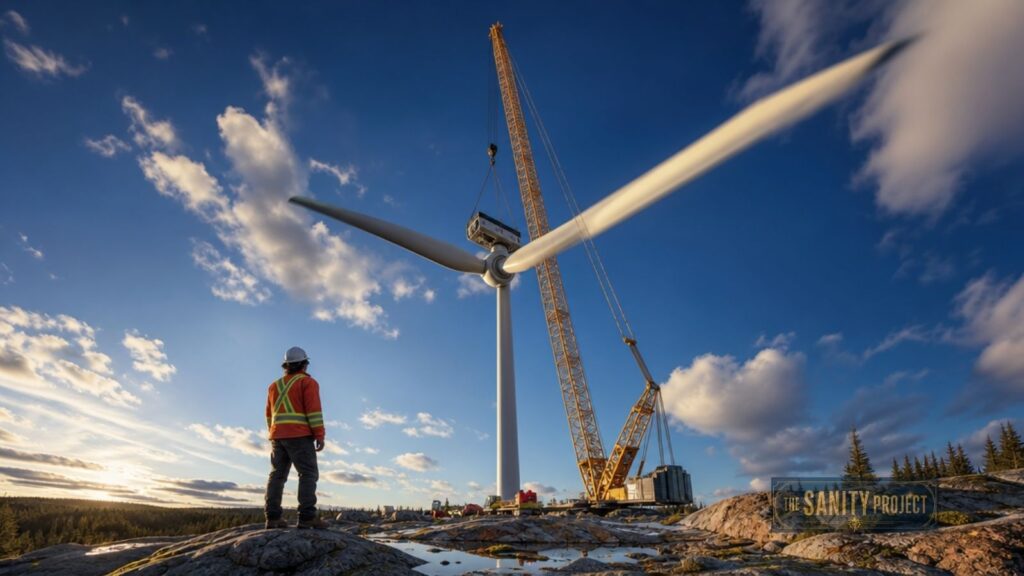
A modern wind turbine is essentially a 300-foot monument to highly specialized critical minerals. The generator at the top is packed with permanent magnets that require rare-earth elements to operate without overheating. An EV battery looks like a sleek metal box, but inside it is a highly concentrated mass of lithium, cobalt, nickel, and graphite — a contained chemical reaction.
Here is the number that puts the scale of this into perspective: the International Energy Agency projects that, to meet the climate goals of the Paris Agreement, global demand for lithium will grow 40-fold by 2040. Not 40%. Forty times. Demand for graphite, cobalt, and nickel is projected to grow 20 to 25 times.
Subscribe To Our Newsletter!
If you’re trying to value the power of a nation that holds dominant reserves of those exact materials, and you’re not factoring them in, you’re doing the equivalent of trying to value Saudi Arabia in the 1970s without ever mentioning the word oil.
What Is Actually in the Ground: Canada’s Critical Minerals Inventory
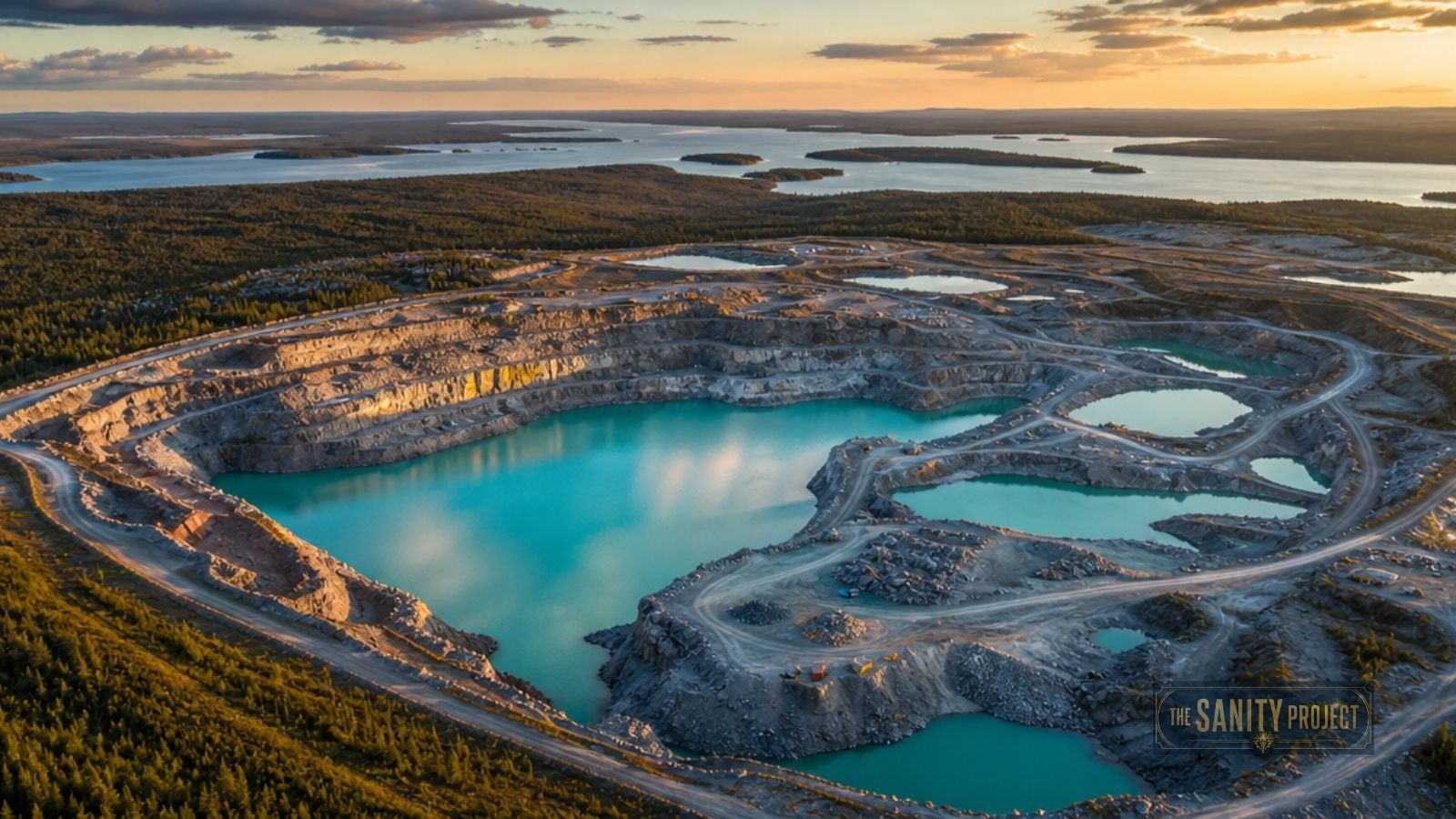
Canada officially recognizes 31 critical minerals — materials designated as essential to economic security, vital to the low-carbon transition, and highly strategic for allied nations. The country currently operates 56 active critical mineral mines and 31 active processing facilities, with 171 advanced projects in development. Let’s build an EV battery from scratch and trace where the ingredients are actually coming from.
Lithium: The Fuel of the Battery Revolution
The primary energy carrier in every modern EV battery is lithium. And Canada’s lithium story is more nuanced than most people realize, because not all lithium is created equal.
In South America’s famous Lithium Triangle — Chile, Argentina, Bolivia — lithium is mostly extracted from underground brine pools. You pump salty water to the surface, let it evaporate for months, and scrape up the salts. It sounds straightforward, but the process takes 12 to 18 months and the resulting lithium often requires extensive chemical processing to reach the purity standards modern EV batteries demand.
In Canada, particularly in Quebec and Ontario, the geology is different. They are dealing with spodumene ore — hard rock mining, where you blast and crush solid rock to extract the lithium. The automotive industry is intensely focused on this Canadian Shield lithium for two reasons: speed and purity. Spodumene can be processed into battery-grade lithium hydroxide significantly faster, and the chemical consistency is far easier to control.
This is not theoretical. Sayona’s North American Lithium operation in Quebec is already at commercial production, shipping concentrate ore today. In Ontario, Frontier Lithium’s PAC Project was the first to move forward under Ontario’s new “one project, one process” streamlined regulatory framework.
More tellingly, Frontier has already signed a memorandum of understanding with Panasonic Energy for future lithium offtake from a planned refinery in Thunder Bay — and Panasonic signed that agreement before the refinery was even built. That level of pre-commitment tells you everything about the market’s desperation.
Nickel, Cobalt, and the Battery’s Dual-Threat Assets
A high-performance EV battery needs more than just lithium. The cathode — the positive side of the battery — requires nickel for energy density and cobalt for thermal stability. Cobalt, specifically, prevents the cathode from degrading or catching fire during rapid charging.
Canada is already the seventh-largest holder of global nickel reserves, with mining infrastructure that has been operational for over a century. Ontario’s Sudbury corridor is one of the most mature nickel-producing regions on earth. But the real story is the expansion.
In Newfoundland and Labrador, Vale — one of the world’s largest mining companies — recently completed a massive expansion of the Voisey’s Bay Nickel Mine, transitioning it from an open-pit operation to an underground mine specifically to target the grades of nickel required for the EV market. The geological bonus: when you mine nickel at Voisey’s Bay, you almost always pull cobalt as a co-product. These are dual-threat assets that simultaneously meet the energy density and thermal stability requirements of the allied supply chain.
Graphite: The Overlooked Ingredient
The EV battery conversation is dominated by lithium, but the anode — the negative side — is almost entirely made of graphite. The IEA projects that global graphite supply needs to double by 2040. Canada already ranks fourth globally in production, with Quebec alone hosting 14 advanced-stage graphite projects.
What is genuinely fascinating is the innovation happening in Welland, Ontario, where Regen Resources Recovery Corporation, backed by a strategic alliance with Linamar, is building a synthetic graphite project. Synthetic graphite is engineered rather than mined — carbon precursors are heated in massive furnaces to nearly 3,000 degrees Celsius (roughly half the temperature of the surface of the sun), and the carbon atoms undergo a structural transformation into the perfect crystalline lattice that defines graphite. The result is molecularly identical, ultra-high-purity material every single time.
The key differentiator for Canada’s version: those furnaces are powered by Ontario’s relatively clean hydro and nuclear grid. Chinese competitors use coal-fired power to run their furnaces, generating an enormous carbon footprint in the process. Canada isn’t just selling the mineral. It is selling the clean energy used to process it.
Rare Earth Elements and Canada’s Critical Minerals Strategy at the Frontier
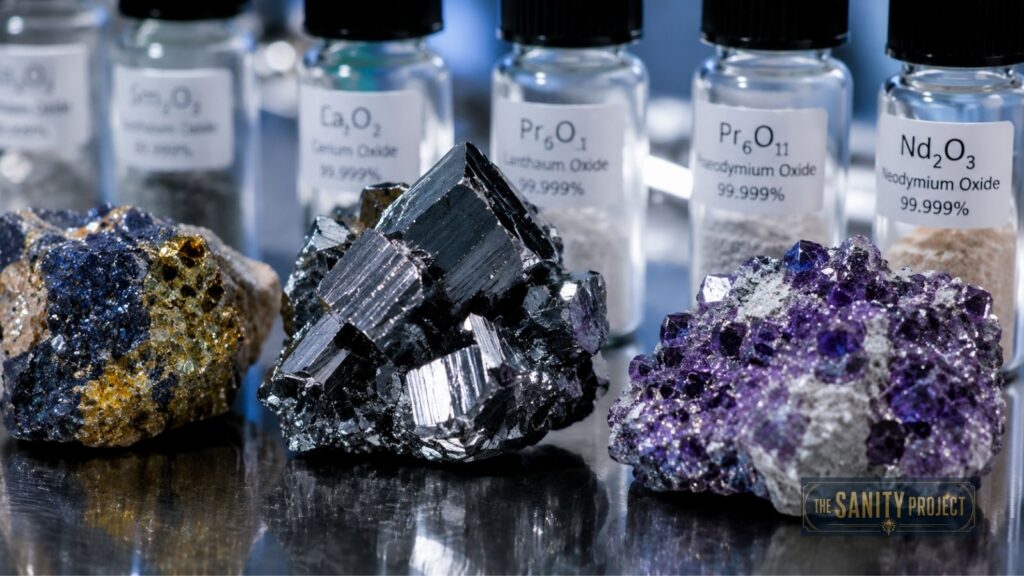
This is where the conversation becomes most geopolitically charged. Rare earth elements — the 17 chemically similar metals at the bottom of the periodic table — are the magic ingredient in permanent magnets. If you want an electric motor that is smaller, lighter, and more powerful, you use magnets made with neodymium and praseodymium. If you want that motor to operate at extreme temperatures — inside an F-35 fighter jet or an offshore wind turbine — you add heavy rare earths like dysprosium or terbium.
These are the exact metals China restricted in October 2025.
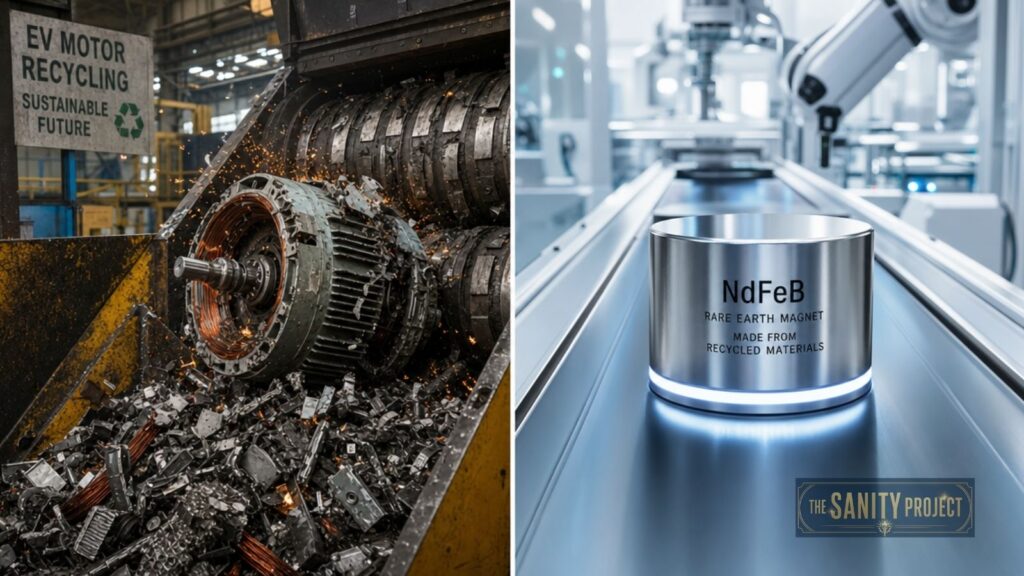
Canada’s response is not to simply dig more holes. A company in Kingston, Ontario, called Cyclic Materials received a conditionally approved $9.1 million federal investment plus a $25 million equity stake from the Canada Growth Fund to build a rare earth recycling centre of excellence. Their approach: take end-of-life products — shredded electronics, old MRI machines, decommissioned wind turbines, discarded EV motors — and extract the rare earth elements directly from the scrap using advanced hydrometallurgy.
No toxic open-pit mining. No radioactive byproducts. Just precision chemistry applied to our own industrial waste.
China’s Stranglehold and Why It Changes Everything
You cannot understand Canada’s strength without first understanding the weakness of the allied world. And that weakness has a name: supply chain concentration.
The numbers are stark. China currently controls 60 to 80% of the midstream and downstream supply chains for key critical minerals. More specifically: 92% of global rare earth element production. 91% of natural graphite. 77% of cobalt. 65% of lithium. 44% of copper.
But the critical point — one that gets lost in the headline numbers — is that much of this dominance is not about geology. China doesn’t simply have all the rocks within its borders. It has been executing a strategic multi-decade plan to control the processing and refining infrastructure, even when the raw ore is mined elsewhere. Cobalt sourced from the Democratic Republic of Congo and lithium mined in Australia both end up on bulk carriers bound for Chinese refineries before becoming battery-grade material.
How did this happen? A combination of economic complacency and what might be called environmental arbitrage. In the 1990s and 2000s, Western economies pivoted toward software, services, and high-tech design. Metallurgical processing is dirty, dangerous, and energy-intensive. Western nations decided to outsource the pollution. What they didn’t realize was that by offloading the environmental burden, they accidentally offloaded the entire scientific and industrial knowledge base required to build modern technology.
China absorbed the environmental damage. And in return, it built a near-impenetrable monopoly on the metallurgical capacity required to turn rock into battery-grade material.
Between 2023 and 2025, China began actively weaponizing that monopoly. First came export restrictions on gallium and germanium — the foundational substrates for advanced semiconductors and military-grade radar systems. Then, antimony is critical for armour-piercing ammunition and night vision goggles. Then, in October 2025, the heavy rare earth elements, along with restrictions on the processing technologies themselves. Beijing wasn’t just restricting the metals. It was legally forbidding allied nations from using Chinese proprietary technology to build their own processing facilities.
That is a comprehensive strategic chokehold.
Canada Didn’t Just Join the Table — It Built It
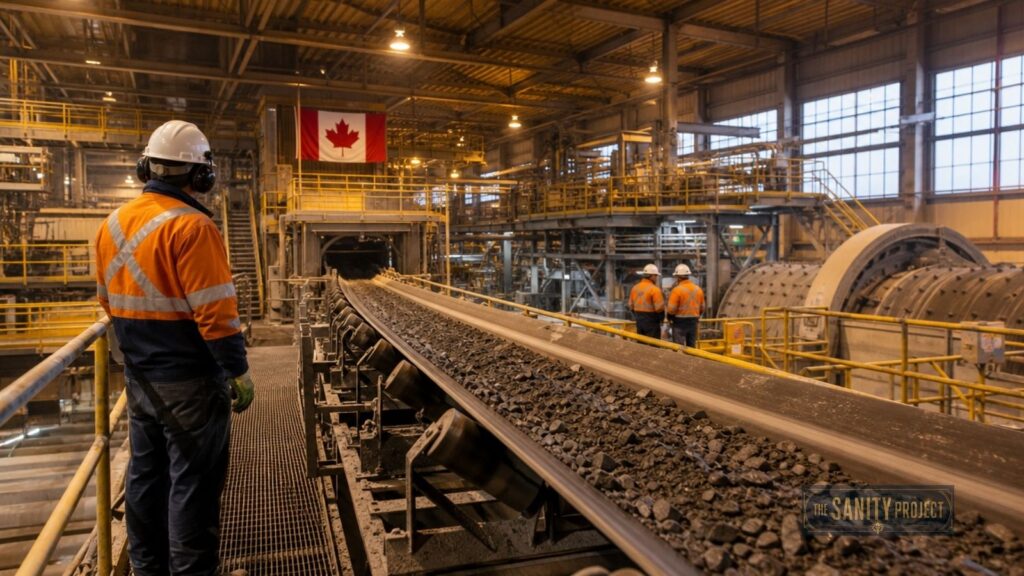
The conventional narrative portrays Canada as a subordinate trading partner seeking favourable terms from larger powers. The documented reality is the opposite. At the G7 Leaders’ Summit in Kananaskis, Alberta, in June 2025, during Canada’s G7 presidency, Canada launched the Critical Minerals Production Alliance and became its chair. The explicit mandate: mobilize capital, coordinate industrial policies, and fast-track priority projects to move critical mineral supply chains away from adversarial nations and into secure allied markets.
The financial results are already being measured. At the Prospectors and Developers Association of Canada (PDAC) convention in Toronto in March 2026, Canada’s Minister of Energy and Natural Resources announced the second round of alliance partnerships: 12 allied nations had locked in $18.5 billion in Canadian mineral investments, with this second round alone unlocking $12.1 billion across 30 new partnerships.
The diversity of these partnerships is what proves the point. It is not one country hedging its bets. It is a synchronized global rush. Siemens Canada is partnering with RockTech Lithium to build lithium conversion infrastructure in Ontario. Greenland Resources is securing a $2 billion, 10-year offtake agreement with Finnish company Outokumpu for molybdenum supply.
Canada and India are signing a memorandum of understanding on critical minerals. The European Investment Bank is signing a letter of intent for project cooperation. Companies and state-backed entities from Germany, Italy, Austria, Denmark, Belgium, Sweden, and South Korea are all signing agreements.
Between 2024 and 2034, nearly 140 projects are planned or proposed in Canada, with a combined potential value of $117.1 billion, nearly half of which specifically target critical minerals.
To bridge the notorious “valley of death” — the funding gap that has historically killed promising mining projects before they reach commercial scale — the federal government has deployed a targeted financial architecture. The $3.8 billion National Critical Minerals Strategy provides the policy foundation. The $1.5 billion First and Last Mile Fund, running from 2026 to 2030, is designed to literally build the roads, bridges, and energy grids needed to connect remote northern deposits to industrial supply chains.
The $2 billion Critical Minerals Sovereign Fund makes strategic investments through equity and debt instruments, with the government acting as a de-risking agent to unlock private capital. And a $443 million allocation under the Defence Industrial Strategy specifically addresses security in the allied military supply chain.
The Innovation Leapfrog: Winning a Game China Didn’t Prepare For
Here is where Canada’s critical minerals strategy moves from impressive to genuinely disruptive.
Canada cannot beat China at traditional mining. China has a 20-year head start, heavily subsidized state capital, and virtually zero environmental constraints. If the allied world tries to win by digging bigger holes faster, it loses. The economics don’t work.
So Canada is changing the game entirely.
Take Ultra Resources Technologies, which has developed a bioengineering-based approach to rare earth separation. Traditional rare earth processing uses sequential baths of highly toxic, corrosive acids. Ultra Resources uses engineered proteins instead — microscopic molecular structures designed with such geometric precision that they bind only to a single rare earth element, ignoring everything else in the solution. You introduce the proteins into a vat of liquid mixed with low-grade mining waste. The proteins locate and bind to, say, neodymium. You filter them out, release the element, and reuse the protein. No toxic acids. No extreme heat. Just biological precision.
Or consider Phoenix Tailings, which has developed a completely solvent-free chemical process to extract rare earths from existing mine tailings — the waste rock left over from decades of traditional mining. These technologies are modular, meaning a small facility can be deployed right next to an existing waste pile rather than permitting a new mine.
And then there is the Vulcan deal: a $1.4 billion combined debt and equity investment from the U.S. government into a partnership between Vulcan Elements and Re Element Technologies. Re Element extracts ultra-high-purity rare earths from end-of-life products and industrial waste. Vulcan takes that recovered material and manufactures it into high-performance permanent magnets in North America. The result is a fully integrated closed-loop supply chain that bypasses primary mining entirely, requires no new holes in the ground, and eliminates reliance on Chinese processing.
When the United States government deploys $1.4 billion into that specific ecosystem, it is documented proof that these technologies have moved past the lab stage. The math works at a commercial scale.
Frequently Asked Questions
What are Canada’s most important critical minerals? Canada officially designates 31 critical minerals, but the most strategically significant for the current energy transition are lithium (particularly spodumene from Quebec and Ontario), nickel and cobalt (from Sudbury and Voisey’s Bay), graphite (14 advanced-stage projects in Quebec alone), and rare earth elements. These are the core materials required to build EV batteries, permanent magnets for electric motors, and advanced defence systems.
Why does Canada’s critical minerals strategy matter for the average person? Because the clean energy products we are all transitioning to — electric vehicles, wind turbines, solar installations — cannot be built without these materials. If supply chains remain concentrated in China, the energy transition is hostage to geopolitical risk. Canada’s strategy is about ensuring those supply chains run through democratic, environmentally accountable nations instead.
How dominant is China over critical mineral supply chains? China controls between 60 and 80% of midstream and downstream processing for key critical minerals, including 92% of rare earth element production and 91% of natural graphite. Critically, much of this dominance is not geological — it is the result of strategic investment in refining and processing infrastructure over several decades.
Is Canada at risk of becoming just a raw material exporter? It is a legitimate concern — the “quarry trap” has undermined resource-rich nations for a century. The data suggests Canada is actively working against this. As of early 2026, Canada operates 31 active critical mineral processing facilities alongside its 56 mines, and 28 of the 171 projects in development are dedicated processing facilities. The stated policy goal is full vertical integration, from mining to battery-grade refining to cathode material manufacturing, all within Canadian borders.
What is the Critical Minerals Production Alliance? It is a multilateral body launched by Canada during its G7 presidency in June 2025, designed to coordinate allied industrial policy, mobilize investment capital, and accelerate the development of critical mineral supply chains among trusted democratic partners. Canada chairs the alliance, which effectively means Canada is setting the terms of engagement for how the global critical minerals market will be structured.
The Lines of Power Are No Longer Where You Think They Are
If you break a bone, an X-ray clearly shows the fracture. Binary, obvious, undeniable. But in the twenty-first-century global economy, the real lines of power are not drawn on traditional maps. They run through lithium brine pools in the Canadian Shield, through synthetic graphite furnaces powered by Ontario’s clean grid, through the molecular robots hunting neodymium in industrial waste, and through the closed-loop recycling facilities turning old MRI machines into the magnets that guide tomorrow’s missiles and charge tomorrow’s cars.
The narrative of a weak, economically fragile Canada is a ghost story built on outdated twentieth-century economics. It describes a world that no longer exists.
The documented reality is this: the clean energy transition, the defence industrial base of every allied nation, and the entire digital economy cannot function without the physical materials Canada controls. The world has not been politely requesting Canadian minerals. It has been competing furiously to lock in long-term partnerships before someone else does. Eighteen and a half billion dollars mobilized at a single convention is not charity. It is desperation capital from nations that understand, perhaps too late, just how exposed they are.
Canada didn’t need to ask permission to become a strategic superpower. It just had to wait for the world to realize what was already in the ground.
Resource LINKS
- International Energy Agency — The Role of Critical Minerals in Clean Energy Transitions https://www.iea.org/reports/the-role-of-critical-minerals-in-clean-energy-transitions
- Natural Resources Canada — Critical Minerals Strategy https://www.nrcan.gc.ca/critical-minerals
- Council on Foreign Relations — China’s Rare Earth Dominance https://www.cfr.org/backgrounder/chinas-rare-earth-monopoly
- PDAC — Prospectors & Developers Association of Canada https://www.pdac.ca