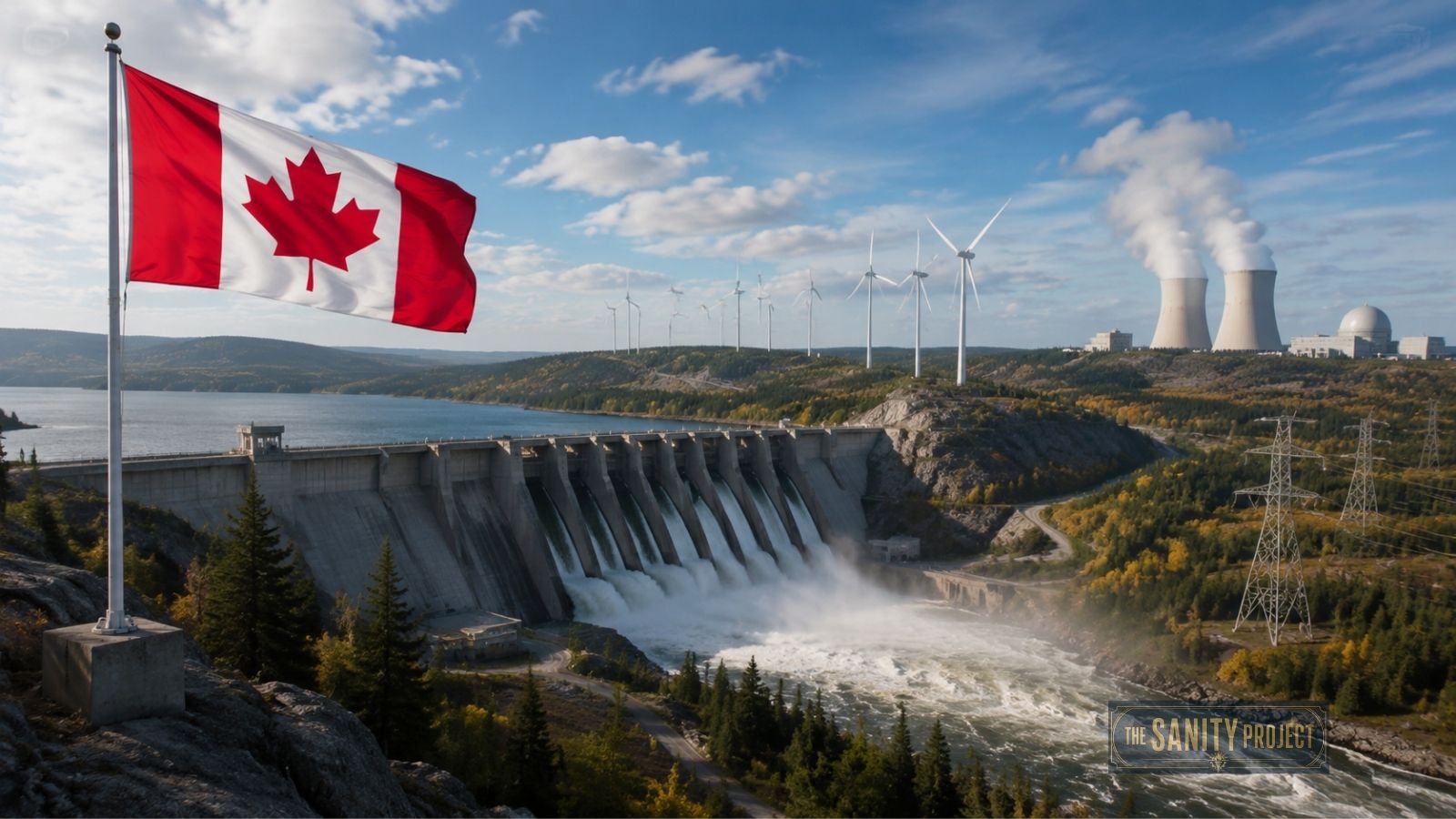
The Powering Canada Strong strategy is a national framework designed to double the Canada Electricity Grid capacity by 2050 to match a projected 100% surge in demand. Spearheaded by Prime Minister Mark Carney, the strategy leverages the federal government’s AAA balance sheet to de-risk an estimated $1 trillion in required infrastructure. By shifting from siloed “electricity islands” to a coordinated national energy architecture, the plan integrates provincial networks, fast-tracks deployment of nuclear SMRs, and uses natural gas as a firm baseload bridge. It aims to secure energy sovereignty while reducing total household energy costs through aggressive electrification.
Quick Answer: Canada’s electricity grid is currently 84% non-emitting, predominantly powered by hydroelectricity, nuclear, wind, and solar. The federal government unveiled a C$1-trillion strategy to double the grid’s capacity by 2050 to meet surging demand from electric vehicles, heat pumps, and industrial electrification
The Nation-Building Mandate
The electrification of the Canadian economy is not merely a utility upgrade; it is the most significant nation-building project since the completion of the transcontinental railway. In a global landscape defined by “energy weaponization” and a frantic race for technological supremacy, the “Powering Canada Strong” strategy frames the electricity grid as the bedrock of 21st-century economic sovereignty. For Canada to maintain its competitive edge, it must transition from a fragmented network of provincial providers into a unified, resilient energy powerhouse capable of supporting the next industrial revolution.
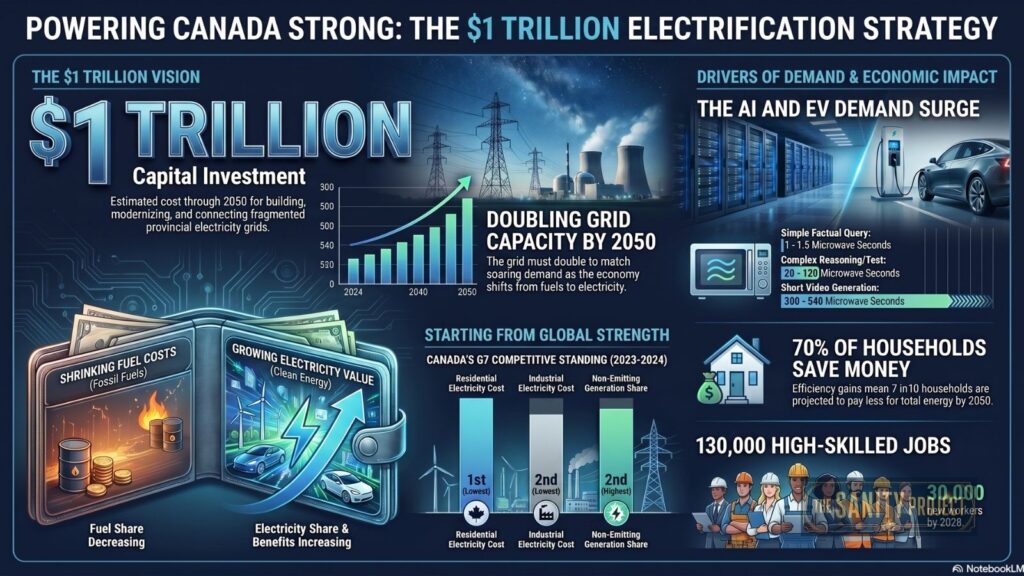
The strategy’s thesis is rooted in a hard reality: Canada’s current infrastructure is insufficient for an “electron-based” future. As we move away from unabated fossil fuels, electricity demand is set to double by 2050. To address this, the Carney government is deploying the federal government’s fiscal “AAA balance sheet” to underwrite a $1 trillion investment.
This approach aims to spread the massive upfront costs of generation and transmission across generations, protecting today’s ratepayers from the “rate shock” typical of large-scale utility builds. However, while the vision is comprehensive, the transition remains a high-stakes gamble, fraught with jurisdictional friction and a race against technological obsolescence.
To understand the scale of this bet, we must analyze the specific demand drivers—from sovereign AI to the mass adoption of heat pumps—that are forcing a total structural redesign of the Canadian Electricity Grid.
——————————————————————————–
The Surge: Why Demand for the Canadian Electricity Grid is Set to Double
The Canadian economy is currently undergoing a fundamental shift from direct fuel combustion to plug-in vehicles. At present, electricity accounts for only one-fifth of Canadian energy consumption. The “Powering Canada Strong” strategy recognizes that for Canada to remain a Tier One economy, this share must expand to dominate the energy mix. This is not an aspirational policy goal; it is a defensive necessity.
Industrial Electrification & AI: The Sovereign AI Race
The most volatile new driver of electricity demand is the rise of Artificial Intelligence. Canada is positioning itself as a global hub for “Sovereign AI” data centers, leveraging its cooler climate to reduce cooling costs. However, the energy intensity of these facilities has triggered a NERC Level 3 alert—the highest rating from the North American Electric Reliability Corporation—warning that current grid processes cannot handle such massive computational loads.
The “microwave seconds” comparison illustrates this intensity: a simple factual AI query consumes the same energy as running a microwave for 1.5 seconds. A conversational query requires up to 5 seconds. Generating a single AI image consumes enough energy to boil a cup of water (two minutes of microwave time), and a short AI-generated video can require up to nine minutes of microwave energy. Compounded over billions of queries, AI data centers alone are projected to require up to 10 gigawatts (GW) of capacity by 2050.
Subscribe To Our Newsletter!
The Transport & Heating Shift
The mass deployment of Electric Vehicles (EVs) and heat pumps represents a bottom-up surge in demand. Fleet-wide EV adoption is projected to require 150 to 215 terawatt-hours (TWh) by 2050, roughly 18% of current demand. Simultaneously, as buildings transition to electric heat pumps, the grid faces a “winter peak” challenge. Unlike summer peaks driven by air conditioning, winter heating requires firm baseload power that can withstand sub-zero temperatures, placing unprecedented strain on local distributed energy resources (DERs).
Critical Minerals & Manufacturing
Canada’s emerging battery supply chain and the “Golden Triangle” critical mineral developments depend on electro-intensive smelting and processing. Without a reinforced grid, these industries—the successors to the traditional automotive sector—will migrate to jurisdictions with more abundant, lower-cost power. Furthermore, new housing is a significant, often-overlooked driver; in Ontario alone, the drive for one million new homes by 2035 is expected to add 6 TWh (a 9% increase) to electricity demand.
Table 1: Projected Sectoral Demand Growth (2025–2050)
| Sector | Estimated Demand / Growth Impact | Timeline |
| AI Data Centers | 3–5 GW (near term) up to 10 GW | By 2050 |
| Electric Vehicles (EVs) | 150–215 TWh (approx. 18% of current total) | By 2050 |
| New Housing (Ontario) | 6 TWh (9% increase) | By 2035 |
| Industrial / Critical Minerals | 11–16 GW (New manufacturing & smelting) | By 2050 |
——————————————————————————–
The Mark Carney Strategy: AAA Finance and Federal Friction
Mark Carney, drawing on his tenure as a central banker, has framed “Powering Canada Strong” as a de-risking exercise for the national economy. The strategy moves beyond simple subsidies, focusing on “climate finance” to unlock private capital.
The Fiscal Architecture
The strategy’s financial pillars rest on the $25 billion Canada Strong Fund, a national sovereign wealth fund designed to seed nation-building projects like energy corridors and mines. By utilizing federal borrowing, the government aims to protect the “Energy Wallet” of Canadian households. While electricity’s share of household spending will grow, the “entire pie” of energy costs is projected to shrink because electric machines (EVs and heat pumps) are 2 to 4 times more efficient than internal combustion or gas-fired alternatives. The plan claims 7 in 10 households will see lower total energy bills by 2050.
Navigating the Federal-Provincial Fault Lines
Despite the economic logic, the plan faces fierce jurisdictional resistance. Conservative Leader Pierre Poilievre has criticized the strategy as a rehash of policies that he claims have already increased power bills by 35%. However, a technical analysis suggests these cost increases are largely tied to provincial “stranded costs” and legacy contracts rather than federal policy. To bridge this divide, the Carney government has signalled a pragmatic “Team Canada” approach, recently signing a deal with Alberta for a $130/tonne carbon price by 2040 in exchange for flexibility on federal regulations.
——————————————————————————–
Balancing the Mix: The Natural Gas and Nuclear Debate

A core tenet of the strategy is the “Nuclear Advantage” and the pragmatic use of natural gas as a bridge fuel. This has sparked a debate between environmental purists and energy realists.
The Natural Gas Controversy: The Carney government has “adjusted” the Clean Electricity Regulations (CER) to allow for natural gas to help maintain grid stability. Critics label this “greenwashing,” but the strategy defends the choice by noting that Canadian natural gas has one of the lowest global emissions intensities. As wind and solar intermittency grow, gas provides the necessary firm baseload to prevent brownouts during “winter peaks.”
The Nuclear Advantage: Canada is a “Tier One” nuclear nation, holding the unique status of being the only country with sufficient domestic uranium production to fuel its entire nuclear fleet. The strategy highlights the Darlington SMR project—the first G7 deployment of a Small Modular Reactor—as a centrepiece of energy sovereignty. By owning the intellectual property for CANDU technology, Canada is positioned to export non-emitting baseload solutions to allies, turning energy policy into a trade advantage.
——————————————————————————–
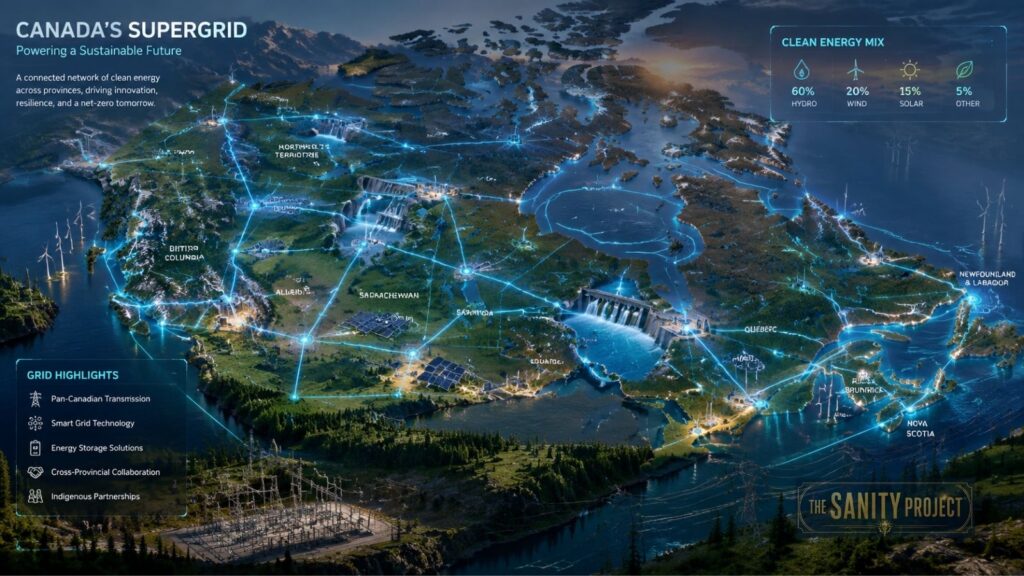
From Islands to Interties: Integrating the Canada Electricity Grid
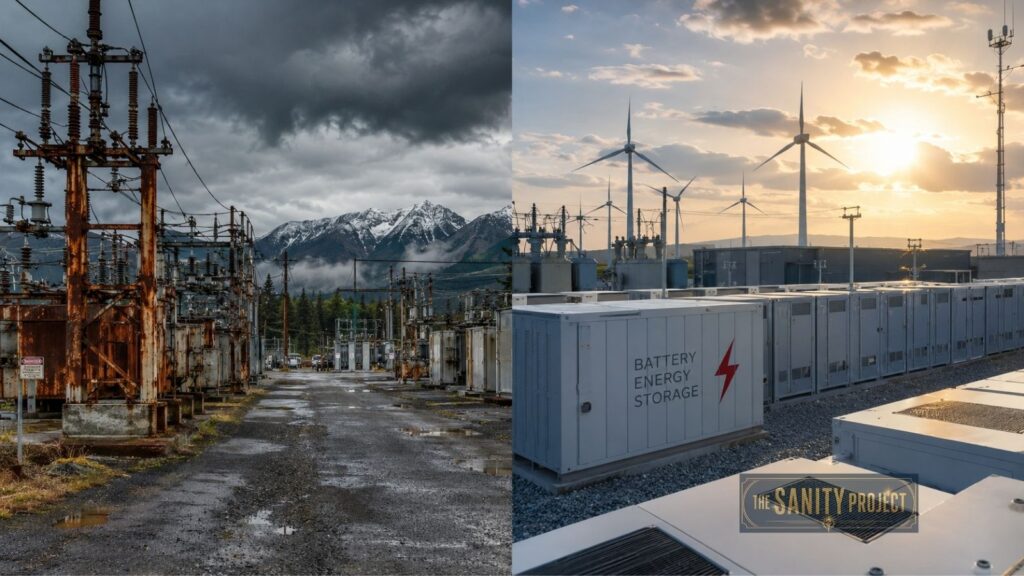
Historically, Canada’s electricity system has functioned as a series of “islands,” with provinces often trading more with the United States than with each other. This fragmentation creates immense economic inefficiency.
The Intertie Strategy
The strategy prioritizes high-voltage inter-provincial “interties” to allow for resource pooling. For instance, connecting BC’s hydro storage with Alberta’s wind and solar creates a symbiotic relationship that reduces the need for duplicative “peak” infrastructure. The data is compelling: a tripling of the Manitoba-Saskatchewan intertie capacity is projected to yield $2.3 billion in net benefits by 2050, while the BC-Alberta connection offers another $1.7 billion in system savings.
The Major Projects Office (MPO)
To overcome “regulatory drag,” the Major Projects Office has been empowered to fast-track projects deemed in the national interest. Key projects currently under MPO supervision include:
- The North Coast Transmission Line (BC): Enabling the “Golden Triangle” critical minerals and the Ksi Lisims LNG facility.
- The Taltson Hydro Expansion (NWT): Doubling hydro capacity and connecting the North and South Slave Lake grids.
- The Iqaluit Nukkiksautiit Project: Nunavut’s first Inuit-owned hydro project, intended to displace diesel generation.
- The Atlantic Energy Strategy: Connecting offshore wind and hydro power across New Brunswick, Nova Scotia, and PEI.
Grid Integration Benefit Matrix
| Metric | Siloed Provincial Operation | Integrated National Grid |
| Reliability | Vulnerable to local weather/NERC alerts | Resilient; pooled resources offset outages |
| Cost Savings | High, redundant “peak” assets required | Lower; billions saved via system optimization |
| Renewable Penetration | Limited by local intermittency | Higher spreads variability across regions |
——————————————————————————–
Workforce and Implementation: The 130,000-Worker Challenge

The most significant bottleneck to this $1 trillion vision is labour. The sector requires 30,000 new workers by 2028 and 130,000 by 2050. The “Team Canada Strong” recruitment effort is a $6 billion nationwide initiative aimed specifically at Red Seal trades. This includes $2 billion for job-ready placements for young Canadians and over $3.4 billion in incentives to ensure apprentices complete their training and enter the workforce. Without this human capital, the strategy remains a “vision document” rather than a physical reality.
——————————————————————————–
Conclusion: The Path to 2050
The $1 trillion price tag for rebuilding the Canada Electricity Grid is undeniably daunting. However, as an economic policy consultant would argue, the cost of inaction is terminal. In a world where AI, EV manufacturing, and critical minerals are the new engines of growth, a nation with a stagnant grid is a nation in decline.
Mark Carney’s “Powering Canada Strong” is a sophisticated attempt to use federal fiscal strength to build a sovereign energy future. While it is currently a “vision document” lacking a fully binding implementation budget, it provides the blueprint for Canada to emerge as a clean-energy superpower. The bet is simple: double the grid today, or lose the economy of tomorrow.
——————————————————————————–
Frequently Asked Questions (FAQs)
1. Why does the Canada Electricity Grid need to double by 2050? The doubling is a demand-matching requirement. As Canada electrifies transportation (EVs), home heating (heat pumps), and industrial processes, while simultaneously competing for energy resources to host energy-intensive AI data centers, the total “load” on the system will reach twice its current capacity.
2. How will the Mark Carney strategy affect my monthly hydro bill? The plan utilizes federal “AAA” borrowing to lower infrastructure costs. While electricity usage will increase, the strategy projects that 7 in 10 households will see lower total energy bills because high-efficiency electric devices are 2–4 times more efficient than fuel-burning machines.
3. Is the grid transition moving away from natural gas entirely? No. The adjusted Clean Electricity Regulations (CER) recognize natural gas as an essential “bridge fuel.” It will continue to provide “firm baseload” and reliability during extreme winter peaks, though its role will eventually be dwarfed by nuclear, hydro, and renewables.
Source Materials
https://natural-resources.canada.ca/energy-sources/electricity-infrastructure/powering-canada-strong-national-strategy-electrified-canadian-economy
https://www.cbc.ca/news/politics/carney-clean-energy-regulations-announcement-9.7198953
https://www.theglobeandmail.com/business/article-ottawa-canada-grid-capacity-expansion-electricity-strategy-2050/
https://www.reuters.com/business/energy/canada-unveils-plan-double-capacity-electricity-grid-by-2050-2026-05-14/
https://globalnews.ca/news/11849175/carney-clean-electricity-strat