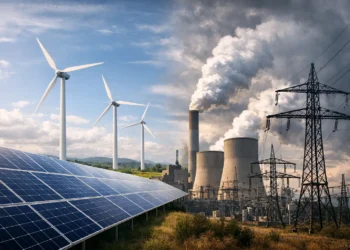
A household opens its utility bill, sees a higher number, and is told the energy transition is either the obvious culprit or the obvious solution. Both stories are convenient. Neither is enough. This energy transition costs guide starts with a less satisfying but more useful premise: changing an energy system costs money, delaying change costs money, and the bill depends heavily on what is counted, when, and who is paying it.
The public argument usually turns on a single headline number. A wind farm costs this much. A transmission line costs that much. A tax credit costs taxpayers that much. Those figures can be real and still tell us remarkably little. Electricity is not a single product rolling off a factory line. It is a system that must work in a heat wave, a winter storm, and at 2 a.m. when the wind is uncooperative.
1. The cheapest power plant is not always the cheapest system
The most repeated comparison in energy debates is levelized cost of energy, or LCOE. It estimates the lifetime cost of producing a unit of electricity from a particular facility. It is useful, but it does not answer the question voters, businesses, and grid operators actually face: what will it cost to provide reliable electricity when people need it?
A solar project may produce inexpensive electricity at midday. A gas plant may cost more per unit of power but can be dispatched when demand spikes. Nuclear plants have high upfront costs and long construction risks, but can supply steady low-carbon output for decades. Hydropower can be exceptionally valuable where geography allows it. Geography, unfortunately, has declined to organize itself around campaign slogans.
As the share of variable wind and solar rises, the system also needs transmission, storage, flexible demand, reserve capacity, and software that coordinates millions of devices. The International Energy Agency has made this point repeatedly: clean-energy investment is not only about generation. Grids are the connective tissue. If they are not built fast enough, cheaper generation can sit far from the homes and factories that need it.
That does not make renewable energy a bad investment. It means a generation-only price comparison is incomplete. It is like declaring a car cheap because you excluded the tires, roads, insurance, and fuel.
2. Upfront costs and long-run costs pull in opposite directions
Energy transitions are capital-heavy. Much of the spending happens before customers receive the full benefit: new transmission corridors, upgraded distribution networks, charging infrastructure, building retrofits, industrial equipment, and replacement generation. This creates a political problem. The costs are visible now. The avoided fuel purchases, lower pollution, and reduced exposure to volatile commodity prices arrive gradually.
Fossil-fuel systems have their own capital requirements, of course, but a large portion of their cost is ongoing fuel. That distinction matters. A wind, solar, hydroelectric, or nuclear facility generally requires substantial construction spending and relatively low fuel spending afterward. A gas-fired system can be cheaper to build but remains exposed to gas prices for its entire operating life.
The price shocks following global supply disruptions offered a useful reminder. Fuel dependence is not free simply because it is familiar. The U.S. Energy Information Administration and the Canada Energy Regulator both track how wholesale fuel prices can flow through electricity, heating, transportation, and industrial costs. A system with more domestic low-fuel-cost generation may cost more upfront while offering more predictable operating costs later.
But “may” matters here. Financing costs can overwhelm good engineering. A project delayed by permitting disputes, local opposition, supply-chain problems, or unclear market rules becomes more expensive whether it is a solar field, a pipeline, a transmission line, or a nuclear reactor. The interest meter is famously nonpartisan.
Subscribe To Our Newsletter!
3. Utility bills are not the full price tag
A lower monthly electricity bill is good news, but it is not proof that the system became cheaper. A higher bill is frustrating, but it is not automatic proof that policy failed.
Some costs appear on utility bills through rates. Others are paid through taxes, public borrowing, private investment, insurance premiums, or product prices. Tax incentives can lower an individual project’s financing cost while shifting part of the expense to the federal budget. Grid upgrades can raise rates in the short term while preventing more expensive congestion, outages, or emergency generation later.
The reverse can happen, too. Keeping rates artificially low by deferring maintenance may feel generous until transformers fail, capacity becomes scarce, and the repair bill arrives with interest. Regulators and politicians often prefer a reassuring near-term bill to an honest long-term investment plan. This is not unique to energy, but electricity makes the consequences especially immediate.
A serious cost assessment therefore asks three questions: What does the customer pay? What does the taxpayer pay? What future cost is being avoided or postponed? Leaving out any one of these produces a tidy answer, which is usually the warning sign.
4. Reliability has a cost, and so does unreliability
Reliability is often used as a rhetorical club. One side invokes it to reject clean energy. The other treats it as a relic of an older grid. Neither position helps an operator keep the lights on.
The North American Electric Reliability Corporation has warned that demand growth, generator retirements, extreme weather, and slow transmission development are tightening reliability margins in parts of North America. Data centers, electrified manufacturing, and electric vehicles add new demand even as older coal and gas plants retire. The precise local risk varies, but the broad planning challenge is real.
Reliability spending includes firm capacity, weatherization, grid hardening, backup power, vegetation management, storage, and interconnections between regions. These investments are not a footnote. They are part of the transition cost.
Still, reliability should not be treated as an argument for preserving every existing asset forever. Older plants can be expensive, inefficient, and vulnerable in their own ways. During severe weather events, fuel supply failures and frozen equipment have demonstrated that conventional generation is not magic. A resilient system uses a diversified mix and plans for the failure modes of each resource rather than pretending one technology has none.
5. The cost of delay is real, but it is not a blank check
There is a temptation to frame every clean-energy expenditure as an emergency purchase. Climate risks, air pollution, aging infrastructure, and geopolitical fuel insecurity are genuine reasons to move with purpose. They are not reasons to abandon cost discipline.
Poorly designed subsidies can reward projects that would have happened anyway. A rushed procurement can lock customers into overpriced contracts. A transmission plan that ignores local land use and community compensation can turn into years of litigation. And policies that force rapid equipment replacement without supporting low-income households can make a defensible goal politically brittle.
The better case for action is more mature: delay carries costs, but so does waste. Governments should prioritize investments that reduce multiple risks at once, such as grid modernization, energy efficiency, demand response, and transmission that unlocks reliable regional power sharing. They should also publish assumptions, compare alternatives, and be willing to change course when costs or technologies shift.
6. Who pays matters as much as how much
An average cost can conceal an unfair outcome. A homeowner with capital can claim a tax credit, install solar panels, and buy an electric vehicle. A renter may help finance those incentives through taxes or rates while having little ability to participate. A factory facing higher power prices may pass them into goods, cut investment, or relocate. A worker in a fuel-producing region may face a very different transition than an investor in a growing clean-tech market.
This does not mean policy should freeze the current system to avoid uneven effects. It means distribution must be designed, not waved away. Targeted bill assistance, affordable financing for efficiency upgrades, workforce transition support, and transparent rate design can reduce the burden on households least able to absorb it.
Canada and the United States also have a regional problem. Resources, grids, weather, and industrial bases differ dramatically. A policy that works in hydro-rich Quebec or the Pacific Northwest may not translate neatly to a fast-growing, gas-dependent region. National targets can set direction; local system planning has to do the hard math.
7. The honest question is compared with what?
Every energy option should be compared not with an imaginary zero-cost status quo, but with credible alternatives. What does it cost to extend the life of an old plant, secure its fuel, and control its emissions? What does it cost to build new generation and the wires to connect it? What are the consequences of more frequent outages, fuel-price swings, and emissions damage? What is the value of a system that can adapt as demand changes?
That is why a useful energy transition costs guide resists a single verdict. Electrification can reduce operating costs for many households and businesses, but only if infrastructure keeps pace. Renewables can lower fuel exposure, but need grid planning and flexibility. Nuclear can provide firm low-carbon power, but faces construction and financing risk. Natural gas can support reliability, but carries fuel volatility and emissions constraints. Efficiency is often cheaper than new supply, yet is less politically glamorous because nobody gets a ribbon-cutting ceremony for insulation.
The adult version of the debate is not “cheap energy” versus “clean energy.” It is how to build an affordable, reliable, lower-emission system without hiding costs in someone else’s bill, another region’s air, or the future. That question is harder to chant. It is also the one worth answering.