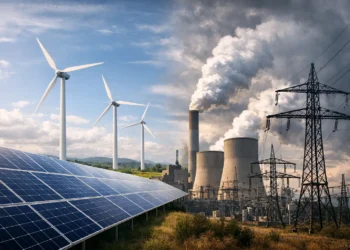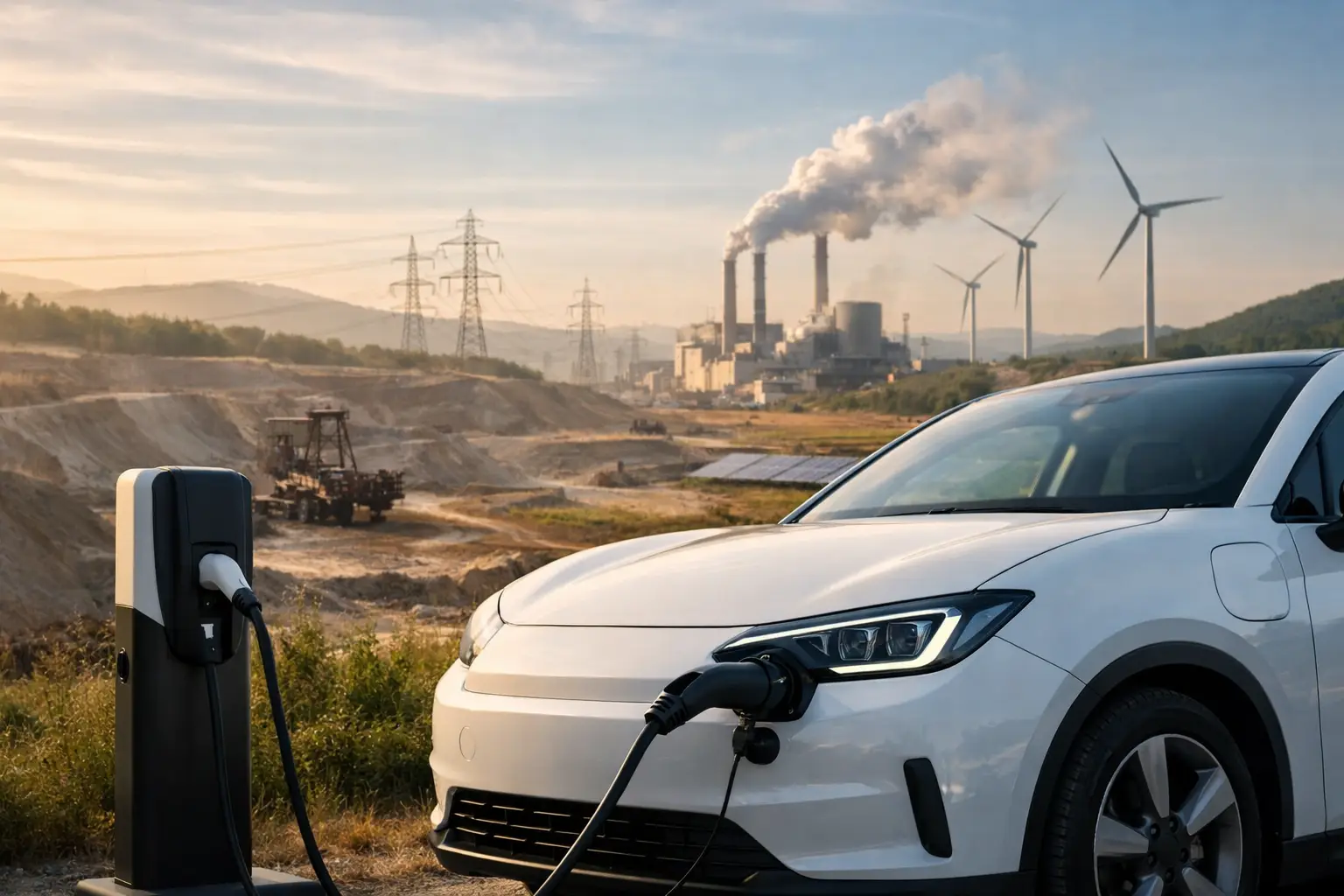
A new electric vehicle rolls off the lot with a battery that required mining, processing, shipping, and energy-intensive manufacturing. That fact is routinely presented as a conversation-ending rebuttal to EVs. It is not. Asking are electric vehicles cleaner requires comparing the full life of both vehicles, not treating the first mile of an EV as the entire story.
The honest answer is less satisfying than either political slogan: in most cases, yes, electric vehicles are cleaner over their lifetimes than comparable gasoline vehicles. But how much cleaner depends heavily on where they are charged, what they replace, how long they last, and whether “cleaner” means fewer greenhouse gases, less local air pollution, or less environmental damage overall.
That is not evasiveness. It is the actual accounting.
1. EVs usually begin with a manufacturing disadvantage
Building an EV generally creates more emissions than building a similar gasoline car, largely because battery production is energy intensive. The International Council on Clean Transportation has found that battery-electric vehicles can have higher production emissions upfront, with the size of the battery and the electricity used by factories making a substantial difference.
This is the part critics get right. A large battery is not a free environmental upgrade stamped into metal. Lithium, nickel, cobalt, graphite, copper, and other materials must be extracted and refined. Mining can affect water supplies, ecosystems, and nearby communities. Labor and governance problems in some supply chains are also real.
But this is not a comparison between an EV with a supply chain and a gasoline car that materializes from goodwill and fresh air. Gasoline vehicles need steel, aluminum, plastics, glass, and a constant stream of oil extraction, transport, refining, and combustion. The fuel system continues creating emissions every time the vehicle moves. An EV’s battery footprint is concentrated near the beginning; a gasoline vehicle’s fuel footprint keeps accumulating.
For a typical driver, the EV’s higher manufacturing emissions are usually offset after years, not decades, of driving. How quickly varies. A small EV charged on a relatively clean grid can reach that break-even point quickly. A large electric pickup charged mostly with coal-generated electricity takes longer. Physics remains stubbornly resistant to marketing departments.
2. The grid matters, but “coal-powered EV” is an incomplete argument
An electric vehicle is only as clean as the electricity used to charge it. That much is obvious. It is also routinely used in a misleading way.
In regions with coal-heavy electricity, EV climate benefits are smaller than in regions powered largely by hydro, nuclear, wind, solar, or natural gas. The U.S. Environmental Protection Agency’s vehicle emissions tools and lifecycle research consistently reflect this regional variation. So does common sense: charging overnight in Quebec is not equivalent to charging in a coal-dependent grid region.
Yet a gasoline car is effectively locked into its fuel source. It cannot become cleaner as refineries improve, as electricity generation shifts, or as renewable capacity expands. Its tailpipe will emit carbon dioxide and other pollutants for as long as it is driven.
Subscribe To Our Newsletter!
An EV, by contrast, gets cleaner when the grid gets cleaner without requiring the owner to buy a new car. That does not mean every grid is decarbonizing fast enough, or that electricity is automatically clean. It means the vehicle and the fuel source are separate systems. One can improve after the other is purchased.
There is another distinction worth making: power plants are not tailpipes. Emissions from electricity generation can still be harmful, especially where coal is common, but they are concentrated sources subject to regulation and can be cleaned up at a system level. Tailpipe emissions occur wherever cars travel – beside schools, apartments, sidewalks, and traffic jams.
3. Cleaner does not mean impact-free
The public debate often sets an impossible standard for EVs: prove that they have no environmental cost whatsoever, or concede that gasoline is fine. By that standard, almost nothing survives inspection, including the smartphone used to make the argument.
Electric vehicles reduce the need to burn gasoline or diesel while driving. They also eliminate tailpipe emissions of nitrogen oxides, carbon monoxide, and particulate pollution. Those benefits matter most in dense urban areas, where millions of people live near busy roads and freight corridors.
They do not erase every transportation impact. EVs still require roads, tires, brakes, parking lots, electricity infrastructure, and raw materials. Heavier vehicles can produce more tire wear, although regenerative braking generally reduces brake-dust emissions. Large SUVs and pickups – electric or otherwise – consume more materials and energy than smaller cars.
This points to an inconvenient truth for both camps: swapping every oversized gasoline vehicle for an oversized EV is better for climate emissions, but it is not the same as building a low-impact transportation system. Vehicle size, transit access, walkable neighborhoods, and freight efficiency still matter. The cleanest mile is often the one that did not require moving two tons of machinery a few blocks. Not every trip, obviously. But more than public policy usually admits.
4. Battery concerns are real, and they are changing
Battery supply chains deserve scrutiny rather than cheerleading. Mining practices vary sharply by country and operator. Water use around lithium extraction can be contentious. Cobalt mining has raised serious human-rights concerns. Recycling capacity is still developing, and collection systems need to improve.
But the battery story is not static. Battery chemistries are changing, with lithium iron phosphate batteries reducing or eliminating the need for nickel and cobalt in many applications. Manufacturers are using less material per unit of energy storage as battery technology improves. Recycling is scaling because batteries contain valuable materials worth recovering.
That last point is economically significant. Gasoline is burned once and gone. Battery materials can potentially be reused in new batteries, though recovery rates, economics, and technology vary. A circular battery system will not eliminate mining, particularly as demand grows, but it can reduce the amount of new extraction required over time.
The sensible position is neither “batteries are perfectly green” nor “batteries make EVs fraudulent.” It is that supply-chain standards, responsible sourcing, smaller battery packs where practical, and effective recycling policy all determine whether EV adoption delivers its promised benefits responsibly.
5. The comparison that matters is specific
“EV versus gas car” is too broad to answer every practical question. A compact electric sedan replacing a high-mileage gasoline SUV is a very different case from a low-mileage EV purchased as a second household vehicle while an efficient hybrid already handles most trips.
Driving distance matters because the more a vehicle is driven, the more its operating emissions matter. Replacing an old, inefficient vehicle generally produces greater benefits than replacing a relatively efficient newer one. Keeping a reliable existing car for a few more years can sometimes make more environmental sense than immediately buying a newly manufactured replacement, especially for low-mileage drivers.
For people shopping now, the practical comparison is usually not theoretical purity. It is between available options: an EV, a hybrid, a plug-in hybrid, or a conventional vehicle. In areas with cleaner grids and reliable charging, an EV is often the lower-emissions choice. For drivers without home charging, who make long rural trips frequently, or who live where electricity remains highly carbon intensive, a hybrid may be a more sensible near-term compromise.
That is not an anti-EV conclusion. It is an argument against pretending one technology fits every household, route, and power grid.
So, are electric vehicles cleaner?
For lifetime greenhouse-gas emissions, the weight of evidence from agencies and lifecycle studies points to yes for most EVs in the United States and Canada. They are not clean in an absolute sense, and their advantages are not identical everywhere. Manufacturing creates a larger upfront footprint, electricity sources matter, and battery supply chains need much better oversight.
Still, the popular claim that EVs are secretly worse than gasoline cars depends on a peculiar accounting method: count every emission involved in making the battery, then treat decades of oil extraction, refining, and tailpipe combustion as background scenery. That is not skepticism. It is selective bookkeeping.
The more useful question is not whether EVs are morally pure. Nothing with wheels, mines, factories, and highways is. It is whether we can make transportation materially less damaging while improving the systems behind it. On that question, the evidence points forward – with fewer slogans and much better standards.