A government says a project is in the national interest, and suddenly the phrase does a lot of work. It sounds decisive, almost self-evident. But when people talk about canada’s national interest projects, they are usually collapsing several different questions into one: What does the country need, who decides, who benefits, and what trade-offs are being ignored because the slogan is doing the heavy lifting?
That is where the real story starts. Not with the branding, but with the gap between political language and practical reality.
What are canada’s national interest projects, really?
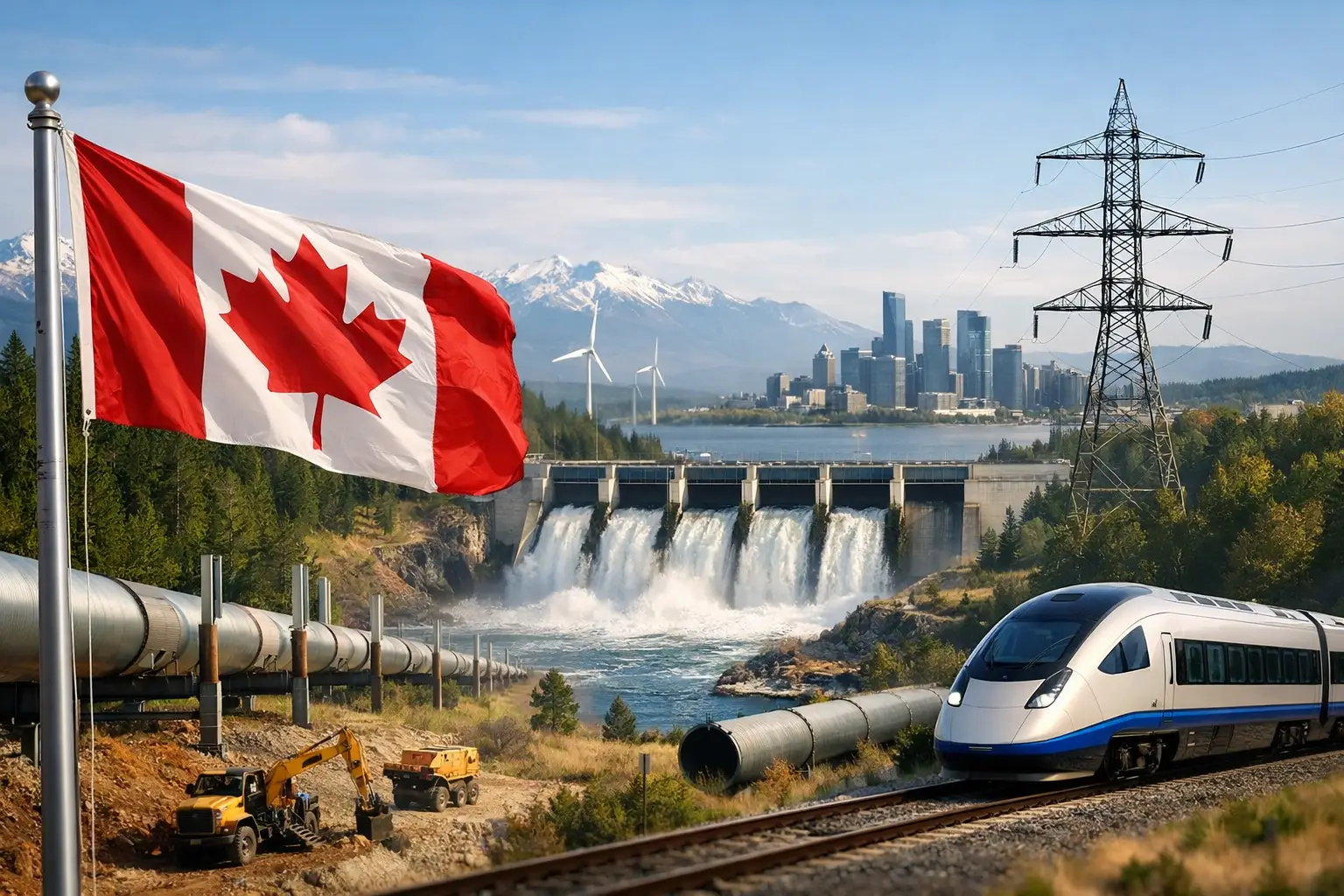
There is no magical category that turns a controversial proposal into an obvious public good. In practice, canada’s national interest projects are major infrastructure or industrial developments that governments frame as strategically important to the country. That can include pipelines, electricity transmission, ports, mining projects, LNG terminals, critical minerals processing, nuclear investments, and major transportation corridors.
The phrase matters because it signals priority. It tells regulators, investors, provinces, and the public that the project is supposed to serve a broader purpose than private profit. Usually that broader purpose is one or more of the following: economic growth, energy security, export capacity, productivity, geopolitical leverage, or supply chain resilience.
That all sounds reasonable. Sometimes it is. But the label itself proves very little.
A project can be large and still be poorly designed. It can promise jobs while destroying capital through delays and cost overruns. It can improve export access while increasing legal conflict with provinces or Indigenous nations. It can reduce one vulnerability and create another. Calling something national interest is not analysis. It is the opening claim.
Why the term is back in circulation
The renewed attention is not hard to explain. Canada is stuck in a familiar loop: abundant resources, high demand for infrastructure, and a permitting system that often moves at the speed of sedimentary rock. At the same time, the outside world has gotten less stable.
Energy security matters more than it did a few years ago. Critical minerals are now tied to industrial policy and defense policy. Trade routes are being reassessed. The United States is subsidizing domestic production aggressively. Europe wants dependable suppliers. And Canada, on paper, has many of the inputs the world wants.
So the argument for national interest projects goes something like this: if the country has strategic assets but cannot build the infrastructure needed to develop them, then it is effectively choosing stagnation. That is not a crazy argument. It is also not complete.
The missing piece is that speed is not the only problem. Coordination is. Canada has overlapping federal and provincial authorities, environmental review systems, court challenges, Indigenous consultation duties, private financing constraints, and a political culture that often wants growth and veto power at the same time. That combination is not impossible to manage. It is just much harder than the phrase national interest suggests.
Subscribe To Our Newsletter!
The strongest case for national interest projects
The best argument is not ideological. It is structural.
A country with Canada’s geography and resource base needs infrastructure to convert potential into actual economic output. Resources in the ground are not GDP. Electricity generation without transmission is not industrial capacity. A mineral deposit without roads, processing, and permits is mostly a press release. If a government can identify a narrow set of projects that materially improve national resilience, export earnings, and productivity, then prioritizing them makes sense.
This is especially true in sectors where timing matters. Critical minerals are a good example. If Canada wants to be part of North America’s battery and advanced manufacturing supply chains, it cannot rely on a ten-year decision cycle and assume investors will wait politely. Capital is mobile. Projects are not.
There is also a serious fiscal point here. Countries do not fund public services through vibes. They fund them through productive economies, tax revenue, and investment. If key projects can expand output, reduce bottlenecks, and improve trade performance, they affect much more than a single sector.
That is the grown-up version of the argument. Not “build everything.” Not “environmental review is fake.” Just a simple question: are there projects whose national value is high enough that government should treat them differently from routine proposals?
Probably yes.
The case against using the label too casually
Now the other side, which is where the rhetoric usually gets thinner.
National interest for whom? That question tends to arrive late, right after the press conference.
A project can generate federal tax revenue and still impose concentrated local costs. It can benefit one region more than another. It can strengthen exports while increasing emissions, land-use conflict, or pressure on housing and services around project sites. And if governments use the national interest label mainly as a way to shortcut scrutiny, they are not reducing conflict. They are storing it for later, with interest.
There is also a habit of confusing scale with strategy. Bigger does not automatically mean more important. Some very expensive projects do little for long-term productivity. Others mainly enrich a small set of firms while leaving the public with cleanup obligations, infrastructure liabilities, or stranded assets if market conditions change.
Then there is execution risk, which rarely gets enough attention because it is less cinematic than a political fight. A project may be worth doing in theory and still become uneconomic in practice due to delays, inflation, labor shortages, weak power supply, or poor procurement. Governments love announcements. Concrete is less cooperative.
How to judge whether a project is actually in the national interest
This is where the conversation gets useful. A serious test is not whether a project sounds strategic. Almost everything sounds strategic if the press release is polished enough.
A better test starts with five questions.
First, does the project solve a real national bottleneck? That could mean export access, grid capacity, processing capability, transportation constraints, or supply chain vulnerability. If it does not remove a meaningful constraint, the strategic language is probably decorative.
Second, is the economic case durable under realistic conditions? Not best-case assumptions. Realistic ones. That means looking at demand, cost inflation, financing, commodity prices, and competing jurisdictions.
Third, are the benefits broad enough to justify public prioritization? A project does not need to help everyone equally, but there should be a credible case that the gains extend beyond a narrow private interest.
Fourth, is the consultation and permitting process clear enough to produce legitimacy? Faster is useful. Arbitrary is not. If communities and Indigenous nations are treated as procedural obstacles, the project is being set up for legal and political instability.
Fifth, what is the opportunity cost? Every government has limited political capital, administrative capacity, and in some cases public money. Prioritizing one project means delaying another. That choice should be explicit, not hidden behind patriotic language.
National interest projects and the politics of impatience
Part of the current appeal is emotional. People are tired of hearing that a country rich in energy, minerals, land, and technical talent somehow cannot build things on a reasonable timeline. Fair enough. That frustration is not invented.
But impatience can distort judgment. Some advocates act as if the only barrier is activist obstruction. Some opponents act as if every large project is a corporate scheme in a hard hat. Both positions are too convenient.
The real issue is state capacity. Can governments define priorities clearly, coordinate across jurisdictions, make timely decisions, enforce conditions, and maintain public legitimacy? If the answer is no, rebranding projects as national interest will not fix much. It just changes the packaging.
That may be the least exciting answer, which is probably why it gets less airtime. But it is the one that matters. Countries do not become more competitive because they say strategic things in a confident tone. They become more competitive when institutions can distinguish between worthwhile projects and expensive theater, then move accordingly.
What this likely means going forward
Expect the phrase to keep expanding. More sectors will try to fit under it, from energy and mining to AI infrastructure, transmission, ports, and advanced manufacturing. Some of that expansion will be justified. Some of it will be opportunistic. A term with political force tends to attract applicants.
The smarter path is not to reject canada’s national interest projects as a concept, and not to accept them as a self-proving category. It is to demand sharper criteria and more honesty about trade-offs.
If a project truly strengthens the country’s productive capacity, strategic resilience, and long-term economic position, it should be able to survive serious scrutiny. If it cannot survive scrutiny, the problem is probably not the scrutiny.
That is the useful filter to keep in mind the next time the phrase shows up wrapped in urgency. Sometimes it signals a real strategic shift. Sometimes it is just politics wearing a hard hat.