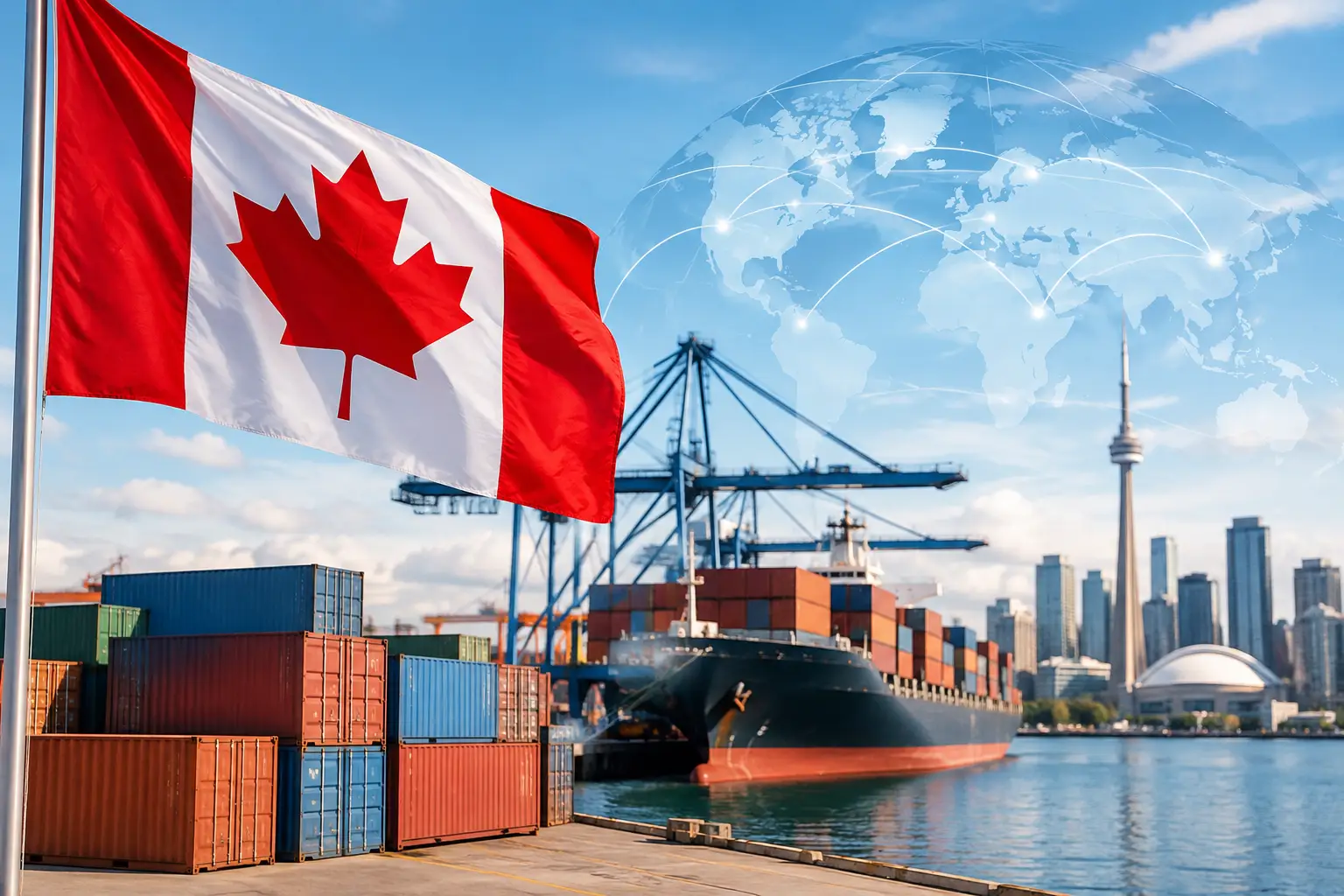
Canada does not merely trade with the United States. It operates inside a continental production system built over decades, then periodically rediscovers that fact when a tariff threat becomes a headline. Any useful guide to Canadian trade exposure starts there. The question is not whether Canada is exposed to trade. It plainly is. The harder question is where that exposure is concentrated, who absorbs the cost when rules change, and whether the popular story matches the economic reality.
The answer is less dramatic than the loudest commentary suggests, but more consequential than a simple export total. Trade exposure reaches into household prices, factory payrolls, capital spending, provincial revenues, and the bargaining power of firms that have few practical alternatives to the U.S. market.
1. Canada’s exposure is real, but it is not uniform
According to Statistics Canada, the United States routinely accounts for roughly three-quarters of Canadian merchandise exports. That number is large enough to justify concern and familiar enough that it can lose its force. A country that sells three out of every four exported goods dollars to one customer has a concentration risk. Calling it “integration” does not make the risk disappear.
But the national figure can also mislead. Canada is not one company with one product line. Exposure differs sharply by industry and region. Energy producers, auto manufacturing, metals, forestry, agriculture, aerospace, and some industrial suppliers face very different market structures. A software firm selling globally from Toronto does not face the same trade risk as a Windsor auto-parts plant or a Saskatchewan canola exporter.
That distinction matters because a tariff or border disruption is never evenly distributed. A measure aimed at steel may barely register in much of the service economy while hitting a particular cluster of producers, transport firms, and communities with real force. National averages are useful for setting the scene. They are a poor substitute for identifying the actual fault lines.
2. The border is a supply chain, not a finish line
The common picture of trade is a Canadian company making a product, placing it on a truck, and selling it to an American buyer. Sometimes that happens. Often, the product has already crossed the border once or several times before it is finished.
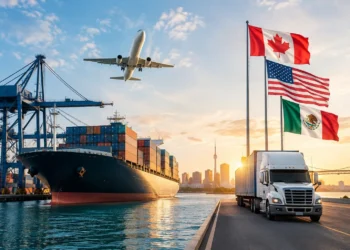
North American auto production is the obvious example. Components move among Canadian, U.S., and Mexican facilities according to specialized manufacturing roles, sourcing rules, and established logistics. The same basic pattern appears in food processing, machinery, chemicals, and energy. Trade is not just an exchange between two sealed national economies. It is part of how the production itself is organized.
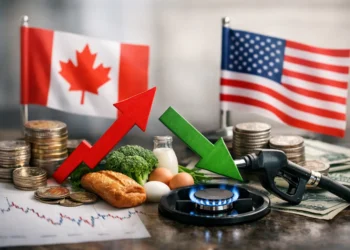
This is why broad tariffs can create a strange political spectacle. A policy marketed as pressure on another country can raise costs for domestic manufacturers using imported inputs, then raise prices for domestic consumers. There is no economic magic in a border charge. Someone pays it: the importer, supplier, producer, worker, shareholder, or customer. Usually, several of them do.
For Canada, the practical implication is that exposure cannot be measured only by final exports. It also includes reliance on imported intermediate goods, transportation corridors, customs processing, and predictable rules of origin under the Canada-United States-Mexico Agreement, or CUSMA. A border that becomes slower, costlier, or less predictable can damage a business even if its final customer is still willing to buy.
3. Energy makes the relationship look lopsided – and mutual
Canada’s energy trade is often described as dependence on the U.S. market. That is true, particularly because pipeline networks and refinery configurations have tied Canadian crude and electricity exports to specific American regions. Geography is not an ideology. It is infrastructure.
Subscribe To Our Newsletter!
Yet the relationship runs both ways. The United States relies on Canadian supplies of crude oil, electricity, natural gas, uranium, potash, aluminum, lumber, and other inputs that feed American homes and industries. The scale varies by product and year, but the broader point holds: Canada is not simply a seller seeking favor from a much larger buyer. It is a supplier embedded in systems that American firms and consumers also depend on.
This mutual dependence does not erase the power imbalance. The U.S. economy is much larger, and it has more leverage simply because it offers the larger market. But mutual dependence changes the calculation. A disruption to Canadian energy or critical-material exports can show up as higher input costs and supply constraints south of the border. That gives Canada some negotiating weight, even if it is rarely as emotionally satisfying as the rhetoric of “standing up” to someone.
4. Diversification is necessary, but it is not a slogan
Whenever trade tension rises, the standard response appears on schedule: Canada must diversify. Correct. Also incomplete.
Selling more to Europe, Asia, and other markets can reduce concentration risk, but diversification takes more than signing an agreement or announcing a trade mission. Businesses need customers, distribution networks, product certifications, working capital, shipping capacity, and a commercial reason to redesign supply chains. For bulk commodities, distance and infrastructure matter enormously. For regulated products, standards and local relationships can matter just as much.
Canada has trade agreements with a wider group of partners than its export profile might suggest, including the Comprehensive Economic and Trade Agreement with the European Union and the Comprehensive and Progressive Agreement for Trans-Pacific Partnership. These agreements improve access. They do not manufacture demand or make the Pacific Ocean smaller.
The more serious version of diversification is therefore selective. It means identifying products where Canada has an advantage, investing in the ports, rail capacity, energy systems, and trade finance that support them, and helping smaller firms manage the fixed costs of entering new markets. It also means accepting that the United States will remain Canada’s dominant trading partner. The goal is not to replace that relationship. It is to avoid having no meaningful options when it becomes difficult.
5. The biggest risk is uncertainty, not always the tariff rate
Businesses can plan around many costs. They struggle to plan around shifting rules, sudden exemptions, contradictory statements, and the possibility that a contract will become unprofitable before the shipment arrives.
That is why trade threats can have effects before any policy takes effect. Firms delay investment. Buyers search for alternative suppliers. Inventories rise as companies try to get ahead of possible charges. Credit decisions become more cautious. These are not always dramatic enough for television panels, but they are how uncertainty moves from political theater into the real economy.
A tariff can sometimes be absorbed, particularly when margins are healthy, demand is strong, or the product is difficult to replace. Uncertainty is harder because it affects every planning horizon at once. A manufacturer deciding whether to add a production line is not only estimating next quarter’s cost. It is making a multi-year judgment about the stability of the market.
This is also where public narratives get careless. A threat may be framed as either proof of imminent disaster or proof that nothing matters because trade continues. Both claims are too neat. The impact depends on product substitutability, contract terms, currency movements, inventory levels, local labor markets, and whether a measure lasts days, months, or years. Economics remains stubbornly unwilling to fit into a slogan.
What a clear-eyed response looks like
A practical guide to Canadian trade exposure should lead to better questions, not performative certainty. Which sectors have a single-market problem? Which imports are essential inputs for Canadian production? Where are the transport and customs bottlenecks? Which trade agreements offer real commercial opportunity rather than ceremonial optimism? And what policies reduce vulnerability without simply making Canadian consumers and producers pay more?
For policymakers, that points toward predictable trade rules, targeted support during genuine disruptions, stronger domestic infrastructure, and serious market development beyond North America. For businesses, it means mapping supplier and customer concentration before a crisis forces the exercise. For citizens, it means resisting the temptation to treat every trade dispute as either national humiliation or a harmless negotiating tactic.
Canada’s trade exposure is not a flaw to be wished away. It is the price, and the benefit, of being deeply connected to the world’s largest economy while supplying things that economy genuinely needs. The useful task is quieter: build more options, understand the dependencies, and refuse to confuse loudness with leverage.