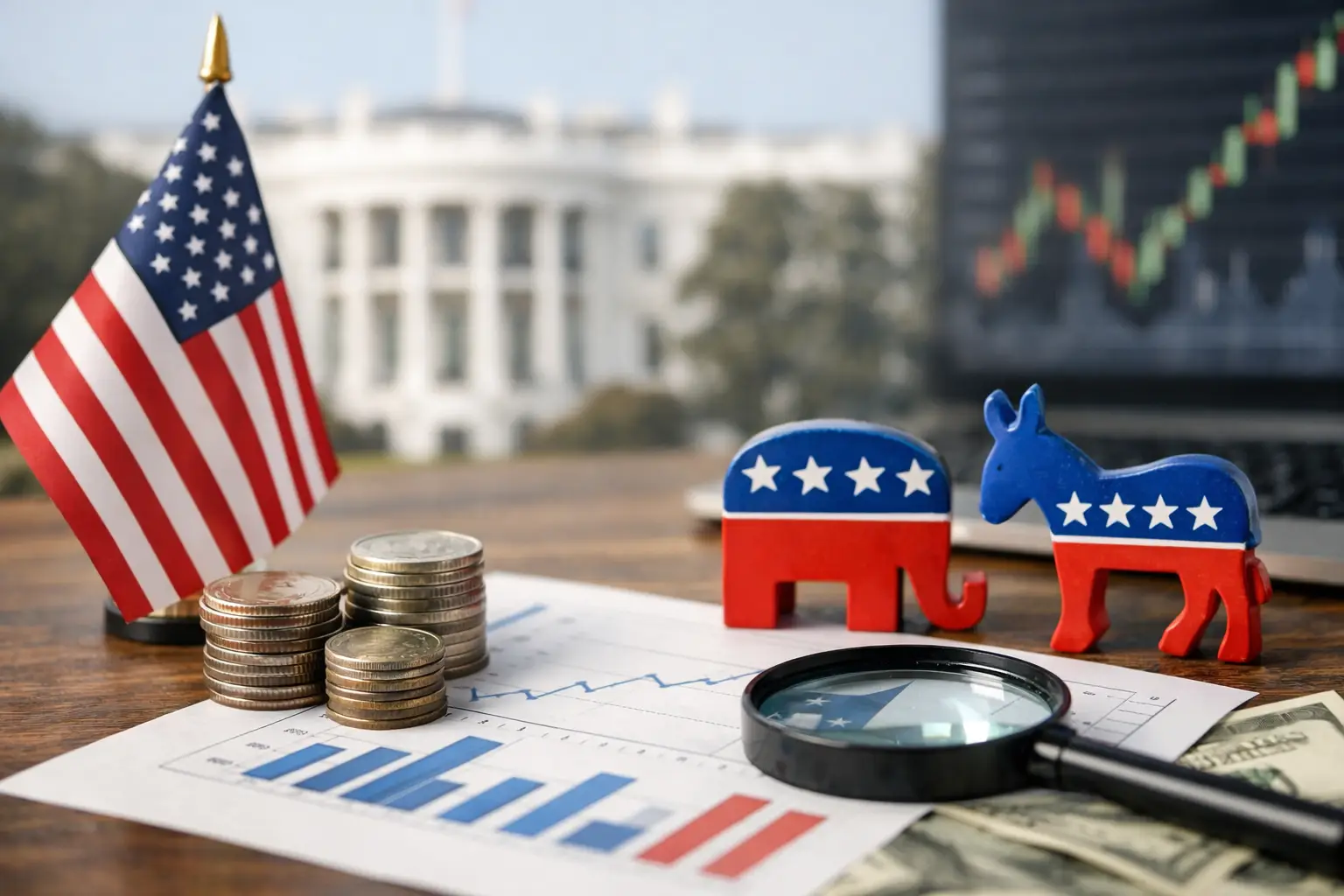
A guide to election year economics starts with an uncomfortable fact: campaigns do not control the economy nearly as much as campaign messaging suggests. Candidates inherit inflation trends, interest-rate decisions, supply disruptions, labor-market conditions, and consumer confidence that have been building for years. Then everyone acts surprised when a 30-second ad fails to explain any of that.
Election years can affect economic behavior. They can delay decisions, shift expectations, and put real policy stakes on the table. But treating every job report, market move, or gasoline-price change as a referendum on the candidates is a reliable way to misunderstand what is happening.
The useful question is not, “Will the election crash the economy?” It is: which parts of the economy can politics influence quickly, which parts move on their own timetable, and where is uncertainty genuinely changing behavior?
1. Separate the economy from the election narrative
The economy is a large system with long lags. Interest-rate changes take time to filter through mortgages, business borrowing, construction, and spending. Tax changes may matter, but their effects depend on timing, household income, corporate investment plans, and whether consumers save or spend the difference. Global oil prices are influenced by production decisions, wars, weather, and demand across the world – not a candidate’s press conference.
Campaigns naturally compress all this into a cleaner story. If conditions are good, the governing party claims competence. If conditions are bad, the opposition claims proof of failure. Both stories may contain a sliver of truth. Neither is a serious model of cause and effect.
That does not mean government is irrelevant. Fiscal policy, trade rules, immigration policy, regulation, energy permitting, health-care spending, and central-bank appointments can materially shape the economy. The point is that the effects often arrive later, and they are rarely attributable to one person or one election alone.
A better habit is to ask two questions whenever a political claim is made: when did this trend begin, and what mechanism connects the policy to the outcome? If nobody can answer either question, you are probably looking at a slogan wearing an economics costume.
2. Watch confidence, not just headline data
Election-year uncertainty can be real even when the national numbers look stable. Businesses may postpone hiring, expansion, or equipment purchases if they expect significant changes to taxes, tariffs, regulations, or government contracts. Households may also become more cautious, especially when political coverage reinforces a sense that disaster is permanently scheduled for November.
Still, confidence is not the same as collapse. A company delaying a factory decision is not evidence that the whole economy has stopped. Nor does a volatile week in the stock market prove that investors have identified the future before everyone else. Markets price probabilities, revise them constantly, and occasionally become theatrical. They are useful information, not an oracle.
For a grounded read, look at several measures together: employment growth, wage growth after inflation, consumer spending, business investment, housing activity, credit conditions, and inflation expectations. One number can mislead. A single month of weak hiring may be weather, strikes, or statistical revision. A single strong retail-sales report may reflect higher prices rather than more goods purchased.
Subscribe To Our Newsletter!
The broader pattern matters more than the loudest chart on social media.
3. Understand why inflation dominates the political mood
Voters often evaluate the economy through prices they encounter repeatedly: groceries, rent, gasoline, insurance, and restaurant bills. This is rational on a personal level. If monthly essentials cost more, a low unemployment rate can feel abstract.
But inflation creates a communication trap. When the inflation rate falls, prices are not falling. They are still rising, just more slowly. A return from rapid inflation to modest inflation can improve the outlook without restoring the price levels households remember. This distinction is basic economics, yet it remains remarkably absent from political rhetoric. Presumably because “disinflation” does not fit neatly on a yard sign.
Election-year claims should therefore distinguish among three different things: the level of prices, the pace at which prices are rising, and whether wages have kept up. A household can be better off than it was a year ago if pay has grown faster than prices, while still feeling poorer than it did before a large price shock. Both can be true.
That gap between measurable improvement and lived frustration is one of the central facts of election year economics. Ignoring the data is foolish. Ignoring the frustration is not much smarter.
4. Treat market predictions with disciplined skepticism
There is no shortage of claims that markets favor one party, fear another, or forecast the winner. Most are much stronger in hindsight than in real time.
Historical averages can be interesting, but they rarely provide a decision rule. Election years differ in starting conditions. An economy recovering from a recession is not comparable to one facing persistent inflation. A close election with radically different trade policies is not comparable to a race where the likely policy path is broadly familiar. Global events can overwhelm domestic politics entirely.
Investors should also distinguish between short-term volatility and long-term value. A proposed tariff might help a protected industry while raising costs for manufacturers and consumers. A tax cut might boost after-tax earnings while increasing deficits and borrowing costs. A regulatory rollback may lift one sector and introduce risks elsewhere. Policy has winners, losers, and unintended consequences. That is not cynicism. It is the normal operating procedure of a complex economy.
For most people, the sensible response to election-related market noise is not to make an all-or-nothing political trade. It is to revisit time horizon, diversification, cash needs, and risk tolerance. If a portfolio only works when your preferred candidate wins, the portfolio may be carrying more risk than the election.
5. Focus on policies, timelines, and constraints
The strongest version of a guide to election year economics is deliberately less exciting than cable-news certainty. It asks what a candidate can actually do, how quickly it could happen, and what institutions could limit it.
A president cannot set grocery prices. Congress controls major tax and spending legislation. The Federal Reserve sets monetary policy independently, though elected officials will certainly have opinions about it. Courts can delay or block regulations. State governments control many rules that affect housing, labor, energy, and business costs. In Canada, federal and provincial responsibilities create a similar complication: a national campaign can dominate attention while important economic levers remain elsewhere.
When assessing a proposal, follow the chain. What is the policy? Does the executive branch have authority to implement it? Does it require legislation? Who pays? Who benefits first? What might change in one year, and what would likely take five?
This approach also clarifies trade-offs. Lower taxes can support household income or investment, but may increase deficits unless spending falls or revenue rises elsewhere. Tighter trade restrictions can protect certain domestic producers, but can also raise input costs and invite retaliation. More public spending can support demand, but may add pressure in an economy already constrained by labor or supply shortages.
There is no policy choice without a cost. There are only costs that someone has decided not to mention.
The calm way to read an election-year economy
Election years reward overreaction because overreaction is profitable for campaigns, pundits, and platforms. The economy itself is usually more stubborn. It reflects decisions made by households, businesses, central banks, legislatures, and trading partners over long periods of time.
Pay attention to policy differences. Take uncertainty seriously when it changes actual investment, hiring, or borrowing decisions. But resist the urge to turn every market tick into a political prophecy. Calm analysis is not passive. It is how you keep temporary noise from making permanent decisions for you.