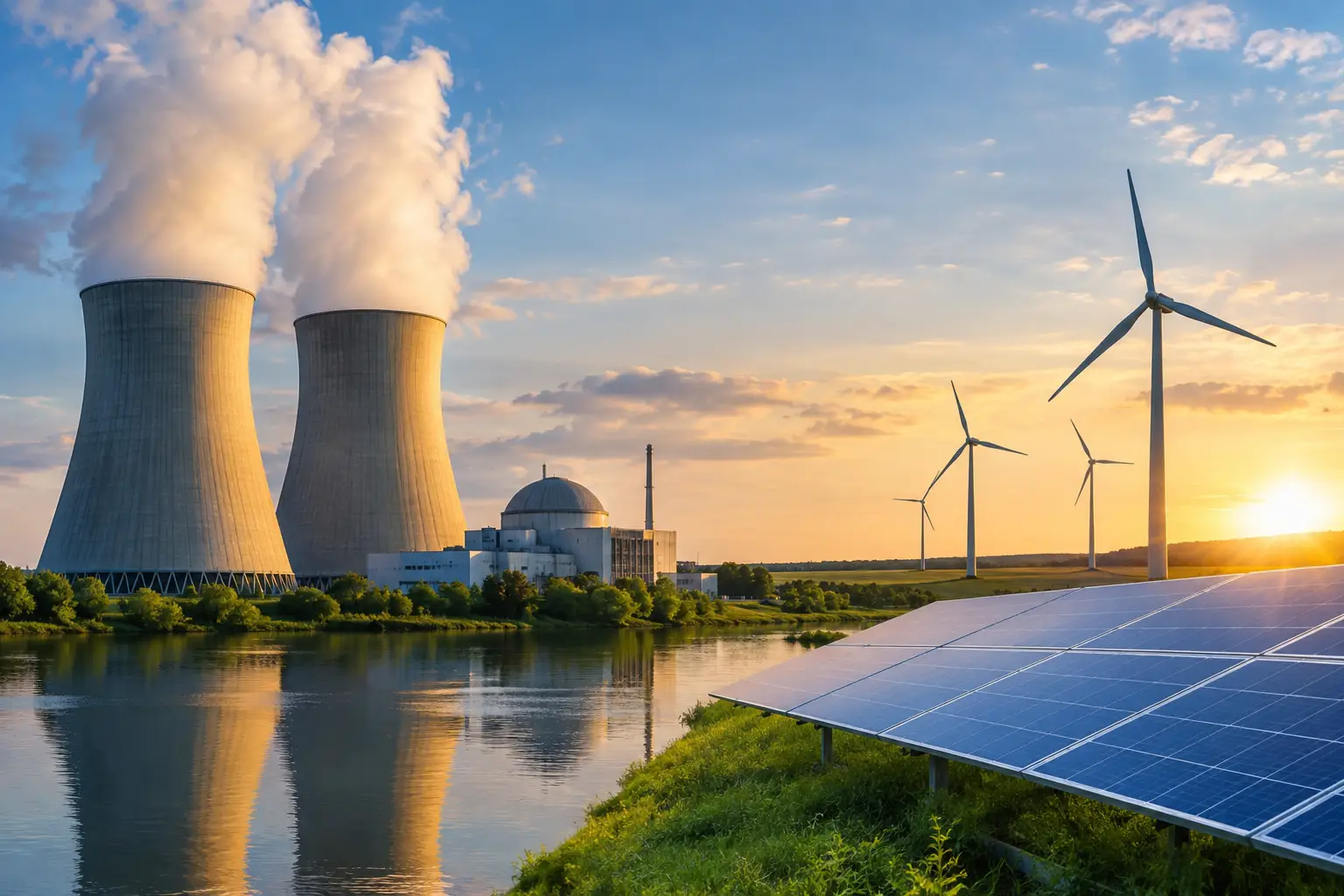
The argument over nuclear power vs renewables usually begins with a misleading premise: that a country must pick one side and prove its moral virtue by rejecting the other. Solar and wind advocates talk as if nuclear plants are relics. Nuclear advocates sometimes describe wind and solar as decorative accessories for a serious grid. Neither framing survives contact with the electricity system.
The actual question is less cinematic: what combination of technologies can cut emissions, keep power affordable, and provide electricity when people need it? That question has different answers in Texas, Quebec, California, Ontario, France, and a rural Midwestern utility territory. Geography, existing infrastructure, demand growth, industrial load, financing, and politics all matter. Annoying, perhaps. Also true.
1. The Nuclear Power vs Renewables Debate Is Mostly a Timing Debate
Wind and solar can be planned and built far faster than conventional nuclear plants. Utility-scale solar projects can often move from approval to operation in a few years, although transmission delays can stretch that timeline. Wind can also be deployed relatively quickly where permitting, interconnection, and local support align. New large nuclear reactors, by contrast, commonly take a decade or more from early planning to commercial operation.
That difference matters because emissions reductions are not an abstract 2050 exercise. Coal plants operating this decade still emit carbon this decade. The International Energy Agency has repeatedly identified renewables as the fastest-growing source of new electricity generation because they are comparatively quick to deploy and, in many regions, among the least expensive sources of new power.
But speed is not the whole story. A solar farm built quickly does not automatically replace a coal or gas plant at 8 p.m. during a heat wave. It produces when sunlight is available. Wind production varies by weather patterns, sometimes helpfully and sometimes not. A system built around variable generation needs transmission, storage, demand management, flexible generation, and careful market design. Those are not optional fine print.
New nuclear is slow. Existing nuclear is already here. Extending the life of a safe, operating reactor can preserve large volumes of low-carbon generation that would otherwise be replaced, at least initially, by natural gas. That is often one of the most practical climate decisions available, even if it lacks the visual appeal of a newly installed solar field.
2. Reliability Is Not the Same as “Always On”
Nuclear plants run at high capacity factors, meaning they generate close to their maximum possible output for much of the year. In the United States, nuclear has consistently produced more electricity per unit of installed capacity than wind or solar. This makes it valuable for a grid that needs dependable energy through cold snaps, heat waves, and long winter nights.
Still, “always on” is a useful shorthand, not a complete grid strategy. Nuclear plants require planned refueling outages and can experience unexpected shutdowns. Extreme weather can affect cooling-water availability. France’s nuclear fleet has demonstrated that a large standardized program can generate substantial low-carbon electricity, but it has also shown how maintenance schedules and corrosion concerns can create system-wide pressure when many units face similar issues.
Renewables have a different reliability profile. Their output is variable, but their fuel cannot be embargoed, priced by a cartel, or delayed by a rail strike. A geographically diverse mix of wind and solar reduces the risk that a single weather event eliminates supply everywhere. Add batteries, hydropower, interregional transmission, and programs that pay large users to shift demand, and variable generation becomes considerably more useful.
The sensible metric is not whether a technology is perfect in isolation. It is whether the entire system can meet demand during its hardest hours at an acceptable cost. A power grid is a team sport, not a personality contest.
Subscribe To Our Newsletter!
3. Cost Claims Often Compare the Wrong Things
It is generally cheaper to build new wind and solar capacity than new large-scale nuclear capacity. This is especially true when comparing the upfront cost per unit of expected electricity. Recent nuclear projects in the United States and Europe have suffered notorious delays and overruns, turning what should have been engineering triumphs into cautionary tales about financing, construction management, and institutional competence.
That does not mean nuclear is inherently uneconomic in every circumstance. It means building a first-of-a-kind or poorly managed reactor in a country that has let its nuclear supply chain atrophy is expensive. South Korea’s construction record and the historical buildout in France suggest costs can be lower when designs are standardized, projects are repeated, workforces are retained, and governments stop redesigning the policy framework halfway through construction. A low bar, one might think.
The same caution applies to renewables. The headline price of a solar panel or wind turbine is not the cost of a fully reliable, decarbonized power system. As renewable penetration rises, the system needs more transmission, storage, backup capacity, and grid upgrades. Those investments are worthwhile and often still economically attractive, but pretending they cost nothing is not analysis.
For households and businesses, the relevant question is total system cost: generation, wires, balancing, resilience, and fuel exposure. The answer will vary. Regions with strong wind resources, abundant sunshine, hydroelectric flexibility, or existing nuclear fleets start from very different positions.
4. Land, Materials, and Waste Require Adult-Level Trade-Offs
Nuclear power is extraordinarily land-efficient. A reactor site can generate large quantities of electricity on a relatively small footprint. Wind and solar require more land area per unit of annual generation, though much of that land can have dual uses. Solar can sit on rooftops, parking lots, brownfields, and disturbed land. Wind turbines can coexist with farming and grazing.
Renewables also require significant quantities of steel, copper, concrete, glass, and, depending on the technology, critical minerals. Nuclear requires large material inputs as well, along with specialized components and a highly regulated fuel cycle. No energy system arrives free of mining, industrial impacts, or local opposition. The clean-energy conversation gets less comfortable once it leaves the campaign brochure.
Then there is nuclear waste, the issue that reliably ends many conversations before they begin. The volume of spent nuclear fuel is small relative to the energy produced, and it is contained and managed rather than released into the atmosphere. The technical case for deep geological repositories is strong. The political case has been much harder because communities and governments have repeatedly postponed decisions.
That is a governance problem, not evidence that the waste vanishes or that it is trivial. It is serious waste requiring long-term stewardship. So are the damaged ecosystems and health costs associated with fossil fuels, which remain far larger and far more immediate. The comparison should be between real alternatives, not between one technology’s visible downside and another’s idealized version.
5. The Real Enemy Is Fossil Dependence, Not the Other Low-Carbon Option
The Intergovernmental Panel on Climate Change, the International Energy Agency, and most serious grid studies converge on the broad conclusion: deep decarbonization requires rapid renewable growth, major grid investment, efficiency improvements, and, in many scenarios, continued or expanded nuclear power. The proportions differ. The direction does not.
For the United States and Canada, preserving productive existing nuclear plants is usually easier to justify than betting everything on expensive new reactors. Meanwhile, rapidly expanding wind, solar, transmission, storage, and demand flexibility is essential because electricity demand is rising. Data centers, electrified vehicles, heat pumps, and industrial reshoring are all asking more of a grid that was already overdue for upgrades.
New nuclear deserves a selective rather than devotional approach. Small modular reactors may eventually help remote communities, industrial sites, and constrained grids, but they have not yet proved they can deliver electricity cheaply at commercial scale. Treating them as a guaranteed breakthrough would be premature. Dismissing them before the evidence arrives would be equally unserious.
The least useful energy policy is one built around tribal identity: nuclear good, renewables bad, or the reverse. A better policy asks what can be built fast, what can operate reliably, what the grid lacks, and what taxpayers and ratepayers can realistically afford. Climate policy has enough hard problems without turning every power plant into a cultural referendum.
The next time someone insists there is only one acceptable answer, ask the boring but decisive question: what keeps the lights on in their plan when demand peaks, the wind slows, the sun sets, and fossil fuel use must still fall? The answer should be more than a slogan.