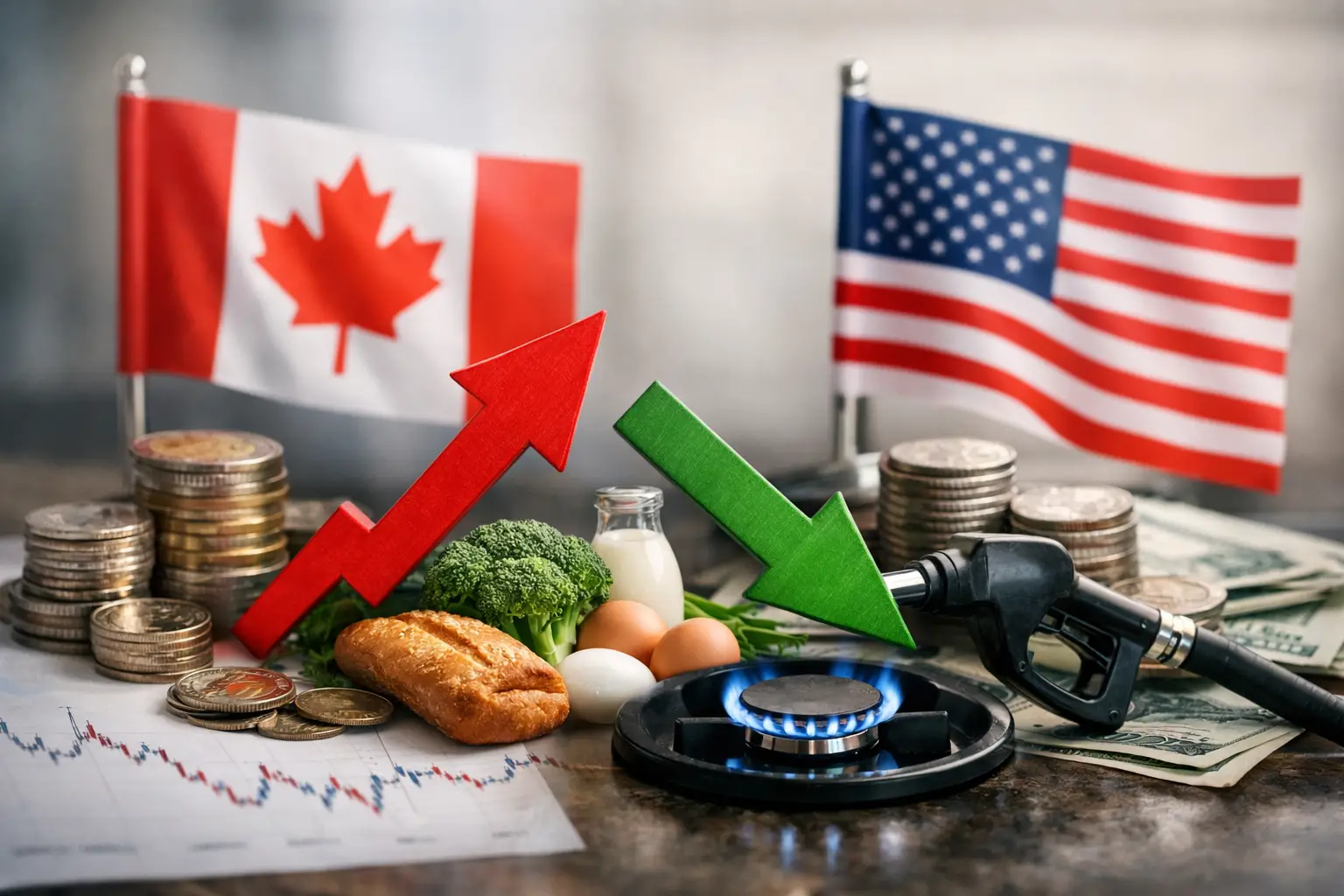
If you only glanced at recent headlines, you could be forgiven for thinking Canada vs US inflation is basically the same story with different flags. Prices surged, central banks hiked rates, everyone got angry at the grocery bill, and politicians claimed they had a plan. Neat story. Also incomplete.
The more useful question is not which country had inflation. Both did. The real question is why inflation felt different, lasted differently across categories, and hit households through different pressure points. That is where the public conversation usually gets fuzzy.
Canada vs US inflation starts with the same shock, but not the same economy
Both countries were hit by the same broad forces. Pandemic disruptions wrecked supply chains. Governments supported household incomes. Consumers shifted spending patterns. Then energy and food shocks added more pressure. None of that is controversial.
What matters is how those shocks landed inside two economies that look similar from a distance but are built a bit differently. The US economy is larger, more productive, and more domestically diversified. Canada is more exposed to housing, household debt, and the downstream effects of commodity cycles. So even when headline inflation moved in the same direction, the mechanics underneath were not identical.
This is where people often flatten the story into a contest. Which country handled it better? That is tempting, but it misses the point. Inflation is not a single number with a moral lesson attached. It is a bundle of price pressures moving through labor markets, housing systems, energy costs, and consumer behavior at different speeds.
1. The US had hotter demand. Canada had a more fragile household backdrop
In the US, inflation was fueled in large part by an unusually strong burst of consumer demand. Massive fiscal support, a rapid reopening, and a labor market that recovered with surprising force pushed spending hard. Americans had cash, confidence, and in many cases a willingness to keep buying even as prices climbed.
Canada also supported households aggressively, but its inflation story ran into a different structural issue: leverage. Canadian households carry high debt loads, much of it tied to housing. That changes how inflation and interest rates are experienced. When borrowing costs rise, the pain transmits quickly through mortgage payments, renewals, and consumer budgets.
So yes, both countries dealt with inflation. But the US looked more like an overheated engine. Canada looked more like a household balance sheet under strain. Similar symptom, different vulnerability.
That difference matters because it shapes policy trade-offs. A central bank facing broad demand overheating may need to stay restrictive longer. A central bank facing inflation in an economy loaded with housing debt has to think about how quickly higher rates will squeeze consumers. There is no elegant version of this. Just hard timing decisions.
2. Housing makes Canada vs US inflation feel very different
If you want to understand why inflation feels more politically toxic in Canada, start with shelter.
Subscribe To Our Newsletter!
Housing costs matter everywhere, but in Canada they carry outsized weight in both economic reality and public psychology. Home prices ran up sharply, rents climbed, and mortgage costs became a central pressure point. Even when overall inflation cooled, shelter kept many households from feeling any relief. Nothing says “inflation is easing” quite like paying hundreds more a month to stay in the same place. Very reassuring.
The US has housing inflation too, but the transmission is different. Many American homeowners locked in low fixed-rate mortgages for long terms, which insulated them from immediate payment shocks. That does not make housing affordable. It just means the effect of higher interest rates hit different groups in different ways, especially renters and first-time buyers, rather than broad swaths of existing owners all at once.
Canada’s mortgage structure created a faster and more visible handoff from central bank tightening to household stress. That is one reason people can look at a chart showing inflation coming down and still feel like the chart is gaslighting them.
Why shelter complicates the narrative
Shelter inflation is also politically awkward because it sits at the intersection of monetary policy, local zoning, immigration, construction costs, and plain old supply shortages. It cannot be fixed by one rate decision or one speech about affordability.
So when people ask whether Canada or the US has “worse inflation,” they are often really asking a narrower question: where is housing breaking the social contract more aggressively? On that front, Canada has had a tougher time.
3. Labor markets looked strong in both countries, but wage dynamics were not the same
Another common claim is that inflation simply comes from workers earning more. That story is tidy, popular, and often overstated.
The US labor market was exceptionally tight. Job openings surged, wage growth accelerated, and employers had to compete harder for workers. That gave the Federal Reserve a real reason to worry that inflation could become embedded through wages and services.
Canada also saw labor market strength, but wage dynamics were less clearly the main engine of inflation. Wage growth picked up, but not in a way that fully explains the cost increases households were seeing across essentials. In many sectors, workers were not outrunning inflation. They were trying not to drown in it.
This distinction matters because wages can be both a source of inflation and a delayed response to it. Treating every pay increase as evidence of excess is a good way to misunderstand what households are actually living through.
Strong jobs numbers do not equal easy economics
Both countries produced periods of surprisingly resilient employment. That helped avoid recession, but it also made the inflation fight messier. Strong labor markets gave central banks room to keep rates high. At the same time, households facing rising food, rent, and debt-service costs did not exactly experience the moment as a triumph of macroeconomic resilience.
That is the problem with broad economic averages. They are useful until they become a substitute for reality.
4. Energy and food distorted perceptions on both sides of the border
Inflation is partly economic and partly psychological. Consumers notice the prices they see often and resent the ones they cannot avoid. Gas and groceries do a lot of narrative work.
In both countries, food inflation hit hard because it landed repeatedly and publicly. You can postpone buying a couch. You cannot postpone eating. Energy prices also swung perceptions because they move quickly and visibly. When gas prices spike, people feel inflation before they study it.
Canada and the US each produce energy, but consumers do not experience those systems in the same way. Taxes, transport costs, regional market differences, and currency effects all shape what people pay. So even when the global shock is shared, the household impact can diverge.
This is another reason headline comparisons only get you so far. Two countries can post similar inflation rates while households fixate on totally different pain points. One family is furious about rent. Another is getting crushed by auto insurance and food. Another is fine on both but stuck with a mortgage reset that feels like a financial prank.
5. The policy response was similar on paper, but the consequences were not
Both the Bank of Canada and the Federal Reserve raised rates aggressively. Both talked about restoring price stability. Both faced the same basic challenge: cool inflation without wrecking the labor market.
But similar policy paths do not guarantee similar outcomes. The US entered the tightening cycle with stronger productivity, deeper capital markets, and more room for economic momentum to absorb higher rates. Canada entered with higher sensitivity to housing and household debt. That does not mean one central bank was right and the other wrong. It means the same medicine can hit two patients differently.
There is also a credibility question lurking underneath. In both countries, official inflation has come down from the peak. But trust does not recover as quickly as the CPI. Households care less about whether inflation is 3 percent instead of 8 percent than whether the price level has permanently ratcheted higher. And of course it has.
That is why the public often sounds more pessimistic than the data suggests it should. People are not confused. They are responding to the fact that disinflation is not the same as going back to the old cost of living.
So which country is actually doing better?
It depends on what you mean by better.
If you mean which economy generated stronger demand and labor-market resilience, the US has a strong case. If you mean which country looks more exposed to housing-driven stress and interest-rate sensitivity, Canada is harder to defend. If you mean which public feels less convinced by reassuring macro headlines, both have reasons for skepticism.
The cleaner takeaway is this: Canada vs US inflation is not a useful debate if it ends at the headline rate. The interesting part is what inflation reveals about each economy’s weak spots. In the US, that was overheating demand and service-sector pressure. In Canada, it was housing dependence, debt sensitivity, and a cost structure that made inflation feel sticky even as top-line numbers improved.
That does not make either economy uniquely broken. It does suggest that any serious discussion of inflation has to move past the scoreboard mentality. Prices are not just rising or falling. They are exposing where systems were already stretched.
And that is probably the most useful way to read this moment. Inflation did not create every weakness in Canada or the US. It simply removed the luxury of ignoring them.