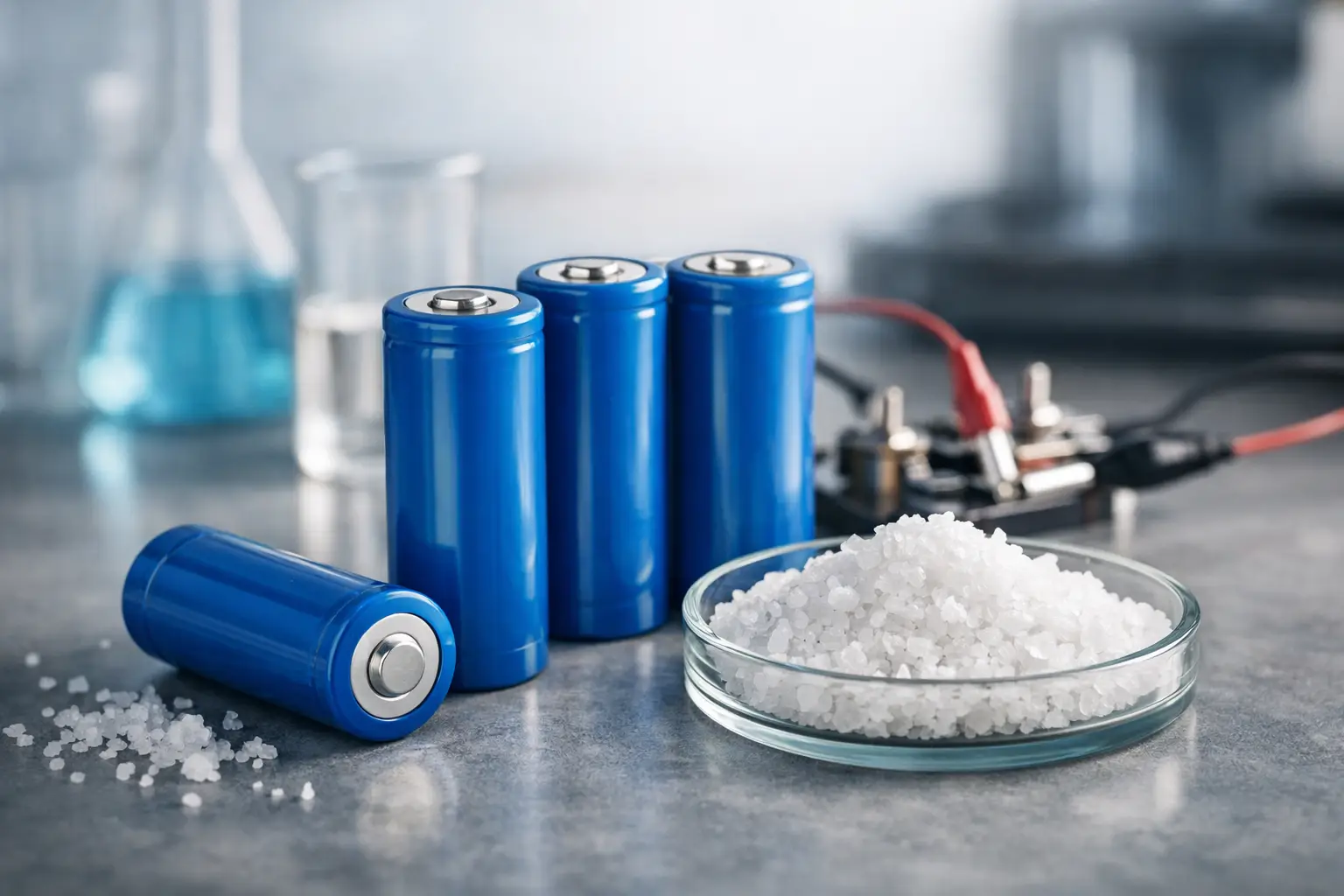
A battery made from common salt sounds like the sort of breakthrough headline designed to travel faster than the underlying science. The reality behind salt-ion batteries is more interesting, and less cinematic. They are not likely to make lithium disappear. They could, however, change which battery jobs require lithium in the first place.
That distinction matters. Battery discussions often compress a sprawling industrial question into a simple contest: lithium is expensive and geopolitically awkward, sodium is cheap and everywhere, therefore sodium wins. That is not how energy systems work. A battery is not merely a chemistry experiment. It is a manufactured product embedded in mines, refineries, factories, grid networks, vehicle designs, safety standards, and financial models.
The useful question is not whether salt-ion batteries are “better.” It is where their particular strengths outweigh their limitations.
1. Salt-ion batteries are usually sodium-ion batteries
The phrase “salt-ion” is catchy but imprecise. Most of the technology receiving attention is sodium-ion battery technology, which moves sodium ions between electrodes during charging and discharging. Sodium can be sourced from abundant compounds, including sodium chloride – ordinary salt – but a battery does not run on a scoop of table salt any more than a gasoline engine runs on crude oil straight from the ground.
The distinction is more than pedantic. Battery-grade materials need processing, purification, engineered electrode structures, electrolytes, separators, and manufacturing controls. Abundance at the level of the periodic table does not automatically mean abundance in a factory at a competitive price.
Still, sodium has a real strategic appeal. It is far more broadly available than lithium, and sodium-ion designs can reduce or eliminate the need for materials such as lithium, nickel, cobalt, and graphite, depending on the specific chemistry. For countries and companies worried about concentrated supply chains, that is not a minor advantage.
2. The energy-density gap is the central trade-off
Lithium-ion batteries dominate phones, laptops, power tools, and electric vehicles for a straightforward reason: they store a lot of energy for their weight and volume. Sodium ions are heavier and have different electrochemical properties, which generally means sodium-ion cells deliver lower energy density than leading lithium-ion cells.
That sounds like a fatal flaw until the application changes. A smartphone needs a small, light battery. A long-range electric pickup needs to carry as much energy as possible without becoming a rolling warehouse. In both cases, weight and space are expensive.
A stationary battery container beside a solar farm faces a different calculation. It does not need to fly, fit in a pocket, or make a vehicle travel 350 miles between charging stops. If it is cheaper, safe, durable, and easy to source, a larger battery may be perfectly acceptable. Physics has not been canceled, unfortunately, but it does not charge the same rent in every use case.
For lower-range urban vehicles, two- and three-wheelers, entry-level cars, backup power, and grid storage, sodium-ion’s lower energy density may be manageable. For aviation, premium long-range EVs, and compact consumer electronics, lithium is likely to retain a substantial advantage for a long time.
Subscribe To Our Newsletter!
Why this changes the public narrative
The popular story says the clean-energy transition hinges on finding one superior battery. The more likely outcome is a portfolio. Lithium iron phosphate, nickel-rich lithium-ion, sodium-ion, flow batteries, and other technologies can coexist because they solve different constraints.
That is not indecision. It is specialization – a concept markets usually understand until a new technology appears and everyone starts demanding a winner by Thursday.
3. Cheap raw materials do not guarantee cheap batteries
Sodium is inexpensive and widely available. But the cost of a finished battery depends on much more than the price of the active ion. Manufacturing yields, factory utilization, component supply, warranty risk, transport, financing, and scale all matter.
Lithium-ion has had a decades-long head start. Its supply chain is immense, its production methods are familiar, and its costs have fallen as factories expanded. Sodium-ion manufacturers must build volume while competing against an incumbent that is still getting cheaper, especially in lithium iron phosphate batteries.
This creates an awkward but normal transition period. Sodium-ion can be technically viable and strategically attractive while still failing to beat lithium-ion on price in some markets. The economics will vary by region, battery format, and customer. A utility that values domestic sourcing and long cycle life may accept a premium. A cost-sensitive automaker selling compact vehicles may not.
There is also a supply-chain point that deserves more attention. Replacing lithium dependence does not mean escaping material dependence. Sodium-ion batteries still require specialized inputs, processing capacity, intellectual property, and industrial equipment. The vulnerability may shift rather than vanish.
4. Grid storage may be the most consequential market
The strongest case for sodium-ion may not be the electric car showroom. It may be the electric grid.
As more wind and solar generation comes online, grids need storage to shift electricity from periods of surplus to periods of demand. The amount required could be enormous. In that setting, resource availability and cost per stored kilowatt-hour can matter more than battery weight.
Sodium-ion technology also offers potential safety and performance advantages in certain designs, including better tolerance for cold conditions and, in some cases, a reduced fire risk relative to conventional lithium-ion chemistries. Those are meaningful attributes for installations near communities or in northern climates. They are not universal guarantees, however. Battery safety depends on cell chemistry, pack design, monitoring systems, installation standards, and operations. Calling any battery “safe” without qualification is how people end up learning about thermal management after the fact.
For the United States and Canada, grid storage also has a resilience angle. A more diverse battery supply can reduce exposure to disruptions in a single material market or production region. That does not make sodium-ion a geopolitical cure-all. It does make it a potentially useful hedge.
5. Commercial traction matters more than promising lab results
Battery announcements tend to arrive with the confidence of a product already sitting on a retail shelf. But lab performance, pilot production, and large-scale deployment are different stages with different failure modes.
A cell can perform well in controlled testing and still struggle with consistency at scale. A manufacturer can produce impressive early units and still face problems sourcing materials, qualifying customers, financing factories, or meeting warranties over ten years. The history of energy technology is full of prototypes that were scientifically valid and commercially premature.
This is why the key signals to watch are not only energy-density records or press-release claims. Look for repeat orders, factory output, independently verified cycle life, installed storage projects, and evidence that manufacturers can make cells reliably. Watch whether sodium-ion earns a stable role in products where its trade-offs are acceptable, rather than being forced into every application as a symbolic replacement for lithium.
What sodium-ion could realistically change
Salt-ion batteries are unlikely to produce a dramatic overnight reset of global battery markets. They may do something more useful: create an additional viable chemistry for parts of the energy system that do not need lithium’s premium performance.
That could ease pressure on critical-mineral supply chains, offer manufacturers another sourcing option, and make large-scale storage more practical in some settings. It could also make battery markets less dependent on a single narrative about scarcity. The transition is not a race to crown the perfect battery. It is a long exercise in matching imperfect technologies to real-world needs – which is less exciting than a miracle, but considerably more likely to work.